Cockatoos and Conferences


Writers are not always the most social beings.  We spend so much time alone working on our craft we tend to forget what it’s like to be out in public.  I go for weeks without seeing anyone besides that guy in my house I married three decades ago who eats all my Rocky Road ice cream and spends an unsettling amount of time watching professional wrestling.  When I finally do get a chance to be out among the crowd, I’m like a German shepherd whose hasn’t seen people in a long while.  That’s why I’m a big believer in writing conferences.  Being around other writers can improve your mental and emotional health.

A major activity in the life of a writer (or at least this writer for the twenty-five plus years I’ve been writing) is attending conferences or conventions.  Surveys distributed at various writing conference around the country and reviewed by the Association of Writers and Writing programs indicate that among the many benefits of attending conferences are learning new writing techniques, improving writing skills, finding fresh ideas, and gaining new contacts.  I had to sift through several writing conferences before I found the perfect one held by Western Writers of America.

I’ve taken part in my fair share of screenwriting conferences.  They were more pitch sessions than anything else.  Usually held in hotel ballrooms in lovely downtown Burbank, California, hopeful script writers had the opportunity to sign up to pitch their screenplays to people who said they were assistant development heads for various studios when in truth they were really pages for a late-night television shows trying to break into the business just like me.  I had just won the Nicholl Fellowship Award and was feeling invincible when I attended my first pitch session.  The first so-called industry go-getter I met invited me to tell him about my work as he fed berries to the cockatoo on his shoulder.  When the bird began squawking, I found it difficult to focus.  The session took an immediate nosedive when I suggested the man’s bird might prefer to be in its cage ringing its little bell and staring at its reflection in a mirror.

Then there was the Actor’s Conference, a symposium designed for aspiring actors to connect with professional actors.  Before things went south between myself and the owner of the cockatoo, he suggested that attending the Actor’s Conference would help me be a better writer.  The idea was that I could learn how to act like the characters I was creating, and that would translate to the page.

The first panel I took part in was an acting exercise with four other pretend thespians.  We were to take our place around a poker table and imagine ourselves as dogs playing poker in a velvet painting.  I tried, but I couldn’t get into it.  First of all, dogs cannot play poker because they don’t have thumbs, and you need thumbs to shuffle and deal a deck of cards properly.  And there’s nothing remotely cute about animals with gambling problems.  It’s very sad.  As a matter of fact, not one of those dogs is smiling in those pictures, because if you look closely at those paintings, you can tell that most of them are playing with money they can’t afford to lose.  And sadder still, remember it takes seven of their dollars to make one of ours.

Thankfully, Western Writers of America conventions are void of gimmicks and pets.  Authors who attend the event are treated to panels and discussions that are truly about the craft of writing.  I tend to gravitate to those panels that focus on sales and promotions.  That kind of information is invaluable and well worth the money spent to participate.  And if you’re the kind of person who makes friends as easily as the Swiss Family Robinsons made ice, WWA conventions help authors with that, too.  Some of the best friends I have are with people I met at the convention.

If you weren’t able to take part in the festivities this year, we hope you’ll be able to attend the 2022 convention in Great Falls, Montana.  All writers suffering from severe isolation are invited.  Just think twice before bringing along any exotic birds.


The Lure of the Fabled Rocky Mountains

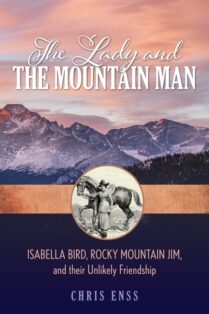
Author Chris Enss details Isabella Bird and her journey to Estes Park and her “unlikely friendship” with Rocky Mountain Jim in this American West classic, The Lady and The Mountain Man.


The Lady and the Mountain Man Book Cover
 

The lure of the fabled Rocky Mountains was an irresistible force for Isabella Bird.

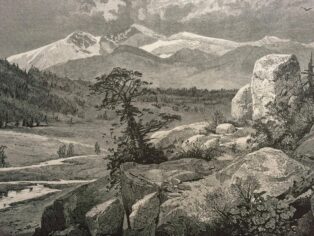
Like many British citizens in the late 19th century, Bird had read stories and heard tales about the majestic American range across the ocean. The air of Colorado’s high altitude offered healing properties for travelers, and its stunning peaks were magnificent sights apt for anyone’s bucket list.

For Bird, who set out from Britain on a steam ship in 1872, the prospect of a visit to the Rocky Mountains was hardly promising or simple. Bird, who had suffered serious health issues since childhood, embarked on the transcontinental journey with a wire cage around her neck, a Victorian medical solution to her weak spine and injured neck.

What’s more, Bird undertook the journey alone, a decision that defied the societal norms and expectations of the time.

“This is in the 1870s, and Bird is a single, Victorian woman in poor health traveling to America,” said author Chris Enss, whose latest book, “The Lady and the Mountain Man,” details Bird’s journey to Colorado in 1873.

Enss’s latest book detailing the history of the American West focuses on Bird’s journey to Estes Park and her “unlikely friendship” with “Rocky Mountain Jim” Nugent, a one-eyed outlaw who guides her to the top of Longs Peak. The book explores Bird’s legacy as an explorer, the colorful characters who resided in Estes Park in the late 19th century and the sometimes fatal regional struggles for land, power and influence.

At its heart, however, the book follows a theme that runs throughout Enss’s impressive oeuvre of dozens of books about the American West. The author has long focused on exploring the lives of the women who braved a new frontier in a time of unabashed sexism and structural misogyny. Isabella Bird, who’d gain a reputation as an unparalleled explorer, author, photographer, author and anthropologist, is a fitting focus for Enss, who’s long worked to spotlight the stories of the women of the West who’ve been overlooked by history.

Throughout her life, Bird’s travels spanned the globe, from Japan to Australia to the Sandwich Islands (Hawaii) to India, Turkey and Singapore. Her writings set the standard for international travel and cultural understanding in the 19th century; she was the first woman to be inducted into the Royal National Geographic Society.

For all of her impressive odysseys, Bird’s travels to Colorado served as a watershed in several ways, Enss said.

“The consistency throughout the book is the story of this strong woman who decided that she was going to do something regardless of what the rest of the world said she could or couldn’t do,” Enss said. “Not only were there stereotypes about what women could do in the American west, but she was also an aristocratic woman from Britain,” she added, noting that Bird defied expectations from multiple cultures.

Enss, who drew material from letters, newspaper articles and other primary sources, added that while Bird serves as the central figure of the book, “The Lady and the Mountain Man” offers readers multiple narrative tracks and simultaneous threads. As the book’s title indicates, the story explores the unique relationship between Bird and Jim Nugent, a grizzled outlaw out of a Western storybook who also boasted a penchant for poetry, literature and history. As Bird herself noted, he was a “man any woman might love but no sane woman would marry.”

Bird, who called Nugent her “dear desperado,” forged a relationship with Nugent as they ascended Longs Peak together, a harrowing journey that would’ve been challenging for even the most experienced mountaineer.

“It was incredibly difficult. They did not have any of the fineries that people have now. She speaks a lot about the difficulty in crossing the lava bed, with all the jagged rocks. Her footing wasn’t so good,” Enss said, citing reports initially spelled out in Bird’s letters to her sister at home, accounts that ultimately figured into her book “A Lady’s Life in the Rocky Mountains.” “It was cold. There were lots of wild animals that seemed to be stalking them.”

As the pair braved those risks in the day, and bonded around the campfire at night, their relationship took on a different dimension, Enss notes. The journey offered an opportunity for both to reveal their character – they swapped verses of poetry, discussions about the Bible and meditations about Shakespeare. According to one of her letters, Nugent “told stories of his early youth, and of a great sorrow which had led him to embark on a lawless and desperate life.”

That combination of peril and intimacy left an indelible mark, Enss said.

“It results with the pair falling in love,” she said. “He drank in excess, he was crude. But at one point he had studied to be a priest. He was a poet and he could quote Shakespeare. Going up to Longs Peak in the evenings, he regaled her with his verses.”

This unlikely bond builds against a backdrop of frontier conflicts and violence. Lord Dunraven, an aristocrat who owned land in the Estes Park area, was intent on claiming large swaths of the area for hunting preserves and other purposes, wanted to get rid of Nugent and drive him from his land. That conflict would ultimately claim Nugent’s life, after Bird left Colorado for further international journeys.

“The book really is in three parts. You have the part with Isabella and Jim; there’s the Lord Dunraven portion of the story and his combative relationship; but you also have Isabella Bird, who as she’s getting healthier, tours the Rocky Mountains by herself,” Enss said, adding that journey ultimately served as a transformative experience – after her time in Colorado, Bird no longer wore the wire cage to support her neck and back. “That was unheard of in 1873 for a woman to do.”

A through-line that undergirds all elements of the book is the setting. Enss has long explored different sites and locales in the American West, but this tome offered the author the opportunity to spotlight Colorado and the Estes Park region as its own character.

“Colorado is a character in and of itself. That’s really important in this book,” she said, adding that the setting and the main character combined to make this piece unforgettable in her 50-plus book bibliography. “Of all the people who I’ve written about (more than 50 books), I’ll miss her the most. She was just an inspired human being.”

For the Love of Longs Peak and Rocky Mountain Jim

Enter now to win a copy of

The Lady and the Mountain Man: 

Isabella Bird, Rocky Mountain Jim, and their Unlikely Friendship


Newspaper articles from the July 13, 1873, edition of the Chicago Tribune informed travelers bound for Colorado that the “atmosphere was so transparent Pikes Peak could be seen from the streets of Denver.”  Pikes Peak was one hundred miles south of the booming city, and, truth be told on a clear day, with at least an average pair of eyes, it was impossible to make out even the dim outline of the peak.  Such exaggerations lured explorers to the area.  Any disappointment over not being able to see the highest summit of the southern front range of the Rocky Mountains from Denver was quickly forgotten when they proceeded to Colorado Springs where the Peak was clearly visible.

This was one of Isabella Bird’s coveted destinations.  For years she had heard of the beauty of the Rocky Mountains and the amazing health- giving air that surrounded the setting.  To stand at the base of the purple foothills in the snow leading to either Longs Peak or Pikes Peak for her was tantamount to drinking from the fountain of youth.  As Isabella made her way across the ocean from the Sandwich Islands to San Francisco, she could see the Colorado mountains in her mind’s eye.  The peaks in the far distance, their crests like burnished silver against the sky, were magnificent to behold.  All she’d heard about the splendor of the territory would prove accurate.  What she didn’t know then was the controversy over who owned and controlled Estes Park, the land in which the mountain range rested.


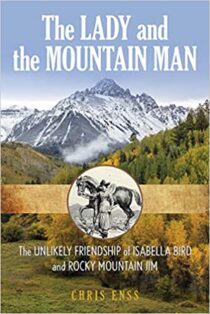
The Lady and the Mountain Man Book Cover


To learn more about Isabella Bird’s time in Estes Park and romance with Rocky Mountain Jim read

The Lady and the Mountain Man

Regard for a Romance

Enter now to win a copy of

The Lady and the Mountain Man: 

Isabella Bird, Rocky Mountain Jim, and their Unlikely Friendship


“Thank you, Chris Enss, for this marvelous introduction to Isabella Bird, an English lady who refused to let unremitting pain keep her from exploring the American West. Isabella was a prolific writer whose reports on all she saw and experienced brought admirers from across the world to bask in the wonders of Colorado and the Rocky Mountains. Americans today will gain greater appreciation for our country, seeing it through this woman’s eyes even as she fell in love with a crusty, drink-riddled mountain man. Enss, a prolific and engaging writer in her own right, beautifully brings this woman to life.”

Two-time Western Writers of America Spur Award Winner, Carol Crigger


Praise for The Lady and the Mountain Man

Enter now to win a copy of

The Lady and the Mountain Man: 

Isabella Bird, Rocky Mountain Jim, and their Unlikely Friendship


The Lady and the Mountain Man Book Cover


“A touching, well-researched story of the love shared between a prolific author and Victorian lady in the Rocky Mountains and the renegade trapper who helped her realize her dream of climbing Longs Peak.”

New York Times Bestselling Author of Give My Heart to the Hawks, Win Blevins


“Thank you Chris Enss, for this marvelous introduction to Isabella Bird, an English lady who refused to let unremitting pain keep her from exploring the American West. Isabella was a prolific writer whose reports on all she saw and experienced brought admirers from across the world to bask in the wonders of Colorado and the Rocky Mountains. Americans today will gain greater appreciation for our country, seeing it through this woman’s eyes even as she fell in love with a crusty, drink-riddled mountain man. Enss, a prolific and engaging writer in her own right, beautifully brings this woman to life.”

Two-time Western Writers of America Spur Award Winner, Carol Crigger


“A delightful account of the peregrinations of Isabella Bird, footloose nineteenth-century English travel and inspirational writer. She documented journeys in Britain and the Pacific, finally ending in Colorado, where she befriended legendary Rocky Mountain Jim Nugent. Her wanderlust later took her to Asia and north Africa. If you don’t know Isabella Bird’s story, you’re in for a treat. A good read by Chris Enss, a perennial winner.”

Spur Award Finalist and Will Rogers Medallion Winner, Harlan Hague


Romance and Estes Park

Enter now to win a copy of

The Lady and the Mountain Man: 

Isabella Bird, Mountain Man Jim Nugent, and their Unlikely Friendship


To burn with desire and keep quiet about it is the greatest punishment we can bring on ourselves.  Isabella Bird loved an outlaw and only shared her feelings with her sister. 

Mountain Man Jim loved a lady and told everyone who would listen.  Read the true story of the unlikely friendship of Isabella Bird and Mountain Man Jim Nugent in The Lady and the Mountain Man.  


The Lady and the Mountain Man Book Cover


Romance in Estes Park

The Lady and the Mountain Man Book Cover

He’s more myself than I am. Whatever our souls are made of, his and mine are the same.” 

Read why Isabella Bird fell in love with a scoundrel like Mountain Man Jim Nugent. 

The Lady and the Mountain Man: 

Isabella Bird, Mountain Man Jim Nugent, and Their Unlikely Friendship is now available. 

Enter now to win a copy of the true story.


Reaching the Summit with Mountain Jim

Enter now to win a copy of

The Lady and the Mountain Man:

Isabella Bird, Mountain Jim Nugent, and Their Unlikely Friendship


Neither Isabella nor Jim was so drained they could not appreciate the incredible sweeping views.  Standing at the highest point in the park, they looked out over an unbroken expanse of pines and snow-slashed pinnacles and more.  “There, far below, links of diamonds showed where the Grand River takes its rise to the mysterious Colorado…,” Isabella wrote describing the sight.  “Nature, rioting in her grandest mood, exclaimed with voices of grandeur, solitude, sublimity, beauty, and infinity, ‘Lord, what is man, that Thou art mindful of him?’”

Isabella and Jim had reached the summit so late their time spent admiring the view was abbreviated.  The group needed to start back down the mountain before daylight faded.  Downer and Rogers were anxious to get underway, and Isabella thought for a moment they would suggest going it alone.  They had made a few comments about women being an encumbrance on such a journey.  “A woman’s incompetence on rough mountainous trips detains the others and can even endanger lives,” she overheard Rogers say.  Jim championed Isabella’s right to climb Longs Peak and assured the men that “if it were not to take the lady up, he would not have gone at all.”

Isabella noted in her memoirs the reason the young men on the venture were in a hurry to descend the mountain was that one of them was afraid long periods in the high altitude would lead to lung damage.  She noted that respiration at 15,000 feet was painful, and they were all struggling with getting enough to drink.  Before starting down the peak, each wrote their name and date on a piece of paper, placed it inside a tin, and tucked the tin snuggly in a crevice.

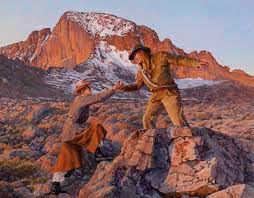
Descending the mountain was unnerving.  Isabella scooted to the edge of the peak, dangled her feet in front of her, and searched the cracks in the rock for a place to set her foot.  Jim had climbed down ahead of her, and, when she couldn’t find a crevice to use as a foothold, he allowed her to put her feet on his shoulders.  His strong arms lifted her from steep rock formations and gently placed her on secure ledges below.  Although Isabella was grateful for Jim’s help, she felt ashamed she required it.  She wanted him to see her as courageous and strong, not needy and dependent.  From what Rogers observed, Jim looked at Isabella with deep admiration and respect.  The glances the two exchanged as Jim held her in his arms carrying her from one narrow, icy ledge to another was proof the two had grown to care for one another.


The Lady and the Mountain Man Book Cover


To learn more about Isabella and Jim’s time in Estes Park read The Lady and the Mountain Man

Downing Award

The Cowgirl magazine Wild Women of the West article by Chris Enss entitled

Dr. Jenny Murphy:  Yanton Doctor of Medicine is a finalist for the 2021 Downing Journalism Award. 

The Downing Award is sponsored by the organization Women Writing the West. 


The Future with a Mountain Man

Enter now to win a copy of

The Lady and the Mountain Man: 

Isabella Bird, Mountain Man Jim Nugent, and their Unlikely Friendship


Isabella considered the criticism Evans had about Jim.  She believed some of the animosity was born out of the fact that he was a popular character and articles about him frequently appeared in Colorado newspapers.  He was a man to be envied, and Evans and others hoping to drive Jim out of the park were consumed with jealousy.  “Ruffian as he looks,” Isabella elaborated on Jim in her memoirs, “the first word he speaks – to a lady, at least – places him on a level with educated gentlemen, and his conversation is brilliant, and full of the light and fitfulness of genius.”

Isabella always keenly felt Jim’s absences.  On one hand she admired him greatly, and on the other she grieved the life she felt he wasted because of his unruly past.  “What good could the future have in store for one who has for so long chosen evil,” she asked herself in her memoirs.  After each encounter, she was consumed with the notion if Jim surrendered all to the Lord his path would be set straight again.  Only then could there be hope for “a most painful spectacle.”  Only then could there be hope the two might find happiness together.  Thoughts of Jim and his restoration crowded her mind to the exclusion of all else.  She couldn’t write.  Distractions were necessary.  Fortunately, the day after her exhilarating ride with Jim and the Deweys, Griff Evans provided one.  Once again, he needed another hand to help with a cattle drive.  Isabella gladly agreed.

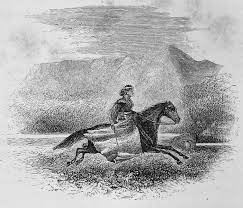
The bronco Isabella was given to ride was quick and resilient.  The pair traveled over rocks and inclines, driving the herds out of canyons and tree lines.  While riding fast and pushing the cows forward, Isabella reflected on her days riding in Hawaii.  That challenge had provided her with the experience needed to round up Texas steers.


To learn more about Isabella Bird’s time with Jim Nugent read

The Lady and the Mountain Man