Posse on the Move

Enter now to win a copy of
Thunder Over the Prairie:
The Story of a Murder and a Manhunt by the
Greatest Posse of All Time


Four horsemen thundered out of Dodge City and quickly rode onto the open range. The land before them rolled for miles under a limitless sky. Wyatt Earp and Bill Tilghman held tight to their swift mounts, lagging a few feet behind Bat Masterson and Charlie Bassett. Charlie’s roan led the way. He sat forward in his saddle like a mad dog straining against a leash, his eyes fixed on the terrain ahead.

At 31 years of age, Charlie Bassett was the oldest among the riders. He had also traveled with more posses than the other men in his five-year law enforcement career in Ford County. He became the county’s first Sheriff when he was 26 years old and on June 5, 1873, he began the first of three terms in office. He had tracked vigilantes, jewel thieves, and cattle rustlers across Kansas’s mostly flat surface, and brought many felons to justice. Bill Tilghman claimed Bassett’s “boyish face belied the steel beneath” and described him as a “steady, level-headed officer who seldom displayed any kind of alarm no matter the crisis.”

Whatever Charlie felt about Dora Hand’s murder was evident in the way he sat his horse. His legs gripped the back of the animal firmly and he had the reigns threaded resolutely through his gloved hands with sufficient lead left over to spank the sides of the ride to make the horse go faster. His attentive gaze shifted from the horizon to the trail directly in front of him. He was driven. Charlie liked Dora. He thought she was, as Stuart Lake, the author of the Wyatt Earp biography Frontier Marshal wrote, “the most gracious, beautiful woman to reach Dodge in the heyday of its iniquity.”
Charlie had a fine appreciation for Dora’s talent as well. She had worked for him on occasion singing at the Long Branch Saloon, an establishment he opened shortly after he arrived in Dodge. The Long Branch, named after a celebrated sporting resort on the Atlantic seaboard, was the largest and most profitable in the region. As an east coast native himself, Charlie was familiar with the popular tavern. One critic called the Dodge City saloon “artistically functional. It offered a little of everything: a lengthy bar, gaming tables, music, entertainment, and dancing. On busy nights the swinging doors were kept open to expedite the traffic.” The doors were kept open every time Dora played the Long Branch.

Charlie’s second job as saloon owner wasn’t uncommon at the time. The risks associated with upholding the law were great and the rewards, especially the pay, were minimal. Charlie’s salary was $100 a month. Men like Wyatt Earp and Bat Masterson took on work defending the law in between gambling and mining projects. It was a solitary occupation for very few.


To learn more about the death of Dora Hand and the posse that tracked her killer read Thunder Over the Prairie.

Cold-Blooded Assassin

Enter now to win a copy of

Thunder Over the Prairie:

The Story of a Murder and a Manhunt by the

Greatest Posse of All Time.


A steady beat of boots hurrying along the wooden plank sidewalks reverberated off the buildings and overhangs lining Dodge City’s Front Street. Curious onlookers peered out of the saloons and bathhouses as two familiar characters sprinted past. Lawmen Wyatt Earp and Jim Masterson, Bat Masterson’s younger brother, raced in the direction of town where a series of gunshots had popped five minutes earlier.

Both men wore the stern, focused look of peace officers accustomed to living in a dangerous unpredictable cow town. Each had a commanding presence that warded off as many as it attracted. Each wore a badge on their vest. Wyatt was an impressive man with blonde hair, a well-groomed mustache, and blue-grey eyes. His slender frame and erect posture made him appear taller than the six feet he stood. Jim was roughly the same height with dark hair and a thick mustache that covered a stubborn line on his thin mouth.

As the men neared the back entrance of the Great Western Hotel, they scanned the area carefully, their hands perched over their pistols, ready to draw if necessary. Fannie Garrettson was crouching near the back door of Mayor James Kelley’s home, sobbing. She saw the two men fast approaching as she backhanded a torrent of tears off her face.

As Earp and Masterson arrived, her plaintive eyes met theirs and before anyone could speak, she pointed a shaking finger at the house behind her. The men quickly noticed a bullet had splintered the door of the home. They entered Mayor Kelley’s place, lifting their six-shooters out of their holsters in the process. A fast inspection of the various rooms of the house led the lawmen to the spot where Dora Hand lay dead.

The two men made their way back outside. They were rattled by the singer’s blood soaked remains, but fixed on the job at hand. “Looks like four shots were fired,” Jim offered after a few moments silence, “maybe more.” Wyatt bent down next to Fannie and waited for her to gather her composure. “She was sleeping in the Mayor’s bed,” she said stammering. “He’s been sick for two or three weeks and last Monday he was obliged to go to the hospital at the post, Fort Dodge.”

The lawmen asked if she had seen the shooter. The grief stricken woman shook her head. Unable to continue holding back the flood of tears that insisted on coming, Fannie broke into more hysterical sobs. The officers waited for the wave of emotion to subside. “What a horrible death,” she cried. “To go to bed well and hearty and not dream of anything and be cut down in such a manner, without a chance to breathe a word.”

Sympathetic friends of the slain entertainer and of Fannie Garrettson were sent for at the same time the acting coroner; Judge Refus G. Cook. The distraught singer was escorted to a hotel, and the coroner was delivered to the deceased.

The mood inside Mayor Kelley’s home was heavy and foreboding. Wyatt and Jim, who had now been joined by Sheriff Bat Masterson, looked on as the Judge lifted Dora’s arm to inspect the spot where the bullet had entered her body. The Judge was a man of medium build with ice-blue eyes that reflected his mighty prowess and serious tone. He handled her still form with gentleness ordinarily reserved for the living. “Coward,” he said under his breath. Bat, a stout, compact man with broad shoulders, dark hair and heavy eyebrows and a mustache, turned away from the scene and headed into the sitting room, disgusted.


To learn more about the death of Dora Hand and the posse that tracked her killer read Thunder Over the Prairie.


The Killing of Dora Hand

Enter to win a copy of

Thunder Over the Prairie:

The Story of a Murder and a Manhunt by the

Greatest Posse of All Time.


Dora Hand was in a deep sleep. Her bare legs were draped across the thick blankets covering her delicate form and a mass of long, auburn hair stretched over the pillow under her head and dangled off the top of a flimsy mattress. Her breathing was slow and effortless. A framed, graphite- charcoal portrait of an elderly couple hung above her bed on faded, satin-ribbon wallpaper and kept company with her slumber.

The air outside the window next to the picture was still and cold. The distant sound of voices, back-slapping laughter, profanity, and a piano’s tinny, repetitious melody wafted down Dodge City, Kansas’s main thoroughfare and snuck into the small room where Dora was laying.

Dodge was an all-night town. Walkers and loungers kept the streets and saloons busy. Residents learned to sleep through the giggling, growling, and gunplay of the cowboy consumers and their paramours for hire. Dora was accustomed to the nightly frivolity and clatter. Her dreams were seldom disturbed by the commotion.

All at once the hard thud of a pair of bullets charging through the wall of the tiny room cut through the routine noises of the cattle town with an uneven, gusty violence. The first bullet was halted by the dense plaster partition leading into the bed chambers. The second struck Dora on the right side under her arm. There was no time for her to object to the injury, no moment for her to cry out or recoil in pain. The slug killed her instantly.

In the near distance a horse squealed and its galloping hooves echoed off the dusty street and faded away.

A pool of blood pored out of Dora’s fatal wound, transforming the white sheets she rested on to crimson. A clock sitting on a nightstand next to the lifeless body ticked on steadily and mercilessly. It was 4:30 in the morning on October 4, 1878, and for the moment, nothing but the persistent moonlight filtering into the scene through a closed window recognized the 34 year-old woman’s passing.

Twenty-four hours prior to Dora being gunned down in her sleep she had been on stage at the Alhambra Saloon and Gambling House. She was a stunning woman whose wholesome voice and exquisite features had charmed audiences from Abilene to Austin. She regaled love starved wranglers and rough riders at stage and railroad stops with her heartfelt rendition of the popular ballads Blessed Be the Ties That Bind and Because I Love You So.

Adoring fans referred to her as the “nightingale of the frontier” and admirers competed for her attention on a continual basis. More times than not pistols were used to settle arguments about who would be escorting Dora back to her place at the end of the evening. Local newspapers claimed her talent and beauty “caused more gunfights than any other woman in all the West.”

The gifted entertainer was born Isadore Addie May on August 23, 1844 in Lowell, Massachusetts. At an early age she showed signs of being a more than capable vocalist, prompting her parents to enroll her at the Boston Conservatory of Music. Impressed with her ability, instructors at the school helped the young ingénue complete her education at an academy in Germany. From there she made her stage debut as a member of a company of operatic singers touring Europe.

After a brief time abroad, Dora returned to America. By the age of twenty-four she had developed a fondness for the vagabond lifestyle of an entertainer and was not satisfied being at any one location for very long. The need for musical acts beyond the Mississippi River urged her west and appreciative show goers enticed her to remain there.


To learn more about the most intrepid posse of the Old West read

Thunder Over the Prairie.

My Life As A Giant, Take 2


A few years back I did a documentary for the BBC with actor and knight, Sir Tony Robinson and in the photos taken after the shoot of the two of us I look like Ruth Buzzi if she were stung by a thousand bees.  Seriously, I look like Andre the Giant’s sister in ALL of the pictures.

I’ve always been big. My father used to try and console be about my height and general size by assuring me that I wasn’t fat just big boned. The last I looked there were no bones in the area in which I’m most concerned. But the effort, Pop, was most appreciated.

Now physical exercise is not the answer. Years ago, I remember watching a beefy President Bill Clinton exercising. He was living proof that physical exercise could be a complete waste of time. The more he jogged, the bigger he got. I recall thinking, if this guy is reelected, the leader of the free world will be Bib the Michelin Man.

I do notice I’m suffering from a chin crisis as I get older. If I don’t keep my head above sea level when pictures are taken, I resemble the dinosaur that got into the jeep with the lost traveler in the first Jurassic Park movie.

When I think about it, the only exercise program that has ever worked for me is occasionally getting up in the morning and jogging my memory to remind myself exactly how much I hate to exercise. Well-meaning friends have suggested I start walking. Walking? If it’s so good for you, how come my mailman looks like Jabba the Hut with a quirky thyroid?

I’ve thought about joining a gym, but honestly, I think they’re too complicated. You know, there’s nothing quite as humiliating as finishing a thirty-minute workout on a piece of gym equipment only to have the instructor tell you you’ve been sitting on it backward.

I guess the only real fitness goal I have in the new year is to obey God and leave all the consequences to Him.  As I’m a giant that’s also a sinner, that’s going to be a tough goal to meet.  But I’m going try.

Now, where’s that pizza?


Bad Girl Kate Bender

It’s a Christmas giveaway featuring some

very badly-behaved women.

Enter now to win five books about women of the Old West who were

wicked to the core.


A fierce wind filled with alkali dust blew past Silas Toles, a Labette County, Kansas farmer, as he made his way to his neighbor’s seemingly vacant home.  Three other farmers followed tentatively behind him.  An endless prairie stretched out on either side of the weather-beaten building.  A hungry calf languished in a nearby fenced enclosure bawled pitilessly for something to eat.  A handful of dead chickens lay scattered about the parched earth leading to the house.  The front door was ajar and creaked back and forth.  Silas cautiously walked to the main entrance of the building and glanced inside.  Light from the late afternoon sun filtered through partially drawn curtains onto the sparse, shabby and torn furnishings in the center of the one room home.

Silas pushed the door open and stood in the dirt entryway.  The home was in complete disarray; clothing, books, paper, and dishes were on the floor; bugs covered bits of food on a broken table, chairs were overturned and a pungent smell of death hung in the air.  The three men with Silas held back waiting for him to motion them forward.  The sound of fast approaching horses distracted the quartet and they watched with rapt attention as several riders hurried to the spot and quickly dismounted.  Colonel A. M. York, a distinguished, bearded man dressed in the uniform of an army officer, led a team of Civil War veterans and lawmen to the entrance of the home.  They pushed past Silas and the others and boldly entered.

Colonel York surveyed the room and kicked away the debris at his feet as he walked around.  He wore a determined, yet forlorn expression.  The group with the Colonel examined the area along with him and inspected the items underfoot carefully.  One of the men noticed a collection of Pagan artifacts including a pentagram and Tarot cards in the corner of the room.  Some of the articles were covered with dried blood.  Colonel York followed a trail of blood from the artifacts to a mound of fresh earth under a pile of soiled sheets.  Kneeling down in the dirt he scooped the earth out until he reached a crude door.  The men around stared wide-eyed at the oddity waiting for the Colonel to make the next move.  One of the lawmen brushed dirt away from a round handle attached to the door.  Before giving it a pull, he glanced over at the Colonel to see if he wanted to continue the search.  The Colonel was quietly transfixed by the scene.  The lawman interpreted his silence as an affirmative answer and quickly pulled the door open.  The foul stench that wafted out of the dark hole hit the men like a punch in the face.  There was no question the source of the odor that had offended their senses from the moment they entered the home was coming from this location.


To learn more about Kate Bender and other badly behaved women like her read the Bedside Book of Bad Girls.


Bad Girl Tessie Wall

It’s a Christmas giveaway featuring some

very badly-behaved women.

Enter now to win five books about women of the Old West who were

wicked to the core.


A parade of horse drawn carriages deposited fashionably dressed San Francisco citizens at the entrance of the Tivoli Theatre. A handsome couple holding hands and cooing as young lovers do, emerged from one of the vehicles. A figure across the street, hidden in the shadows of an alleyway, eyed the pair intently. Once the couple entered the building Tessie Wall stepped out of the darkness into the subdued light of a row of gas lamps lining the busy thoroughfare. Tears streamed down the svelte, blonde’s face. The pain of seeing the man she loved with another woman was unbearable.

Several hours before, Tessie and her ex-husband, Frank Daroux entertained passersby with a robust argument over the other woman in his life. After accusing the man of being a liar and a thief, Tessie begged him for another chance and promised to make him forget anyone else he was involved with.  Frank angrily warned Tessie that if she started anything, he would put her “so far away that no one would find her.”

The words he had said to her played over and over again in her head. “You’ve got my husband,” she mumbled to herself. “And you’ll get yours someday. It’s not right.” She chocked back a torrent of tears, reached into her handbag and removed a silver-plated revolver. Hiding the weapon in the folds of her dress, she stepped back into the dark alleyway and waited.

It wasn’t long until Frank walked out of the theatre, alone. Standing on the steps of the building, he lit up a cigar and cast a glance into the night sky. Preoccupied with view of the stars, Frank did not see Tessie hurry across the street and race over to him. Before he realized what was happening, Tessie pointed the gun at his chest and fired. As Frank fell backwards, he grabbed hold of the rim of a nearby stage. Tessie unloaded two more shots into his upper body. Frank collapsed in a bloody heap.

Tessie stood over his near lifeless frame, sobbing. When the police arrived, she was kneeling beside Frank, the gun still clutched in her hand. When asked why she opened fire on him she wailed, “I shot him, cause I love him, Damn him!”


To learn more about Tessie Wall and other badly behaved women like her read Pistol Packin’ Madams: True Stories of Notorious Women of the Old West.


Bad Girl Kate Elder

It’s a Christmas giveaway featuring some

very badly-behaved women.

Enter now to win five books about women of the Old West who were

wicked to the core.


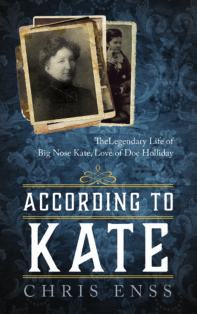
Doc Holliday’s paramour Big Nose Kate could never get a publisher to give her the big bucks she demanded to tell the story of her life, but that didn’t mean she didn’t collect material she wanted to use in a biography. Over the fifty years Mary Kate Cummings, alias Big Nose Kate, traversed the West she saved letters from her family, musings she had written about her love interests, and life with the notorious John Henry Holliday. Using rare, never before published material Big Nose Kate stock-piled in anticipation of writing the tale of her days on the Wild Frontier, the definitive book about the famous soiled dove will finally be told.

Kate claims to have witnessed the Gunfight at the OK Corral and exchanged words with the likes of Wyatt Earp and Josephine Marcus. There’s no doubt she embellished her adventures, but that doesn’t take away from their historical importance. She was a controversial figure in a rough and rowdy territory. What she witnessed, the lifestyle she led, and the influential western people she met are fascinating and represent a time period much romanticized.


To learn more about Kate read

According to Kate:  The Legendary Life of Big Nose Kate Elder,

Doc Holliday’s Love


The Forsaken Gambler

It’s a Christmas giveaway featuring some

very badly-behaved women.

Enter now to win five books about women of the Old West who were

wicked to the core.


“In one corner, a coarse-looking female might preside over a roulette-table, and, perhaps, in the central and crowded part of the room a Spanish or Mexican woman would be sitting at Monte, with a cigarette in her lips, which she replaced every few moments by a fresh one.” Author, lecturer, and feminist Eliza Farnham – 1854

Blood spattered across the front of the dark-eyed, brunette gambler Belle Siddon’s dress as she peered into the open wound of a bandit stretched out in front of her. Biting down hard on a rag, the man winced in pain as she gently probed his abdomen with a wire loop. Pausing a moment, she mopped up a stream of blood inching its way across the crude wooden table where he was lying. Two men on either side of the injured patient struggled to keep his arms and legs still as the stern-faced Belle then plunged the loop back into his entrails. “How do you know about gunshots?” one of the rough looking assistants asked. “My late husband was a doctor and I worked with him,” Belle replied. “Is he going to die?” the other man inquired. “Not if I can help it,” Belle said as she removed the wire loop.


To learn more about Belle Siddons and other lady card players read

The Lady Was a Gambler: True Stories of Notorious Women of the Old West.


Bad Girl Lottie Deno

It’s a Christmas giveaway featuring some

very badly-behaved women.

Enter now to win five books about women of the Old West who were

wicked to the core.


A broad grin spread across Doc Holliday’s thin, unshaven face as he tossed five playing cards facedown into the center of a rustic, wooden table. His eyes followed a petite, gloved hand as it swept a pile of poker chips toward a demure, dark-haired beauty sitting opposite him. Lottie Deno watched the infamous dentist, gambler, and gunfighter lean back in his chair and pour himself a shot of whiskey. Doc’s steely blue eyes met hers and she held his gaze. “You want to lose any more of your money to me or is that it, Doc?” “Deal,” he responded confidently. Lottie did as he asked and in a few short minutes had managed to win another hand.

A crowd of customers at the Bee Hive Saloon in Fort Griffin, Texas, slowly made their way over to the table where Lottie and Doc had squared off. They cheered the cardsharps on and bought them drinks. Most of the time Lottie won the hands. The talented poker players continued on until dawn. When the chips were added up, the lady gambler had acquired more than $30,000 of Holliday’s money.

“If one must gamble, they should settle on three things at the start,” Doc said before drinking down another shot. “And they are?” Lottie inquired. “Decide the rules of the game, the stakes, and the quitting time.” Holliday smoothed down his shirt and coat, adjusted his hat, and nodded politely to the onlookers. “Good evening to you all,” he said as he made his way to the exit. Lottie smiled to herself as she sorted her chips. Holliday sauntered out of the saloon and into the bright morning light.

Historians maintain that it was only natural that Lottie Deno would have grown up to be an expert poker player—her father was a part-time gambler who had taught his daughter everything he knew about cards. She is recognized by many gaming historians as the most talented woman to play five-card draw in the West.


To learn more about badly behaved women on the American frontier read 

The Lady Was A Gambler.