Lillian Russell, America’s Greatest Beauty

Enter to win a copy of

Entertaining Women:

Actresses, Dancers, and Singers in the Old West


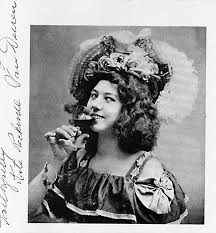
It was not so much the late Lillian Russell’s great dramatic ability or her clear, well-trained voice as her personality and physical beauty that made her the most famous musical comedy star of her day and acclaimed for more than a generation as “America’s Greatest Beauty.” And after she had ceased to sing and act for the public the compelling charms that had lifted her to the stage’s topmost pinnacle persisted and made her up to the very day of her death one of the most admired of women.

Other women marveled to see how Lillian Russell, as she neared sixty years of age, still retained the clear complexion, soft skin, unwrinkled face, youthful expression and all the vivacity of earlier life.

How did she achieve these modern miracles? What was the secret of her unfading beauty?

Lillian Russell made no secret of some of the measures and means she employed to retain her extraordinarily good looks, but she did not tell the whole story. She did not say that in addition to the baths, cold creams, cosmetics, exercise and wholesome living she made liberal use of common sense, self-control, persistence, energy and cheerfulness-factors neglected by many women who faithfully follow her other formulas.

She employed the combination of mental qualities and drug store and beauty parlor accessories not only during her whole stage career, but long after the time when most women realize that they are growing old and believing that they have become passé and unattractive, make no effort to improve their appearance. At sixty Lillian Russell was even more careful of her appearance her face and figure, than she was at twenty or thirty.


To learn more about Lillian Russell’s career and her beauty regiments, read

Entertaining Women:

Actresses, Dancers, and Singers in the Old West.


Caroline Chapman, The Quick-Change Artist

Enter to win a copy of

Entertaining Women:  Actresses, Dancers, and Singers in the Old West


The theater at Camp Seco, a gold camp in California, could hardly compare to the Greenwich Theater in New York, or the Jenny Lind in San Francisco, or theaters in New Orleans, Philadelphia, or other cities she’d played in, but Caroline Chapman had rarely seen a more enthusiastic audience.  Twitching her skirts into place, she waited for her cue.  Tonight they would conclude the program with a spoof of notorious entertainer Lola Montez, an act that always brought down the house.

Caroline and her brother, “Uncle Billy” Chapman, had left San Francisco in an uproar after starring in a hilarious play by Dr. Robinson.  Newspaper editors had sharp words for Who’s Got the Countess? and Caroline’s part in it.  How, they asked, could the “modest” Miss Caroline Chapman descend to such tasteless, even cruel burlesque of the lovely Lola?

That was easy, Caroline thought.  She was a professional actress, and as she waited for her cue, she could balance that accomplishment against a lack of beauty that had also been politely noted in the press.  Critics admired Lola’s stunning face and form, but few of them considered her a serious actress.  Lola’s stage career in Europe had included a stint as the mistress of the King of Bavaria, who had made her Countess of Landsfelt.  Caroline, on the other hand, had started learning stage work as a child on her father’s riverboat and had garnered praise from her first performance.

Beauty was not Caroline’s stock in trade.  Caroline was too plain to compete with the legendary Lola’s charms.  The most complimentary report on her appearance had come from theater historian Joseph Ireland, who described her as slender and plain-featured but with excellent teeth in a large, mobile mouth.  Her face was radiant with expression communicated by a pair of gleaming, dark eyes that could convey more meaning, either of mirth or sadness, said Ireland, than any contemporary female on the New York stage.

Unlike the scandalous Lola, Caroline had never indulged in affairs with royalty or famous authors and had never smoked a cigar, kept a pet bear, or threatened to take a riding whip to a cynical newspaper editor.  Caroline Chapman had what Lola lacked:  talent.  Nowhere did she find it more fun to exhibit than in Dr. Robinson’s send-up of the glamorous Countess of Landsfelt, whose stage reputation depended more on her display of shapely legs than on a demonstration of acting ability.

Lola became famous for her Spider Dance–a frantic effort to shake blackened cork “spiders” from her skirts that required lifting and shaking of dress and petticoats–which shocked the polite world but attracted droves of admirers to the theater.  Lola’s well-attended appearances in San Francisco in 1853 inspired local theatrical entrepreneur Dr. G. C. Robinson to pen the hilarious farce Who’s Got the Countess? in which Caroline performed.  “Some weeks ago the Countess came to fill us with delight and drew admiring throngs to see her spider dance each night. . . .”  As Dr. Robinson’s familiar song rang out over the heads of miners crowded into the makeshift theater, Caroline swirled haughtily onstage.  She might not be beautiful, but she could act rings around the likes of Lola Montez.


To learn more about Caroline Chapman and other female entertainers of the Old West read Entertaining Women:  Actresses, Dancers, and Singers in the Old West

Laura Keene, The President’s Actress

Enter now to win a copy of

Entertaining Women:  Actresses, Dancers, and Singers in the Old West


Mary Todd Lincoln screamed.  Clara Harris, seated in the balcony adjacent to President Abraham Lincoln’s wife, jumped out of her seat and rushed to the hysterical woman’s side.  “He needs water!”  Harris cried out to the audience at Ford’s Theatre staring up at her in stunned silence.  “The President’s been murdered!”  The full, ghastly truth of the announcement washed over the congregation, and the scene that ensued was as tumultuous and as terrible as one of Dante’s pictures of hell.  Some women fainted, others uttered piercing shrieks and cries for vengeance, and unmeaning shouts for help burst from the mouth of men.  Beautiful, dark-haired actress, Laura Keene hurried out from the wings dressed in a striking, maroon colored gown under which was a hoop skirt and number of petticoats that made the garment sway as she raced to a spot center stage.  She paused for a moment before the footlights to entreat the audience to be calm.  “For God’s sake, have presence of mind, and keep your places, and all will be well.”  Laura’s voice was a brief voice of reason in a chaotic scene.  Few could bring their panic under control.  Mary Lincoln was in shock and sat on her knees beside her mortally wounded husband rocking back and forth.  She cradled her arms in her hands and sobbed uncontrollably.

Laura ordered the gas lights around the theatre turned up.  Patrons bolted toward the building’s exits.  As they poured out into the streets, they told passersby what had occurred.  Crowds began to gather, and there were just as many people coming back into the theatre as were trying to leave.  Laura stepped down off the stage and began fighting against the current of people pressing all around her.  Word began to pass through the frantic group that John Wilkes Booth was responsible for shooting the President.  Sharp words were exchanged between the individuals coming in and going out the building.  Insane grief began to course through the theatre, and ugly suppositions started to form.  “An actor did this!”  Laura wrote in her memoirs about what people were saying at the event.  “The management must have been in on the plot!  Burn the damn theatre!  Burn it now!”  Laura disregarded the remarks and somehow worked her way to the rear box where Mr. Lincoln was and stepped inside.

According to the biography of Laura Keene by Vernanne Bryan, when the actress entered the President’s box he was laying on the floor.  “At first glance it was as if he had only fallen and his usual black, unruly hair had simply become more tousled from the fall,” Bryan reported what Laura witnessed.  “But upon closer scrutiny, the picture became distorted and took on the shadowy quality of the non-rational, for under his great head, seeping slowly across the floor in a crimson pool, came his life’s blood.”  Doctor Charles Leale was attending to President Lincoln while Laura was there and told other physicians on the scene that Mr. Lincoln’s wounds were fatal.  “It is impossible for him to recover,” he is noted telling his colleagues.


To learn more about Laura Keene and other thespians like Laura read Entertaining Women:  Actresses, Dancers, and Singers in the Old West


Adah Menken, The Frenzy of Frisco

Enter now to win a copy of

Entertaining Women:  Actresses, Dancers, and Singers of the Old West


Adah Menken in a scene from Mazzepa.


In 1847 the western territory of the United States was a sleepy wilderness populated mostly by Indians and Mexicans.  But when word reached the eastern states that there were rich deposits of gold in the mountains of the frontier, the region changed virtually overnight.  Two hundred thousand restless souls, mostly men, but including some women and children, traveled to the untamed western lands, primarily to California, during the first three years of the Gold Rush.  They came from all over the world, leaving homes and families for the dream of finding riches.

Soon the West was dotted with mining boomtowns and bustling new cities.  Fortunes were made and lost daily.  Lawlessness was commonplace.  At first gold seekers were content with the crude entertainment provided by ragtag bands and their own amateur fiddle-playing neighbors.  They flocked to bear-wrestling and prize fighting exhibitions.  In these impetuous atmosphere gambling dens, saloons, brothels, and dance halls thrived, but after a while the miners and merchants began to long for more polished amusements.  Theatre, backstreet halls, tents, palladiums, auditoriums, and jewel-box-sized playhouses went up quickly and stayed busy, their thin walls resounding with operas, arias, verses from Shakespeare, and minstrel tunes.

The western pioneers’ passion for diversion lured brave actors, dancers, singers, and daredevils west.  Entertainers endured the same primitive conditions as other newcomers.  They lived in tents and deserted ship and canvas houses or paid enormous rents for the few available wooden cabins.  But nineteenth-century thespians were often prepared for such a lifestyle.  Acting was largely an itinerant profession at the time, and most players earned their living barnstorming from town to town and even from country to country, performing different plays or musical numbers from a large repertoire every night of the week.  Bored miners were willing to pay high sums to these entertainers, especially to the females.

Many of the most popular women entertainers of the mid-and late-1800s performed in the boomtowns that dotted the West, drawn by the same desire for riches and bringing a variety of talents and programs.  They were mostly well received and sometimes literally showered with gold.   Adah Menken was one of those celebrated entertainers.  She was said to have had one of the most beautiful figures in the world.

On August 24, 1863, San Francisco’s elite flocked to Maguire’s Opera House.  Ladies in diamonds and furs rode up in handsome carriages; gentlemen in opera capes and silk hats strutted in stylishly.  It was an opening night such as the city had never before seen.  All one thousand seats in the theatre were filled with curious spectators anxious to see the celebrated melodramatic actress Adah Menken perform.

Adah was starring in the role that made her famous, that Prince Ivan in Mazeppa.  It was rumored that she preferred to play the part in the nude.  Newspapers in the East reported that audiences found the scantily clad thespian’s act “shocking, scandalous, horrifying and even delightful.”  The story line of the play was taken from a Byron poem in which a Tartar prince is condemned to ride forever in the desert snipped naked and lashed to a fiery, untamed steed.  Adah insisted on playing the part as true to life as possible.

The audience waited with bated breath for Adah to walk out onto the stage, and when she did, a hush fell over the crowd.  She was beautiful, possessing curly, dark hair and big, dark eyes.  Adorned in a flesh-colored body nylon and tight-fitting underwear, she left the audience speechless.  During the play’s climatic scene, supporting characters strapped the star to the back of a black stallion.  The horse raced up the narrow runway between cardboard mountain crags.  The audience responded with thunderous applause.  Adah Menken had captured the heart of another city in the West.


To learn more about Adah Menken and other thespians of the Old West read Entertaining Women:  Actresses, Dancers, and Singers of the Old West

The Posse After Bronco Bill Walters

Enter now to win a copy of

Principles of Posse Management: 

Lessons from the Old West for Today’s Leaders


Five riders moved swiftly across the open country through Granite Pass in southwest New Mexico.  An electrical storm lit up the sky around them, and a deluge of hail broke free from the clouds, pelting the men in their saddles and their horses.  Sounding like a troop of demons advancing, the wind howled and screamed as it pushed over the massive walls of rock the riders passed.

Former peace officer Jefferson Davis Milton rode in front of the others.  He was a tall man with sloping shoulders, his granite like visage partly hidden by a dark mustache that curled around to meet his thick sideburns.  George W. Scarborough, a blue-eyed, gruff-looking, one time law man from El Paso, Texas, took a position on Jeff’s left.  Eugene Thacker, a youthful son of a railroad detective, rode on Jeff’s right side.  Directly behind the three were Bill Martin and Thomas Bennett, Diamond A ranch cowboys turned bounty hunters.  The men pulled their slickers around their necks and urged their mounts on through the tempest.  Claps of thunder ushered in another downpour of hail.

The determined riders, members of a posse pursuing a gang of train robbing outlaws, were soaked to the bone once they reached Fort Apache, a military post near Coolidge Lake.  No one said a word as they made camp outside the garrison’s gates.  Discussing the obstacles on the way to achieving that goal wasn’t necessary.  Their focus was on capturing Bronco Bill Walters and his boys.

William E. Walters, also known as Bronco Bill Walters, was from Fort Sill, Oklahoma.  What he did before being hired at the Diamond A ranch in 1899 is anyone’s guess.  It’s what he did after getting a job as a cowhand that warranted attention.  The Diamond A was a five hundred square mile spread nestled in the boot heel of New Mexico.  The magnificent acres of grass there made it the perfect spot for raising cattle.  The ranch was always in need of workers.  Cowpunchers that dropped by looking for employment were generally hired on the spot.  It was considered a rude violation of the proprieties of a cow camp to inquire into a man’s connections or character.  Just wanting to work was enough.  Bronco Bill Walters wanted to work, and that’s all that mattered and all the foreman at the Diamond A would have cared about if Bronco Bill hadn’t have desired more than the job had to offer.

During long, dull evenings around the campfire, Bronco Bill contemplated a life that was exciting and profitable.  He thought about robbing a stage or a train.  He imagined how he would tackle such a daring feat and rehearsed a getaway.  After a while, it wasn’t enough only to imagine such actions.  Bronco Bill left the Diamond A ranch in the fall of 1890 in search of excitement and money.


To learn more about Bronco Bill and the posse after him read

Principles of Posse Management.

The Posse After James Kenedy

Enter now to win a copy of

Principles of Posse Management: 

Lessons from the Old West for Today’s Leaders


Dora Hand was in a deep sleep. Her bare legs were draped across the thick blankets covering her delicate form, and a mass of long, auburn hair stretched over the pillow under her head and dangled off the top of a flimsy mattress. Her breathing was slow and effortless. A framed, graphite-charcoal portrait of an elderly couple hung above the bed on faded, satin-ribbon wallpaper and kept company with her slumber.

The air outside the window was still and cold. The distant sound of voices, backslapping laughter, profanity, and a piano’s tinny, repetitious melody wafted down Dodge City’s main thoroughfare and snuck into the small room where Dora was sleeping.

Dodge was an all-night town. Walkers and loungers kept the streets and saloons busy. Residents learned to sleep through the giggling, growling, and gunplay of the cowboy consumers and their paramours for hire. Dora was accustomed to the nightly frivolity and clatter. Her dreams were seldom disturbed by the commotion.

All at once the hard thud of a pair of bullets charging through the door and wall of the tiny room cut through the routine noises of the cattle town with uneven, gusty violence. The first bullet was halted by the dense plaster partition leading into the bed chambers. The second struck Dora on the right side under her arm.  There was no time for her to object to the injury, no moment for her to cry out or recoil in pain. The slug killed her instantly.

In the near distance, a horse squealed, and its galloping hooves echoed off the dusty street and faded away.

A pool of blood poured out of Dora’s fatal wound, turning the white sheets she rested on to crimson. A clock sitting on a nightstand next to the lifeless body ticked on steadily and mercilessly. It was 4:15 in the morning on October 4, 1878, and for the moment nothing but the persistent moonlight filtering into the scene through a closed window marked the thirty-four-year-old woman’s passing.

Twenty-four hours prior to Dora’s being gunned down in her sleep, she had been on stage at the Alhambra Saloon and Gambling House. She was a stunning woman whose wholesome voice and exquisite features had charmed audiences from Abilene to Austin. She regaled love-starved wranglers and rough riders at stage and railroad stops with her heartfelt rendition of the popular ballads “Blessed Be the Ties That Bind” and “Because I Love You So.”

Adoring fans referred to her as the “nightingale of the frontier,” and admirers continually competed for her attention. More times than not, pistols were used to settle arguments about who would be escorting Dora back to her place at the end of the evening. Local newspapers claimed her talent and beauty “caused more gunfights than any other woman in all the West.”

Dora arrived in Dodge City in June of 1878.  Several of the city’s residents who knew the songstress was on her way were eagerly anticipating her arrival.  Among them was the mayor of Dodge City, James Kelley.  Mayor Kelley had made Dora’s acquaintance at Camp Supply.  He was smitten with her, and the pair became romantically involved shortly after she stepped off the stage in Dodge.

James “Spike” Kenedy, the handsome, overly indulged son of Texas cattle baron Mifflin Kenedy, was annoyed that Dora was spending time with the mayor.  He hoped to make her his own.  James was a tall man with a strong build and he was accustomed to getting his own way.  He wore tailor-made clothes and carried himself with confidence derived mostly from his family’s sizeable bank account and land holdings.  In September 1878, James strutted into the Alhambra Saloon and Gambling House with the intention of proposing to Dora.  He hoped they’d marry quickly, and then he would escort her back to the family ranch.  It didn’t enter his mind that Dora would reject his offer of marriage in favor of a relationship with the mayor.  He was furious when she told him, and his hatred of Mayor Kelley and Dora grew from that day forward.


To learn more about the posse after James Kenedy read

Principles of Posse Management


Business Lessons Learned from the Posse After the Doolin-Dalton Gang

Enter now to win a copy of Principles of Posse Management:

Lessons from the Old West for Today’s Leaders


Divide and Conquer

Posse leaders after the first outlaw gang to rob a train determined early on that the best way to capture the bandits was to employ an age-old plan of attack.  Deputy U. S. Marshal Hixon decided to gain an advantage over the desperados by divided the posse in two.  The lawmen were able to overtake several of the bandits in Ingalls, Oklahoma.


Inspire Trust

The first job of a leader is to inspire trust.  Deputy U. S. Marshal Bill Tilghman inspired trust in politicians and law enforcement agents throughout the Oklahoma territory.  Lawman Bat Masterson called him the “best of us all.”  It was only natural Tilghman would be called on to help capture the Doolin-Dalton gang.  Tilghman knew trust was the single most essential element to the ability to deliver extraordinary results in an enduring way.  To assist him in tracking the notorious train robbers, Tilghman called on two men he trusted with his life, Heck Thomas and Chris Madsen.  These men became legendary in their pursuit for outlaws.


Be steadfast and relentless.

Marshal Tilghman and his posse were driven to succeed.  The Doolin-Dalton gang eluded them for a while, but the lawmen were single-minded in their pursuit.  Action combined with commitment results in success.  In the case of the Doolin-Dalton gang it resulted in criminals’ deaths.


Know when to ignore public perception

The Doolin-Dalton gang’s reputation for being able to evade the law was well documented and many doubted the outlaws would ever be apprehended.  If the posse after the gang had believed what the newspapers reported as a “futile endeavor” the lawmen would never have begun the search for them.  The posse never entertained the idea that tracking the lawbreakers was folly because in their minds there was no other option beyond getting the bad guys.  If they path the posse followed wasn’t successful it didn’t mean it was time to give up.  It just meant it was time to shift tactics.


Be willing to accept advice.

Bill Doolin had been hiding out in New Mexico for weeks and the posse after the outlaw was unable to locate him.  One of the posse members reminded Officer Heck Thomas that Doolin was hopelessly in love with his wife and child and would eventually come out of hiding to try and get to his family.  It was suggested that the posse travel to Oklahoma where Doolin’s wife lived and wait for the desperado to appear.  The advice paid off.  Doolin did return home and the posse was waiting for him.


To learn more about the posse after the Doolin-Dalton Gang read

Principles of Posse Management.

The Posse After the Doolin-Dalton Gang

Enter to win a copy of Principles of

Posse Management:  Lessons from the Old West for Today’s Leaders


One of the grizzliest battles between outlaws and lawmen took place on September 3, 1893, twelve miles east of Stillwater, Oklahoma, at the town of Ingalls.  More than ten people who were situated on the eastern edge of Payne County only a few miles from the rocky retreats and nearly inaccessible wooded areas of Creek County were killed.   For some time it had been the spot where a gang of bandits, murderers, train robbers, and horse thieves known as the Doolin-Dalton Gang had made their headquarters.

The two-hundred-fifty people that resided in Ingalls had decided it was better business and safer to accept the outlaws who had overtaken the town than to fight them.  In return for not robbing local merchants, outlaws could get drunk in an Ingalls’ saloon without having to shoot their way out, and they could rent a bed in Mary Pierce’s hotel (with or without a girl in it) and not have to worry about waking up with a sheriff’s gun in their chests.

The Doolin-Dalton Gang was the last great bandits of the old West.  Bill Doolin and William Dalton worked to together at the HX-Bar Ranch in Oklahoma Territory.  In 1891, they decided life as ranch hands was too sedate and traded in their legitimate jobs to rob trains and banks.  Federal marshals began pursuing the gang in October 1892, after the daring outlaws attempted a double band holdup in Coffeyville, Kansas.  The gang was comprised of more than eight men.  In addition to the Dalton boys and Bill Doolin, there were also George Newcomb, alias Bitter Creek, Tom Jones, also known as Roy Daugherty, William “Texas Jack” Blake, and Dan Clifton, alias Dynamite Dick.

It wasn’t until after the Doolin-Dalton Gang held up two trains in the Cherokee Outlet at Wharton in Oklahoma that law enforcement learned the outlaws were hiding in caves outside Ingalls, Oklahoma, and as an extension, Ingalls itself.  Deputy U. S. Marshal John Hixon rode toward Ingalls on Thursday, August 31, 1892.  Among the fourteen members of the posse with him were marshals L. J. Shadley, T. J. Houston, Dick Speed, and Jim Masterson.  They had received information that the gang was rendezvousing at the hotel at nine in the morning.  The posse decided to separate and make their way into Ingalls from different directions.  They would surround the town and move in to capture the outlaws on Friday, September 1, 1892.

The Pierce Hotel was a two-story structure that possessed an almost unobstructed view of the entire town.  A woman named Anderson, commonly reported to be George Newcomb’s girlfriend, was at the hotel when the posse began approaching Ingalls from the north, northwest, and northeast.  While on the balcony surveying the sights, Newcomb’s paramour saw something suspicious moving in the middle distance.  Other gang sympathizers noticed the activity, too, and reported to Bill Doolin.  An alarm warning the outlaws that the law was closing in sounded throughout the burg.

Four of the five bandits hurried across the street to Ransom’s Saloon where a fifth bandit was waiting, prepared to open fire on the posse fast approaching.  Tom Jones stayed behind at the hotel in an upstairs room ready to cover his colleagues when and if they retreated.  Tom had no sooner loaded his gun and aimed out the window than the lawmen opened fire on the outlaws in the saloon.  The desperadoes returned fire.  Bullets pierced buildings and shattered glass.


To learn more about the Doolin-Dalton Gang read

Principles of Posse Management


Lessons Learned by the Posse After Tom Bell

Enter now to win a copy of Principles of Posse Management:

Lessons from the Old West for Today’s Leaders

 Surround yourself with 10s. 

Deputy Sheriff Bob Paul of Calaveras County recruited the finest six-gun and rifle shots and trackers in the region to be a part of the posse that tracked down Tom Bell.  He found experts in areas needed to get the job done and didn’t feel threatened by them.


Walk in someone else’s shoes.

Various members of the posse disguised themselves as outlaws and saloon patrons in order to collect information needed to apprehend criminals.  Instead of figuratively walking in someone else’s shoes, the posse made it experiential.  By doing this they were in a better position to propose solutions to potential problems and learned how to best achieve their objective.


Learn to give up trying to control everything. 

The leaders of the three posses after Tom Bell were comfortable with letting the men riding with them take on extra responsibility.  They recognized that being good at their job meant listening to those around them.  Officer George Walker listened to posse members Detectives Robert Harrison and Daniel Gay after they captured one of Bell’s gang members.  They wanted to persuade the desperado to act as a mole to help guide the other outlaws into a trap.


Read everything you can about your business.

Captain William King poured over newspapers to find out what the press was reporting about the posses progress.  While reading one of the area newspapers he happened onto a note written to him from the outlaw.  The fugitive’s rant against the lawman paved the way for the posse to ferret the bandit out of hiding.


Wait.  Patience increases your capacity for success.

A hard-earned discipline for every man with the posse after Tom Bell was patience.  Officer Robert Price exercised patience while scanning the banks of the San Joaquin River and the result was spotting the outlaw as he was trying to find a spot to cross the water.  If the lawman had allowed himself to be pressured into generating results he would have missed seeing the bandit out right.


To learn more about the business management skills used by the most successful Old West posses read Principles of Posse Management


Library of Congress & Lillian Russell

 “Come Down Ma Evenin’ Star”–Lillian Russell (1912)

Added to the National Registry: 2019

Essay for the Library of Congress by Chris Enss 


When actors and Broadway producers Joe Weber and Lew Fields debuted their burlesque show “Twirly Whirly” in the fall of 1902, New York critics unanimously panned the production. An article in the September 12, 1902, edition of the “St. Louis Post” noted that “in the opinion of the theatrical reviewers at large, the piece itself showed how little real wit it takes to amuse the public.”

The only bright spot in the program was a ragtime song sung by the celebrated actress and singer Lillian Russell. According to the December 19, 1902, edition of the “Kansas City Daily Gazette,” “L. Russell’s stunning beauty and glorious delivery of a brilliant piece entitled ‘Come Down Ma Evenin’ Star’ was the one and only highlight in ‘Twirly Whirly.’” Written by composer and conductor John Stromberg, the sentimental ballad would become stage queen Lillian Russell’s signature tune.

Stromberg was a well-respected songwriter who had created several popular works for Weber and Fields’ productions. Born in Canada in 1853, Stromberg often collaborated on his songs with lyricist Edgar Smith. Although Stromberg penned “Come Down Ma Evenin’ Star” specifically for Lillian, he resisted handing the song over to her because he didn’t believe it was good enough. He had promised to write Lillian the “prettiest song she ever sang” and was consumed with doubt over the finished product.

In early July 1902, John Stromberg was found dead at his home in Freeport, New York. The official cause of death was ruled as paralysis of the heart, following a long attack of rheumatism. Friends and colleagues knew the exceptional agony Stromberg suffered as a result of his rheumatism and were saddened to learn the real reason he had died was because he’d taken a fatal dose of insecticide to stop the pain once and for all.

When Stromberg’s body was discovered, the sheet music for “Come Down Ma Evenin’ Star” was found in the pocket of the suit he was wearing.

Lillian Russell was the theater’s leading musical comedy prima donna in the 1890s. She had played in many of the Gilbert and Sullivan operettas and had received tremendous acclaim both abroad and in America. Her beauty and voice had drawn innumerable admirers who showered her with jewels. Although she thought Stromberg was an exceptional talent, she worried her fans would not be pleased with her singing a ballad. The song “Come Down Ma Evenin’ Star” would be a significant change in her style.

When the curtain rose on “Twirly Whirly” and Lillian took her place center stage, the audience erupted with applause before she even uttered a note. When the excitement died down, she sang “Come Down Ma Evenin’ Star” with the feeling of an opera aria, displaying deep and personal emotion to the public before her. At the conclusion of the song, the audience cheered and clapped approvingly. Lillian’s anxieties were at last relieved. A review of her performance in the mid-September edition of the “Daily Mirror” reported that “Miss Russell made a decided hit with ‘Come Down Ma Evenin’ Star.’”

Lillian would sing Stromberg’s final song often in her future years. She noted in her memoirs that each time she sang the song she would see John in his last, painful hours finishing the manuscript just for her. “I always thought of Honey Stromberg whenever I sang that song,” she wrote. “And, strange to say, no one ever sang it in public but me.”

In a final tribute to Stromberg, Weber and Fields, led by Lillian, staged a benefit for Stromberg’s widow. It netted more than $6,000.

In 1912, Lillian recorded her rendition of “Come Down Ma Evenin’ Star.” It was the only recording she ever made.

Visit https://www.loc.gov/programs/national-recording-preservation-board/recording-registry/descriptions-and-essays to hear Lillian Russell sing Come Down Ma Evenin’ Star.