Bull Rider Alice Greenough

Enter now to win a copy of

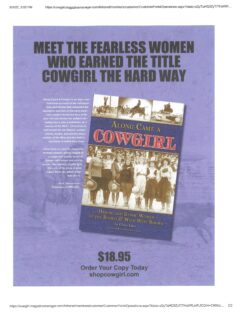
Along Came a Cowgirl:

Daring and Iconic Women of Rodeos and Wild West Shows


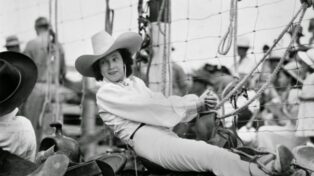
Spain.  September 1932.  Alice Greenough, a seasoned cowgirl, sits astride an angry steer.  In the place of a saddle a surcingle, a sort of plastic girdle has been fashioned around the animal’s back and cinched to his stomach.  He doesn’t like it.  Alice’s attractive face is focused as she secures a good grip on the flat braided rope tied to the steer’s flank.  When she was ready the bucking chute opened, and the angry beast stormed into the arena.  The spectators were on their feet, cheering.  Alice was quickly thrown from the steer’s back, but not off the animal entirely.  He wouldn’t stop kicking and jumping long enough for the rider to drop safely to the ground.  Matadors dressed in traditional garb raced to the scene and threw their capes over the steer’s head to slow him.  Finally, the cowgirl leapt off.

Thirty-year-old Alice was one of only six people in history, and the only woman, to avoid injury riding a steer with a surcingle.  Bullfighting fans erupted with applause at the achievement.  Alice bowed and waved at the enthusiastic onlookers.

Alice was born daring.  Her parents, Benjamin and Myrtle Greenough, were residents of Red Lodge, Montana.  They welcomed their daughter to the world on March 17, 1902.  Benjamin was a rancher, and his seven children helped him work the property.  Alice learned to rope and ride at a young age.  By the time she was fourteen she was delivering the U. S. mail on horseback to friends and neighbors along a thirty-seven-mile route around Billings.  She was still in grammar school when she began riding saddle broncs at local rodeos, and a few years later, she and her sister Marge were hired by the Jack King Wild West Show to be trick riding performers.

Alice won the World’s Championship in women’s bronc riding in Boston in 1933, 35, and 36, and again in 1940 in New York.  Her professional career spanned more than twenty-four years.  She was one of the stars of the Madison Square Garden rodeo for eighteen straight seasons.  She traveled throughout the United States, Mexico, and Canada competing for titles in relay racing, trick roping and riding.  Alice toured England and Australia and in 1934 won the women’s bronc riding event in Melbourne.  During her travels, she met with British royalty including King George V and the Duke of Windsor.

Not content with performing solely in Wild West Shows, Alice was eventually hired as a stunt woman for motion pictures and provided riding lessons to the King of the Cowboys and the Queen of the West, Roy Rogers and Dale Evans.

Alice was married twice, to Roy Cabill and then to Joe Orr.  She and Joe created their own show, the Greenough-Orr Rodeo.  Their rodeo featured the first woman’s barrel racing event.  Not only did Alice help produce the various shows, but she also participated in the acts as well.

Alice Greenough-Orr was inducted into the Cowgirl Hall of Fame in 1985.  She passed away at the age of ninety-three at her home in Tucson, Arizona, in 1995.


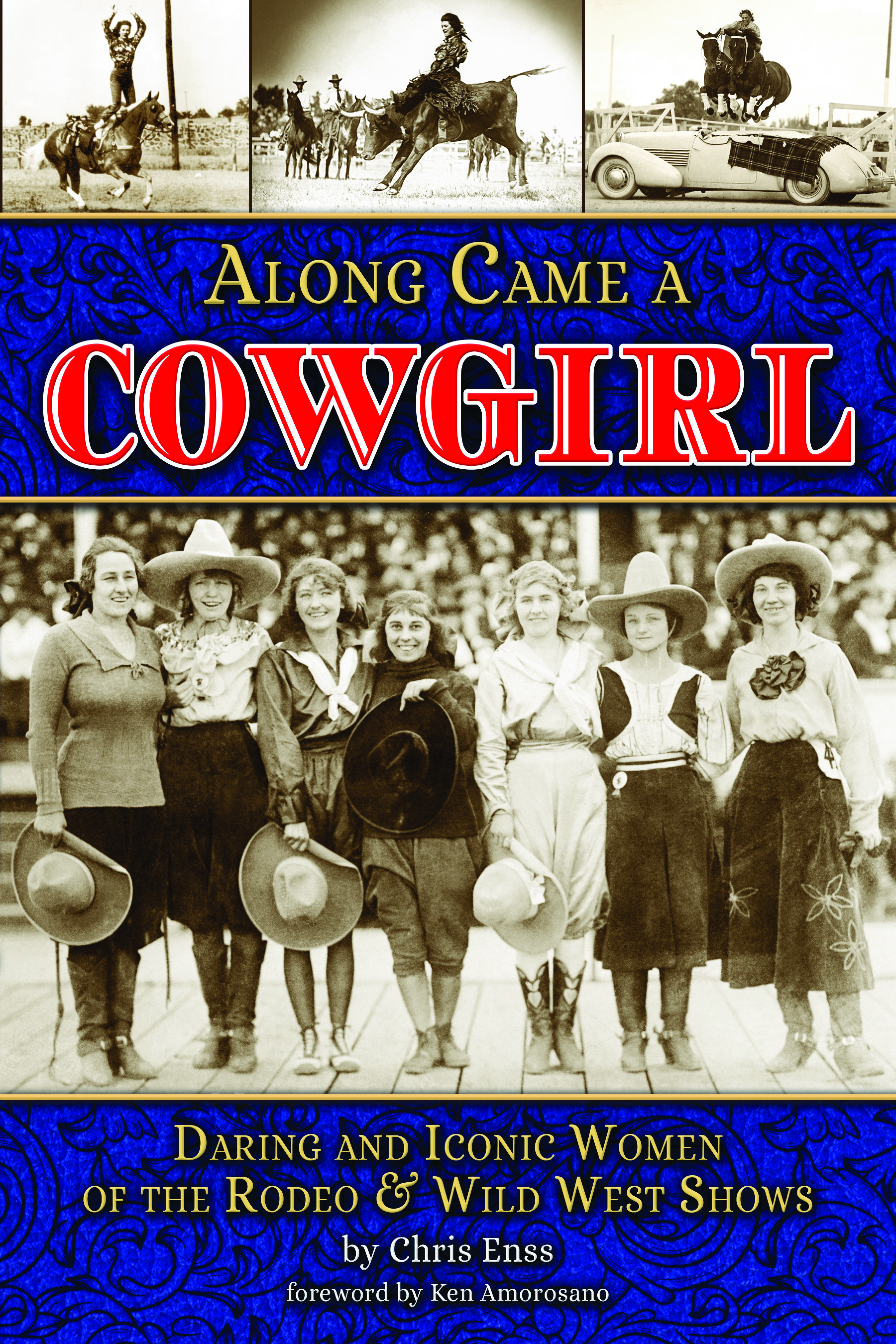
along came a cowgirl cover

To learn more about iconic cowgirls who made rodeo history read Along Came a Cowgirl. 

Iconic Cowgirl Queen Mary Duncan

Enter now to win a copy of

Along Came a Cowgirl:

Daring and Iconic Women of Rodeos and Wild West Shows


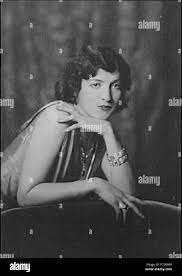
Rodeo fans at the Round-Up in Pendleton, Oregon, in 1928 were thrilled by the prospect of meeting the cowgirl actress chosen to reign over the prestigious event.  Queen Mary Duncan had entertained motion picture audiences with her horseback riding skills in the popular silent films Four Devils and The River.  Audience members hoped she would demonstrate some of the roping and riding techniques she performed on screen at the event, maybe even participate in a relay race or two.  Champion trick rider Mabel Strickland, who had ruled as queen over the prior year’s program, had dazzled ticket buyers with an exhibition of her talent.  Queen Mary’s contribution to the festivities would not be as daring.

Born on August 13, 1894, in Luttrellville, Virginia, Mary learned to ride at a young age and could have gone on to work in Wild West shows but decided to attend Cornell University instead.  She left college after two years to go on the stage.  She made a phenomenal success in the Broadway plays Poppy and Shanghai Gesture.  On the merits of those performances, she was signed by Fox Film Corporation to appear in a series of films portraying a feisty rancher’s daughter who helped fight off cattle thieves.  The vivacious, auburn-haired beauty’s talent for the screen equaled her talent on stage.

Mary Duncan had been in Pendleton a month prior to the Round-Up.  She arrived with director Edward Sedgwick and other cast and crew members to film a movie entitled Our Daily Bread.  Sedgwick wanted to use the rodeo as a backdrop for the setting.  It was the first time in motion picture history that the Round-Up would be both heard and seen on the screen.  The director had filmed the rodeo in 1924 when his then wife, Josie Sedgwick had been the queen of the event.  Unlike Josie’s court, Mary’s did not feature cowboy attendants.  The Round-Up board of directors appointed a traditional court: two princesses from Pendleton and two from the surrounding area.  Queen Mary and her attendants appeared in the parade dressed in white leather costumes trimmed in black.  Mary rode in a stagecoach and her attendants followed her on horseback.

When the Round-Up concluded, Mary, Edward Sedgwick, and the others associated with the production of Our Daily Bread remained in the area.  Local newspaper reporters followed Mary’s every move, referring to her as “Queen” in the articles written about her and the film being made in the wheatfields and hills of Umatilla County.  “The people out here are perfectly marvelous,” she told a reporter for the La Grande Observer. “I wish you would convey for me how glorious my time in Oregon has been.”

Pendleton residents who spent time with the actress during her visit praised her for her charm and kindness.  Some claimed she was one of the “most talented Round-Up Queens who never rode a horse.” The community invited Mary back to the rodeo to serve again as the queen of the event years after she returned to Hollywood, but she declined the offer, insisting the honor should go to a working cowgirl.

Queen Mary Duncan died on May 9, 1993, at the age of ninety-eight.


along came a cowgirl cover


Learn more about iconic cowgirls like Queen Mary when you read Along Came a Cowgirl


Along Came A Cowgirl in Cowgirl Magazine

Enter now to win a copy of

Along Came a Cowgirl:

Daring and Iconic Women of the Rodeo and Wild West Shows


“Coming Soon!” read the billboards, “World Championship Rodeo! $10,000 in cash prizes! Biggest, wildest, most thrilling rodeo ever held!”

“What’s a rodeo?” inquired the lady in the large, wide-brimmed hat decorated with plumes and flowers.

“Darned if I know,” replied the woman in the puffed blouse and fluted skirt. “Let’s go and find out.”

Within the first five minutes, they got more thrills than they had ever had in their lives before. They saw a cowboy leap from the back of a running horse to the hurricane deck of a galloping steer – a great, wild brute fresh from the Great Plains, weighing nine hundred pounds and every pound full of fight. The steers seemed to be the meanest, most devilish animals that ever walked on four feet, but they were nothing compared to the outlaw horses the women watched trying to throw riders.

This attraction called a “rodeo” was no place for a weakling. It seemed, indeed, to be a man’s game, a red-blooded, two-fisted sort of a game where you would never expect to find a woman. However, the ladies were there, riding with the best of them. Outlaw horses or wild steers couldn’t scare those females from the cattle country.

For more than six years I’ve been writing about those brave, talented ladies in the Iconic Cowgirls column for this magazine. After so many articles and with the enormous interest in women in the rodeo sports, it seemed fitting to pen a book about those women whose names resounded in rodeo arenas across the nation in the early twentieth century. Along Came a Cowgirl: Daring and Iconic Women of Rodeos and Wild West Shows highlights the ladies who ventured into the male dominated rodeo and trick riding world, defying all expectations.

In the beginning, rodeo events were confined to men, but it wasn’t long after the exhibitions began to grow in popularity that women joined the festivities. All they needed to do to compete was prove themselves as fearless as the men, and they did.

The origins of the rodeo can be traced to the early days of the American cattle industry. Once or twice each year, cowboys rounded up cattle on the ranges and drove the herds to various marketing centers. There, in celebration of the roundups, they staged informal competitions designed to exhibit the skills of their trade. The first formal rodeo contest was held in Cheyenne in 1872; the first competition offering cash prizes was staged in Pecos, Texas, on July 4, 1883, and the first such event charging admission took place in Prescott, Arizona Territory, on July 4, 1888.

The four events contested at most of the early rodeos were saddle bronco riding, bareback bronco riding, steer wrestling, and calf roping. Other events featured included exhibitions of trick riding, shooting, and simple lassoing, as well as a number of humorous contests such as attempts to milk a wild cow or to saddle a bucking bronco.

Women began competing in rodeos as early as 1890. Many women, west of the Mississippi, had been roping cattle and riding broncos, along with their male counterparts, since settling in the wild frontier. It was their skill in the saddle that enabled them to find places in rodeos and performing in Wild West shows.

Wild West shows were touring the country eight years before public rodeos came into being. One of the first such shows, and certainly the most well-known, was Buffalo Bill Cody’s Wild West. Organized in 1883 by William F. Cody, Buffalo Bill’s show was a leading source of entertainment and education for more than thirty years. During that time of worldwide travel and countless presentations, a variety of performers captured the hearts and imaginations of fans everywhere. Among those popular entertainers were courageous women bronc riders, calf ropers, trick riders and trick shooters.

The popularity of Buffalo Bill Cody’s Wild West show prompted other businessmen to produce their own programs. Among some of the other western themed exhibitions were the 101 Ranch Wild West show, Pawnee Bill’s Wild West, Colonel Cummins’ Wild West Indian Congress and Rough Riders of the World, and Diamond Dick’s Congress of World’s Western Champions. Cowgirls seeking to earn their living riding wild horses, twirling lassos, and wrestling steers signed on with the various Wild West shows. Many of those cowgirls were given titles that reflected the acts in which they excelled. Posters and flyers referring to the shows’ stars as “Champion Lady Bronc Rider,” “Best Relay Race Rider,” or “All-Around Champion Cowgirl of the World” were displayed in stores, railroad depots, restaurants, and other such establishments from coast to coast. Those labels attracted patrons, but, more often than not, the titles given to the cowgirls were unofficial.

Iconic cowgirls Fox Hastings, Tillie Baldwin, and Mabel Strickland were all billed at the same time as “Champion Lady Bulldogger.”  Mildred Douglas, Goldie St. Clair, and Prairie Rose Henderson were likewise labeled as the “Lady Bronc Riding Champion.”  Florence LaDue, Hazel Hickey Moore, and Bonnie Gray were all celebrated in the same time period as “Best Trick Roper.”  All the women were exceptional at their given talent, and all were proclaimed as top in their fields by the directors of the Wild West shows in which they rode. It wasn’t until women participated in rodeo events and won that they could officially be recognized as “champion,” or “best of…” in whatever category they were competing.

Lucille Mulhall was one of the first women superstars of the rodeo and Wild West shows. By the time she was eighteen, she had won numerous bronc riding and steer roping honors. In 1904, she won a gold medal for steer roping at the Cattle Convention Rodeo in Fort Worth. The three steers she roped in the show were picked out of an immense herd of wild and unruly beasts. She roped and tied the first one at one minute forty-five seconds. She cut that time down to one minute and eleven seconds with her second steer, and she dropped her third one in the remarkable time of forty seconds. Her total time for the three was three minutes and thirty-six seconds, several seconds faster than the nearest cowboy against whom she was competing. After her win in Texas, she was hailed as the “Queen of the Range.”

Mulhall set the stage for other daring cowgirls to follow. There was Blanche McGaughey, a bronc buster for the 101 Ranch Wild West Show who consistently won top honors at the Pendleton and Cheyenne rodeos and was recognized as the champion woman bronc buster of the northwest in 1912 and 1913; Pearl Biron, a trick roper who could flick the ashes off the cigarette of a fellow performer or a flag off the head of her horse; relay racing sensation Donna Card Glover who won multiple trophies at rodeos across the country, including the Yankee Stadium Rodeo in New York; and Lulu Parr, “Champion Lady Bucking Horse Rider of the World” who not only excelled at riding outlaw horses, but buffalos, too.

Along Came a Cowgirl: Daring and Iconic Women of Rodeos and Wild West Shows is the story of these riding marvels from yesteryear. Young women admired these cowgirls – women who dared to break society’s traditional roles, jump aboard a horse, and hold their own in a male profession. The women included in the book came from a variety of backgrounds and locations, but all had in common the desire to entertain crowds on the backs of their horses. With a lot of grit and determination, they were able to saddle up and follow their dreams.


Learn more about these amazing women when you read Along Came a Cowgirl


This Day…

On August 1, 1911 the first rodeo was held at the race track grounds, however it was advertised as a Wild West Show. Since it ran for a whole week, “Red” Cornett called it “Big Week” and Frank Griffen wanted to call it “The California Rodeo.”

Along Came A Cowgirl & Cowgirl Magazine

Enter now to win a copy of

Along Came a Cowgirl:

Daring and Iconic Women of Rodeos and Wild West Shows


Forword by Ken Amorosano

Publisher of COWGIRL and True West Magazines.


along came a cowgirl cover


The Iconic horsewomen of the American West, as depicted in the pages of Along Came a Cowgirl: Daring and Iconic Women of Rodeos and Wild West Shows, were trailblazers in every sense of the word.  Proving themselves fearless, athletic, and above all, “good horsemen,” was not only a goal, but a mission in many of their lives.

Along this rough and storied path is a very rare narrative that includes world records set, true stardom, and a stream of broken dreams and in many cases, broken bones.

Adventure, freedom, and a tough American grit endeared many horsewomen of the early 20th century to enter the man’s world of rodeo and along with it came fame, fortune, and a hardscrabble lifestyle only the toughest could endure.

Chris Enss is a prolific chronicler of these women, giving insight to a rough and tumble brand of Cowgirl with moxie and a lot to prove.  Her mastery of getting to the core of the story is what makes Chris the gifted writer that she is.

Along Came A Cowgirl is an important historical account of the individual lives and stories that cemented the reputation and lore of the early American cowgirl chronicled by a writer who not only knows her subject intimately but is also a trailblazer as a woman of the West.  Chris Enss is well known for her historic compositions, books, and articles about women of the West and the history and times in which they lived.

With names like Mabel Strickland and Florence LaDue, these ladies were the superstars of their time, executing death-defying stunts atop speeding horse and going head-to-head with the men in bronc riding and steer wrestling competitions much to the delight of the crowds and to the chagrin of the rodeo men.

While competing for prize money in rodeos such as the Pendleton Round Up and Cheyenne Frontier Days, the lure of the Wild West Shows brought greater excitement and international fame.  Although they were competitors earning a living from prize money, they were entertainers more than anything and they reveled in the accolades of screaming audiences and relished precious moments in front of royalty in places they would never have dreamed of being.

Many of the cowgirls in Along Came A Cowgirl attained great fame becoming super stars in Buffalo Bill Cody’s Wild West show and many others including the 101 Ranch Wild West show, Pawnee Bill’s Wild West, and Colonel Cummins’ Wild West Indian Congress and Rough Riders of the World.

Not only did the young American cowgirls wow the crowds in Paris and New York, they also broke molds of the norm and set fashion trends all the while dressed to the nines in fancy boots, hats, scarves, colorful riding dresses, pants, and chaps. These were the true sweethearts of the rodeo, and no man was to stand in their way.  Although sometimes shunned by a prudent audience of big city ladies for riding in pants as unladylike, these spitfire mavericks were the Madonna’s of their time, and they lived and regaled in every minute of it.

Along Came a Cowgirl: Daring and Iconic Women of Rodeos and Wild West Shows is the story of these pioneering cowgirls who lived life to its fullest and who’s legacy still lives today in the lives of the modern-day cowgirl.

Email gvcenss@aol.com to enter to win a copy of Along Came a Cowgirl.


This Day…

1863 – Indian Wars: Chief Pocatello of the Shoshone tribe signs the Treaty of Box Elder, promising to stop harassing the emigrant trails in southern Idaho and northern Utah.