
Selling Stories


This is going to come as no surprise to any full-time author, but writing has rarely been a lucrative career choice. According to the Author’s Guild, the median pay for full-time writers in 2019 was $14,300. Most writers need to supplement their income with speaking engagements or teaching. I learned this lesson years ago writing jokes for various comedians. Any notion I had of getting rich writing material for fellow University of Arizona comics performing at the Wild Cat House, was quickly dispelled.

So, I took a job with an office maintenance company. I was cleaning toilets for a living (on the night shift, for crying out loud).  I didn’t even rate cleaning bathrooms during the day. My bosses actually thought to themselves, “Yeah, Enss is good, she’s real good.  She’s just not ready for The Show yet.”  Thirty-five years and more than fifty published books later, I’m still holding down other jobs to supplement my writing income.

Holding onto a less-than-inspiring day job to pay the bills while pursuing your passion as a writer is not a new phenomenon. It’s worth recalling that many famous authors throughout history have kept their day jobs, whether for the financial security, or because they wanted to pursue different passions.

Harper Lee wrote To Kill a Mockingbird in her free time while working as a ticket agent for Eastern Airlines and British Overseas Airways Corporation. She had dropped out of law school and moved to New York to pursue her writing career but realized quickly she’d need to do something else to boost her income besides writing articles and short stories for various magazines.

Zane Grey’s day job was as a dentist, and he hated it. After marrying his wife Dolly in 1905, he closed the practice he’d been running for nine years to focus on his literary career. The couple then lived off Dolly’s inheritance.

Agatha Christie was employed as a pharmacist assistant for several years. She parlayed her knowledge of pharmaceuticals in many of her novels, the first of which, Hercule Poirot’s Mysterious Affair at Styles, was published in 1920.

John Steinbeck was a tour guide and caretaker at a fish hatchery in Lake Tahoe. Not long after he wed Carol Henning in 1928, he started a business manufacturing plaster mannequins. When that endeavor failed, his parents agreed to support him until his writing took off.

And then there’s Mark Twain. He didn’t find financial success until late in his career. In 1895, the great American writer and humorist – steamboat man and creator of Tom Sawyer and Huck Finn – was way down on his luck. In his late 50s, Twain was deep in debt after a series of disastrous investments.  So, he decided to embark on a worldwide standup comedy tour to recoup some of his losses. It paid off. That tour, along with his travel book Following the Equator released shortly after the tour ended, got Twain out of debt and then some.

I think you’d have to have the kind of books to your credit Twain did to pull off a successful comedy tour. I did standup for years to supplement my income as a writer, but never broke into the big money. But Twain was performing at posh venues such as the Stillman Theater in Cleveland, Ohio, and the Marquam Grand Opera House in Portland, Oregon. I played only the finest strip clubs from Tucson to Albuquerque. Not a night went by I didn’t hear the crowd yell, “Hey, get those naked women off the stage. Bring us a comedian.”

To do what you absolutely love and have a crazy passion for requires sacrifice. For many authors, nothing makes us happier than knowing someone is getting lost in the details of something we’ve written. To make that happen we’ll take on whatever extra jobs we need. “To survive, you must tell stories,” Umberto Eco, author of The Island of the Day Before once told a classroom full of aspiring writer. I’ll get to that in couple of hours. Just as soon as I’m done performing the next standup routine.
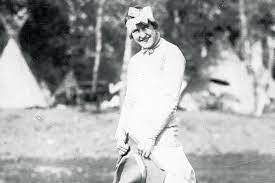
Along Came a Cowgirl & Relay Racer Donna Card

Enter now to win a copy of

Along Came a Cowgirl:

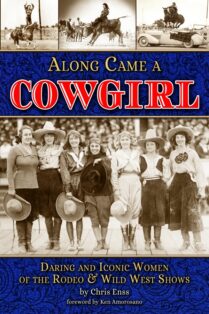
Daring and Iconic Women of Rodeos and Wild West Shows


Professional bronc rider Kitty Canutt grabbed a stick of wood lying next to a horse stall at the rodeo grounds in Spokane, Washington, and smacked champion relay racer Donna Card in the mouth with it. The incident occurred in early September 1918 and was the start of a feud between the cowgirls that would continue until their passings.

Kitty, wife of famed Hollywood movie stuntman Yakima Canutt, was upset with Donna over the way she behaved in the women’s relay race at the Spokane Rodeo. She claimed Donna fouled her in the third lap by crowding her into the fence. She complained to the judges, and, after investigating the charge, they determined Donna had run a clean race. Kitty was furious over the ruling and confronted Donna about the perceived indiscretion.  Kitty was disqualified from riding in any other events at the rodeo and was fined $25 for her violent outburst.  Donna went on to win the trophy as top relay racer.

Missoula, Montana, born Donna Card was a horseback riding phenomenon. She was an expert trick roper and fancy rider who won numerous championships, but her expertise was the women’s relay. Often associated with the Drumheller Company, a respected ranching firm that raised thoroughbred horses used in relay races, Donna was considered by rodeo enthusiasts to be one of the best women riders in the field.

The relay race required riders to make three laps around the track, changing horses at the end of the first and second laps. It was compulsory for riders to touch the ground with both feet when making horse changes. Early on, the relay race was considered a man’s game because of the danger and physical effort necessary in changing mounts. Donna was one of a few who proved women could become as good in the ranch sport as the men.

Donna frequently competed against accomplished relay racers Vera McGinnis and Mary Harsh. The women’s relay was considered by most rodeo attendees as the most spectacular of the events. Vera and Donna generally finished first and second in the contest, with Donna beating Vera for the top spot most of the time.

In 1918, Donna’s big win at the Spokane Rodeo made headlines. “Among the most interesting races of the day was the women’s relay, in which three strings were entered,” an article in the September 3, 1918, edition of the Spokesman Review read. “Miss Donna Card, clad in blue and white silk, was the winner, negotiating the two miles in three minutes forty-seven seconds.”

Donna defeated the world’s champion relay racer, Mabel Strickland, at the Spokane fair in September 1922. She took a commanding lead in the first lap and held it throughout the race. So outrode both Mable and Kitty Canutt.

In addition to being recognized for her efforts in relay racing, Donna was also a fashion trendsetter. The blue satin riding skirt, white jersey, and patent leather slippers worn at the Yankee Stadium Rodeo in New York in 1923 was duplicated by clothing designers in attendance and sold to the public.


To learn more about rides like Donna Card read Along Came a Cowgirl

Mattie Goff Newcombe & Along Came A Cowgirl

Enter now to win a copy of

Along Came a Cowgirl:

Daring and Iconic Women of Rodeos and Wild West Shows


A mammoth crowd of westerners gathered at the Black Hills Roundup in Belle Fourche, South Dakota, in early July 1927.  Among the spectators present at the prestigious rodeo were President Calvin Coolidge and South Dakota Senator Peter Norbeck.  The politicians, their wives, and staff members applauded the cowboys and cowgirls who rode into the arena to tackle rowdy steers and untamed broncos.  When Mattie Goff, the All-Around Cowgirl and World Champion Trick Rider, and her horse charged out of a chute and raced around the grounds, the president leapt to his feet cheering.

Mattie waved to the congregation as she hurried by them, preparing to perform her signature trick known as the back drag.  In the back drag, Mattie would place a foot in a loop on either side of the saddle, bend backwards over the rear of the horse until her hands touched the ground, and then pull herself upright.  The daring stunt was perfectly executed, and the onlookers cheered and clapped.  Mattie went on to dazzle fans with additional entertaining and dangerous tricks.  The celebrated cowgirl was treated to a standing ovation as she rode out of the arena.

Mattie Eugenia Goff was born on December 21, 1906, in Meade County, South Dakota.  She was one of seven children born to homesteaders George and Grace Goff.  She began riding at age three, and by the time she was fifteen was performing at rodeos.  In addition to trick riding, Mattie participated in bronc riding and relay racing events.  Her talent for trick riding was noticed by Wild West showman Leonard Stroud who hired her to work in his show.  Stroud, recognized as the greatest trick rider and roper of all time, taught Mattie such stunts as the Roman stand, under the neck, and the slick saddle stand.

In the summer of 1926, Mattie participated in the Bell Fourche Roundup and, using all she had learned from Leonard Stroud, won first place in the trick and fancy roping and riding competitions earning her the title of World Champion Trick Rider.  In August of that same year, Mattie gave a fine exhibition of Roman riding in a half mile race at the Mississippi Valley Fair in Davenport, Iowa.  She finished the race in fifty-eight seconds and won the top prize.  From there she competed at the Gardner’s Elkhorn Ranch Rodeo in Lexington, Kentucky, winning the trick riding and roping contest.  By the time Mattie performed for the president at the Black Hills Roundup the title of Champion Women Relay Rider of the World had been added to her list of titles.

Mattie Goff married cowboy Maynard Newcombe on December 15, 1927.  She retired from the rodeo world shortly thereafter to help her husband work their ranch on the Cheyenne River in eastern Meade County in South Dakota.

Mattie was inducted into the National Cowboy Hall of Fame in Oklahoma City in 1961 and inducted into the National Cowgirl Hall of Fame in Texas in 1994.  The former All-Around Cowgirl was ninety-eight years old when she passed away on July 26, 2005.


along came a cowgirl cover


To learn more about the daring women like Mattie read

Along Came a Cowgirl

This Day…

1939 – “The Wizard of Oz”, American musical fantasy film directed by Victor Fleming and King Vidor, premieres at Grauman’s Chinese Theatre, Hollywood, starring Judy Garland (Dorothy), Ray Bolger (Scarecrow), Jack Haley (Tin Man), Bert Lahr (Cowardly Lion), Frank Morgan (Wizard), Billie Burke (Glinda), and Margaret Hamilton (Wicked Witch)

Along Came a Cowgirl & Faye Blesing

Enter now to win a copy of

Along Came a Cowgirl: 

Daring and Iconic Women of the Rodeos and Wild West Shows


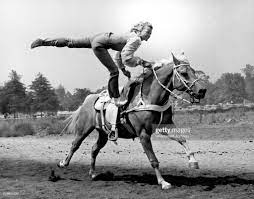
Skillful and graceful trick rider Faye Blesing and her Palomino horse Flash raced by excited fans at the Butte’s Buckaroo and Homecoming Days Rodeo in Butte, Montana, on July 6, 1951. Faye smiled at the spectators while demonstrating one of her most popular stunts, the Cossack, or Russian Drag. Pulling her feet out of the stirrups she flipped herself around in the saddle, looped one foot through a slot in the seat jockey, and hung upside down with her other foot hanging over her head, her head and hands dangling inches from the ground. With Flash running at breakneck speed, Faye twisted, spun, leaped, and swung around on the animal’s back. She ended her routine with a shoulder stand on Flash’s withers. The mesmerized crowd cheered the amazing tricks performed by the talented woman fans called the “sweetheart of the rodeo circuit.”  She’d made every trick look effortless.

Born on Christmas Day 1920 in Craig, Colorado, Faye was a teenager when her family relocated to southern California. Her father established the Lazy 3 Riding Stables in Burbank, where he rented saddles horses and provided wild horses for the movie studios. It was through her father’s business she perfected her riding technique, and at the age of sixteen, got her start in films. Prior to being a trick rider, Faye was a stunt woman. She doubled in numerous westerns performing feats considered too dangerous for Hollywood stars. Betty Grable and Rhonda Fleming were among the many actresses for whom she was a double.

The transition from film to the rodeo circuit was a natural for Faye. She would attend rodeos and watch the trick riders work and then go home and practice what she’d seen. For more than seven years, she rode in shows with various rodeos at Madison Square Garden in New York City. She even spent a month in Paris and Rome performing in historical venues.

Some of Faye’s friends and family considered trick riding a dangerous business. But in all the years she rode, she was injured only twice. Both accidents occurred when it was raining. The arenas where she and Flash were performing were muddy and slick. Flash slipped and fell, and Faye broke her leg one the first occasion and in her foot in the second. She credited her talented horse for keeping her safe through most of their career.

In 1942 she met Wag Blesing, a rodeo rider traveling in the same circuit, and the two married in 1944. Wag was the world champion bull-rider in 1947 and parlayed his love for horses and riding into film work. He was a stuntman and actor, and he and Faye occasionally worked together performing stunts in television shows such as F Troop and Wanted Dead or Alive.

Faye retired from trick riding in 1978. She and her husband then moved to Ramona, California, and opened a bar called the Wag Inn. Faye was inducted into the Cowgirl Hall of Fame in 1987. She passed away on April 7, 1999, at the age of seventy-eight.


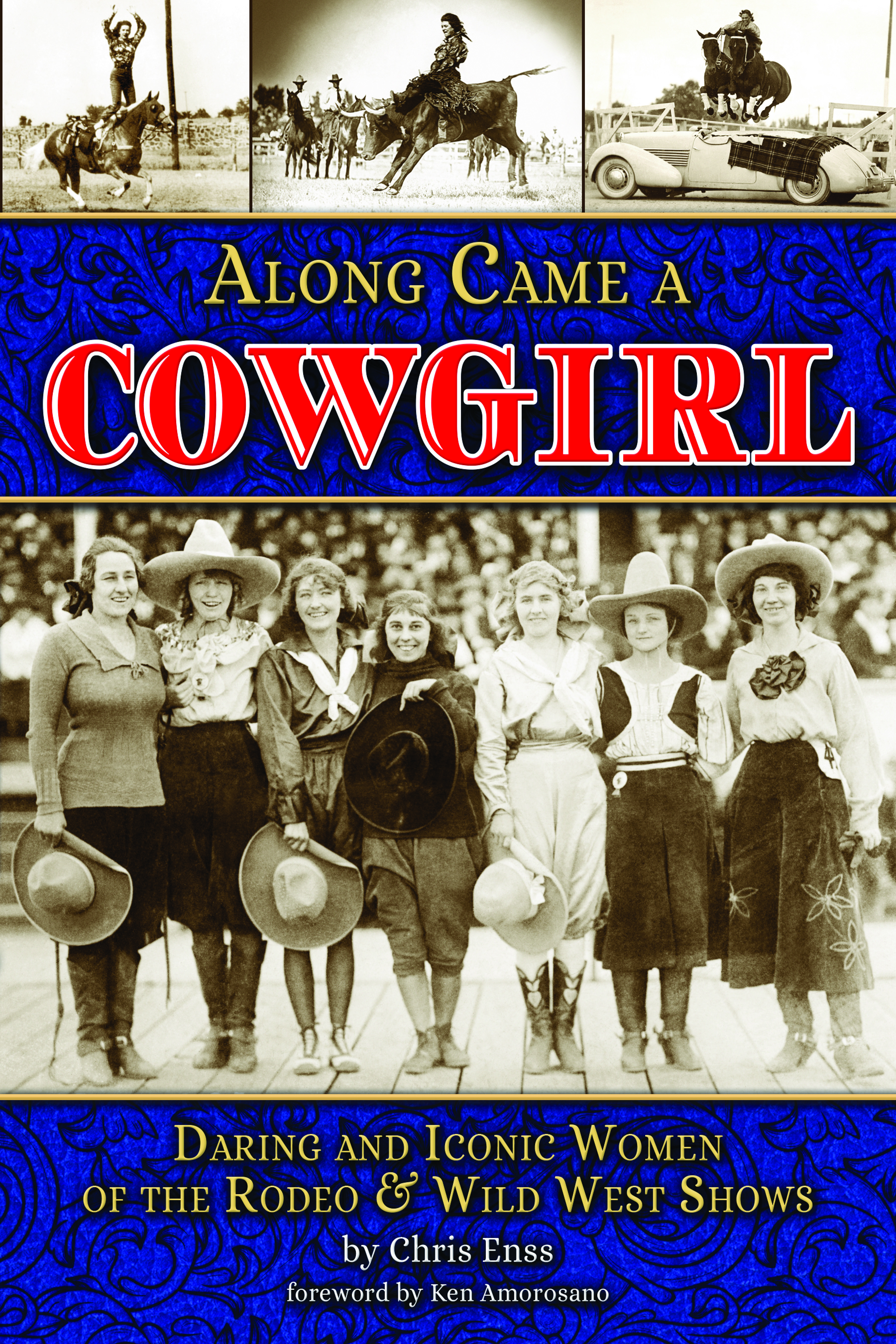
along came a cowgirl cover


To learn more about the women who made rodeo history read Along Came a Cowgirl.

Along Came a Cowgirl and Kitty Canutt

Enter now to win a copy of

Along Came a Cowgirl: 

Daring and Iconic Women of Rodeos and Wild West Shows


Bronc busting champion Kitty Wilkes won her first title at the Wild West Celebration Rodeo in Miles City, Montana, in 1916. The seventeen-year-old, New York native’s straightforwardness and untamed physical daring gave fans the impression she was born and bred into the rugged life of a Wyoming ranch. Few would have guessed she was new to the sport or that winning the top prize would inspire her to excel in other rodeos. From that exciting moment in Miles City she was determined to show the world that one need not be “born in the saddle” to be a crack rider.

Katherine Derre, whose stage name was Kitty Wilkes, was born on July 15, 1899. She had a natural talent for breaking horses and parlayed that skill into bronc riding in public showings. Not only did she have a way with wild horses, but she was also an exceptional trick and fancy rider. Owners of relay strings were eager to gain her services.

Between the rodeo in Montana in the summer of 1916 and the Pendleton Roundup in Pendleton, Oregon, in early fall of 1916, Kitty honed her bronc riding talent at ranches and rodeos throughout the West. She insisted on using the orneriest animals for training. Outlaw horses were blindfolded and saddled for her to ride. One encounter resulted in the horse bucking Kitty off and bruising her ribs. She wouldn’t allow the horse to beat her, however. She swung back into the saddle, refusing to leave it until the animal finally broke.

Kitty’s nickname was Diamond Girl because she had a diamond set in her front tooth. When needed, she would remove the diamond and pawn it for the entry fees to rodeo contests.

Her performance at the Pendleton Roundup in 1916 resulted in her being named the All-Around Champion Cowgirl. Among the many people she met during the roundup was Yakima Canutt. Canutt, who also competed at the rodeo, would go on to become one of Hollywood’s leading stuntmen. Kitty and Yakima fell in love and were married in Kalispell, Montana, in 1917.

Kitty was a fierce athlete who hated to lose. It was not uncommon for her to challenge women who outrode her, and she believed cheated, to a fistfight. In September 1918, she was disqualified from participating in a rodeo in Washington because she hit a rider in the mouth with a piece of wood.

Not content with being the top female bronc rider in the country, she aspired to be the top female relay racer as well. Rodeo fans loved to watch the petite woman fly past the grandstands on her horse, hurrying to meet the next mount waiting to be saddled and ridden to the next point. More than once Kitty would be finishing part of the race standing on the stirrups trying to get into the saddle. Her grit and resolve often paid off with a win.

The rodeo stars Kitty often competed against were Mabel Strickland, Bonnie McCarroll, and Prairie Rose Henderson.

Kitty Wilkes was eighty-eight years old when she died on June 3, 1988.


along came a cowgirl cover


To learn more about the women of the rodeo read the new book

Along Came A Cowgirl