The Widowed Moment

Enter now to win a copy of

The Widowed Ones: Beyond the Battle of the Little Bighorn
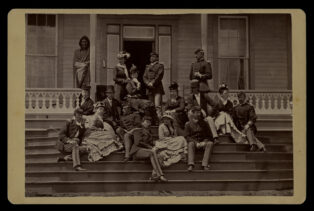


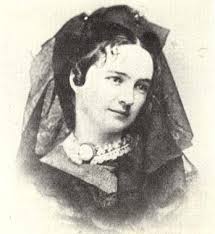
On Saturday, May 27, 1876, Henrietta “Nettie” Smith, her good friend Elizabeth Custer, and several other soldier’s wives made their way to the steamship Far West, docked in the waters near Fort Lincoln.  They were excited and filled with purpose.  They planned to persuade the ship’s captain, Grant Marsh, to transport them up the Missouri, to the Yellowstone River near where their husbands were camped.  The wives of the Seventh Cavalry officers had met with their spouse in the field before, some living in tents with them while they performed their duties, so the request wasn’t out of the ordinary.  When the troops had marched away from the fort a mere nine days prior, the goodbyes had been emotional and touching Nettie Smith, who had been married to Lieutenant Algernon Smith for more than nine years, was desperate to see him again.  A sense of fear and foreboding over his safety had overtaken her and letters he had written assuring her he was fine could not convince her he was well.

Far West crew members welcomed the women aboard the vessel and as per the custom, Captain Marsh ordered a meal prepared for them.  Nettie, Elizabeth, and the other wives were escorted the ship’s dining room where they were served “as dainty a luncheon as the larder of the board could afford.”  Elizabeth requested the captain join them and he reluctantly did so.  He was busy preparing the steamship to rendezvous with the Seventh Cavalry.  He and his thirty-man crew were loading the vessel with food, ammunition, and other supplies the troops would need.  There wasn’t a moment to spare.

After listening patiently to the officer’s wives request, Captain Marsh explained that in the best of circumstances “he did not wish to be burdened with many passengers for whose safety and comfort he would be responsible.”  He went on to inform the women that the anticipated voyage to the Yellowstone River to be “both dangerous and uncomfortable.”  This revelation did not cause the women to change their minds about their objective.  They believed their place was with their husbands wherever they were and whatever peril might lie ahead.
 

Widowed Ones Book Cover


To learn more about the friendship between the grieving soldier’s wives read

The Widowed Ones:  Beyond the Battle of the Little Bighorn

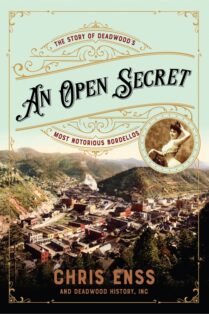
An Open Secret

An Open Secret Cover

The discovery of gold in the southern Black Hills in 1874 set off one of the great gold rushes in America. In 1876, miners moved into the northern Black Hills. That’s where they came across a gulch full of dead trees and a creek full of gold and Deadwood was born. Practically overnight, the tiny gold camp boomed into a town that played by its own rules and attracted outlaws, gamblers, and gunslingers along with the gold seekers.

Deadwood was comprised mostly of single men. In the beginning the ratio of men to women was as high as 8 to 1. The lack of affordable housing, the hostile environment, the high cost of travel, and the expense of living in Deadwood prevented many men from bringing their wives, girlfriends, and families to the growing town. Hordes of prostitutes and madams came to Deadwood to capitalize on the lack of women. By the mid-1880s, there were more than a hundred brothels in the mining community.

One of the most notorious cat houses in Deadwood was owned and operated by Al Swearengen. Swearengen was an entertainment entrepreneur who opened a house of ill-repute shortly after he arrived in town in the spring of 1876. Initially known as The Gem, the brothel was host to several well-known soiled doves of the Old West from Eleanora Dumont to Kitty LeRoy.

Among the many madams who ran other cat houses in and around Deadwood were Poker Alice Tubbs, Mert O’Hara, and Gertrude Bell. The names of some of the most popular brothels in Deadwood Gulch were the Shy-Ann Room, Fern’s Place, The Cozy Room, the Beige Door, and the Shasta Room. After more than a hundred years of continual operation, the brothels in Deadwood were forced to close in 1980.

In the summer of 2020, the Beige Door reopened for business. This time as a museum. The Deadwood Historic Preservation Commission, the Main Street Initiative Committee, and Deadwood History, Inc. (DHI) developed the idea of opening the only brothel tour in the Black Hills. The Brothel Deadwood has had a steady flow of visitors since the tour opened

The book An Open Secret: The Story of Deadwood’s Most Notorious Bordellos focuses on infamous cat houses like the Beige Door, those individuals who managed the businesses, their employees, their well-known clientele, the various crimes committed at the locations, and their ultimate demise.

Alone in the Shadows

Enter now to win a copy of

The Widowed Ones: Beyond the Battle of the Little Bighorn


The town of Monroe, Michigan, was blanketed in snow on the morning of December 25, 1876.  The yard in front of the Custers’ home and the street beyond resembled an unfinished painting.  Much of the canvas was perfectly white, waiting for an artist’s hand to bring color into the scene.  Elizabeth sat by the window in her room watching the morning light struggle through the fog and cold.  At some point, she would need to get dressed and join her in-laws for breakfast, but she lacked the will to move.  It was her first Christmas without her husband, and the near paralyzing grief she thought she had learned to control found her.  Elizabeth turned away from the window, and her eyes settled on a framed photograph of Custer sitting on her bureau.  She remembered the awful moment when she had first heard the news of his death.  She would never forget the devastated look on the faces of the wives who had also lost their husbands that day.  “From that time the life went out of the hearts of the women who wept,” Elizabeth wrote in her memoirs, “and God asked them to walk alone in the shadows.”


To learn more about Elizabeth Custer and the other officer’s wives who lost their husbands at the

Battle of the Little Bighorn read The Widowed Ones.


The Talk About the Widowed Ones

Here’s what a few people have to say about

The Widowed Ones: Beyond the Battle of the Little Bighorn


Widowed Ones Book Cover


“Chris Enss and Howard Kazanjian’s inspiring history title, The Widowed Ones, is about seven women who banded together to overcome their grief.  It is a compelling history text focused on women’s experiences following the Battle of the Little Bighorn.”

Foreword Clarion Review


“Readers interested in 19th-century, women’s and military history will be drawn into this thoroughly humane and sympathetic treatment of U.S. army widows.”

Library Journal


“The rigor of the scholarly research on display here is quite simply astonishing, as the authors seem to leave no stone unturned.”

Kirkus Review


“An extraordinary and inherently fascinating read from cover to cover, “The Widowed Ones: Beyond the Battle of the Little Bighorn” is an amazing and original work historical scholarship that lifts these women from an undeserved obscurity and effectively introduce them to an appreciative new generation of historians and non-specialist general readers. The true life experiences of women widowed in the aftermath of one of most famous 19th Century encounters between Native Americans and the United States military known as the Battle of Little Bighorn, “The Widowed Ones: Beyond the Battle of the Little Bighorn” is an impressively original contribution that will be enduringly valued by both academia and the general reader alike.

Enhanced with black-and-white historic photograph images, an informative Introduction, an eight page Bibliography, twelve pages of Notes, and an eight page Index, no community, college, or university library 19th Century American History can be considered comprehensive within the inclusion of “The Widowed Ones: Beyond the Battle of the Little Bighorn” into their collection.

Exceptionally well written, organized and presented, “The Widowed Ones: Beyond the Battle of the Little Bighorn” is an ideal and unreservedly recommended addition to 19th Century American Biography supplemental studies curriculums.”

Midwest Book Review


“This reviewer owns countless books on Custer and the battle at the Little Big Horn. Some are well researched. Some are well written. Few enjoy both qualities. “The Widowed Ones” scores ten in both respects.

It also presents an entirely new angle to the oft done subject matter. In other words, this is the best Custer book ever for the casual reader and the jaded western researcher.  Bravo! Chris Enss. She, in collaboration with Howard Kazanjian and Chris Kortlander, gives a stunning and emotionally charged view of the women that were left behind after the historic loss of George Custer’s command in 1876.

The book weaves its way through the devastation wrought upon Libby Custer and the widowed wives of the men that wore the blue of the 7th Cavalry.  Enss and Kazanjian do a terrific job detailing the women’s handling of loss; not only their husband’s demise, but also the pain of official criticism aimed to besmirch their loved ones, and their grappling with getting on with their lives without any apparent means.  The path Libby et. al. took is detailed in “The Widowed Ones”, an insightful glimpse of how the survivors cope, or don’t.  Each reader can measure their grit and resolute devotion to their fallen husbands.  It is a marvelous story.  Enss and company have filled in a neglected hole in one of the West’s greatest historical events.  If you are restricted to one last book purchase, this is the one.”

Green Valley News  Green Valley, Arizona

Arizona Daily Star  Tucson, Arizona


Will Rogers Medallion Award Finalists

Creative works by authors from two countries and 24 states have been named finalists for the 2022 Will Rogers Medallion Awards (WRMA) celebrating excellence in fiction, nonfiction, poetry, and photography of the American West.  I’m honored to learn three of the books I’ve written are listed among the finalists.


Finalist in the category of Biography/Memoirs


The Lady and the Mountain Man Book Cover

The Lady and the Mountain Man: 

Isabella Bird, Rocky Mountain Jim, and their Unlikely Friendship


Finalist in the category of Western Nonfiction

iron women book cover


Iron Women: The Ladies Who Helped Build the Railroad


Finalist in the category of Western Photographic Essays


Happy Trails Cover

Happy Trails:

A Pictorial Celebration of the Life and Times of Roy Rogers and Dale Evans

Duty and Faithfulness

Enter now to win a copy of

The Widowed Ones: Beyond the Battle of the Little Bighorn


Elizabeth Custer and Annie Yates sat on the front porch of the Yates home watching Annie’s children playing in the yard.  A stack of papers rested in the laps of both women, and, when they weren’t distracted by the unremarkable daily tasks of their new lives without their husbands, they sifted through the letters and government paperwork that had steadily arrived since late July 1876.

The summer of 1876 had passed slowly.  The men who died at the Little Bighorn were sorely missed.  Elizabeth had taken to sleeping with one of Custer’s shirts.  It smelled like him, and, at night when she longed to have him near, it helped ease her pain.  Annie spent evenings after the children were in bed writing letters to her deceased husband.  She knew he was gone, but she had an overwhelming need to communicate with him about their little ones and the difficulty she was having moving on.  Elizabeth and Annie had found unique ways to deal with their grief and by mid-fall were venturing out into public, if only to visit one another.  Maggie Calhoun, on the other hand, still struggled, refusing to leave her parents’ home to even attend church. “Now that Bubbie is gone,” Maggie shared with Elizabeth about James Calhoun’s death, “…I do not feel that mentally I am fitted to fill any position of usefulness to others.”

Nettie Smith’s correspondence to Elizabeth revealed her struggle to move forward from the tragedy as well.  “Last night I found a diary kept by Smithie on the Yellowstone Expedition [1873] in which so often he writes of his ‘little wife’.  In one place he says, ‘These are hard marches, but it is consoling to know that we are marching toward my little wife Dudds.  God bless her!  Only about a month separates us.’  Oh, if that last part could only be true now.  I realize the terrible truth more and more every day.  Where shall we find the strength to endure?”

Some of the other officers’ widows weren’t faring any better.  In early October, Elizabeth had received a letter from Eliza Porter.  Mrs. Porter had returned to Maine where she and her husband James had met and married.  She wanted her two sons to be near her family in Franklin County.  The Porter’s first child, David, had been born in 1871 in Massachusetts, and their second boy, James, had been born in March 1876 at Fort Abraham Lincoln.  Elizabeth had been with her at the birth.


Widowed Ones Book Cover


To learn more about the Elizabeth Custer and the other widows read

The Widowed Ones: Beyond the Battle of the Little Bighorn