
1855 – 1st train crosses 1st US railway suspension bridge, Niagara Falls
Harvey Car Courier Corps
Enter now to win a copy of
Iron Women: The Ladies Who Helped Build the Railroad
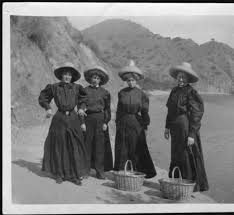
The Harvey Car Courier Corps will take you away “into the beckoning, foot-loose distances of New Mexico,” reads the Santa Fe Railway brochure on Indian Detours. The brochures were distributed to train travelers crossing the arid Southwest desert in the late 1920s, who were looking for adventure and romance.
Indian Detours were created by the Fred Harvey Company in 1925. The popularity of the automobile and the airplane had created a lull in railroad travel. The Harvey Company introduced the detours in hopes of encouraging the public to journey by train to their next vacation destination. The tours were only available for the Southwest part of the country, from the Grand Canyon to Santa Fe. The specialized tours by car were to divert passengers from the train for one to three days and drive them through the “wilderness panoramas” of northern New Mexico to Indian ruin sites and living pueblos.
The drivers of the Harvey vehicles, which included Packards, Franklins, Cadillacs, and White Motor Company buses, were always men. The tour guides or “couriers” were always women. Executives at the Harvey Company believed following the business model of the Harvey Girls would assure the success of the Indian Detours.
The women selected to be members of the Harvey Car Courier Corps spent weeks training for their positions. In order to be qualified tour guides, they were required to know the archaeological, ethnological, cultural, geological, botanical, historical, and legislative makeup of New Mexico. It was necessary that the information they shared with travelers was accurate. The couriers attended lectures and participated in trips along the detour trail. According to the March 12, 1975, edition of the Santa Fe New Mexican, the majority of the Harvey Car Courier Corps members found the work interesting. Aside from teaching school, there were very few interesting jobs for women post World War I. Couriers earned $150 a month, $160 a month if they spoke a foreign language and could communicate with travelers from other countries.
Among the well-known individuals who took advantage of the Indian Detours was Albert Einstein, John D. Rockefeller, Will Rogers, and Guglielmo Marconi, the inventor of the wireless telegraphy.
The Harvey Couriers were required to dress in Navaho-style costumes while giving the tours. The authentic outfit consisted of velveteen skirt, concha belts, and squash blossom necklaces.
The tours originated from the Harvey Houses: the Castaneda in Las Vegas, New Mexico; the Alvarado in Albuquerque; the Ortiz in Lamy; and the Navajo in Gallup. The most popular detour trips were to the Painted Desert, the Petrified Forest, and the Indian Pueblos in Taos and Santa Clara. The cost for the tours ranged from $10 to $14 a day.
The Great Depression brought about the end of the Indian Detours and the Harvey Couriers.
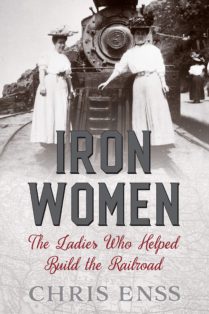
To learn more about the ladies who helped build the railroad read
Iron Women.
This Day…
1872 – Yellowstone becomes the world’s 1st national park.
The Convention Train West
Enter now to win a copy of
Iron Women: The Ladies Who Helped Build the Railroad
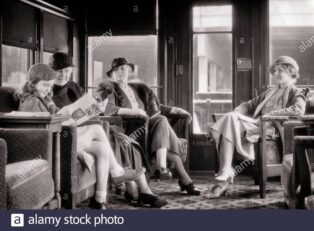
In July 1927, Pearl Matlock, assistant manager of the Fred Harvey Company advertising department, helped organize train travel for more than 1,000 delegates of the Business and Professional Women’s Club. The career women were making their way from New York to Oakland, California, for the national convention. The train made stops along the way to collect representatives of the organization, and at each stop reporters were waiting to cover the momentous trip. Pearl was one of the Harvey Company’s employees as well as the national chairwoman of the Business and Professional Women’s Club.
By the summer of 1927, the organization had more than 45,000 members. Its goal was to call attention to the “broadening effect of women’s contact in businesses and promote higher efficiency among them.” An article about the event in the February 20, 1927, edition of the Albuquerque Journal explained that “Businesswomen in the East, who did not fully realize and appreciate the historic and artistic Southwest, would have an opportunity on the train trip to acquaint themselves with the progress made in that part of the country.”
Key delegates of the Business and Professional Women’s Club acted as “conductors” when the train traveled through their respective home states. The BPW transcontinental train was scheduled for extended stopovers in Colorado, Santa Fe, and at the Grand Canyon.
The July 14, 1927, edition of the Arizona Daily Star covered the group’s arrival into Flagstaff on July 13. “When the train jolted to a stop at 3 A.M., twenty BPW/AZ ‘cowboys’ dressed in ten-gallon hats, neckerchiefs, white blouses, blue, bobby skirts, guns, and holsters pretended to hold up the train,” the article explained. “Once on board, they distributed copper and wooden souvenirs, Progressive Arizona magazine, a half a train carload of cantaloupes, and other Arizona fruit to passengers.”
When the train arrived at the Grand Canyon at 6 A.M., Governor George W. Hunt and other staff officials welcomed the organization’s president to Arizona. Hopi Indians performed ceremonial dances, and cowboys staged a small rodeo. After disembarking from the train, passengers walked or drove around the canyon rim while others rode mules a short distance down the Bright Angel Trail. The day ended when the Santa Fe Railway transported the women to a banquet at the Harvey House hotel the El Tovar.
The first all women railroad party to cross the continental divide arrived in Oakland on July 21, 1927. The organization’s motto “Better Businesswomen for a Better Business World”, typified all the club represented. It would eventually become the largest women’s organization in the world.
To learn more about ladies who helped build the railroad read Iron Women.
This Day…
1950 – “Your Show of Shows” with Sid Caesar & Imogene Coca premieres on NBC Writers include Mel Brooks, Neil Simon & Woody Allen
Iron Ladies #1 New Release
This Day…
1872 – 1st national convention of Prohibition Party (Columbus Ohio).
The Telegraphers
Enter now to win a copy of
Iron Women: The Ladies Who Helped Build the Railroad
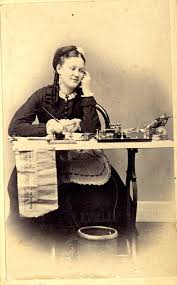
Twenty-eight-year-old Elizabeth Cogley sat at a small desk in the Pennsylvania Railroad ticket office in Lewiston Junction, Pennsylvania, on April 16, 1861, frantically writing down the message coming through the telegraph. The neatly dressed woman wore a serious expression; the message she was transcribing was vital and history making. The day before, a similar wire had reached Elizabeth. She carefully noted its contents and passed it along to the ranking military official in the area. It was from President Abraham Lincoln, and it read, “I appeal to all loyal citizens to favor, facilitate, and aid this effort to maintain the honor, the integrity, and the existence of our National Union, and the perpetuity of popular government; and to redress the wrongs already long enough endured.” This was Lincoln’s first call for troops. He asked for 75,000 volunteers.
The following day, Pennsylvania’s first war governor, Andrew G. Curtin, sent a telegram to Captain Selheimer, commander of the First Defenders Association in Lewiston, to rally his men together to report to Harrisburg, Pennsylvania, as soon as possible. After delivering the message to the captain, Elizabeth was instructed to respond to Governor Curtin with news that he and his troops would “move at once.” The railroad telegrapher dispatched the important information quickly and accurately. Little did Elizabeth know the event would be remembered as the first telegraph exchange of the Civil War.
Born on November 24, 1833, Elizabeth learned telegraphy in the office of the National Telegraph Company. She entered the service of the Pennsylvania Railroad Company on April 13, 1856. She was stationed in the Lewiston office until the beginning of the Civil War. She remained with the railroad company for more than forty years.
Some of the earliest women in railroading can be found in telegraph stations. The job of the telegrapher was to transfer information between the train dispatcher and the train operator. A telegrapher copied train orders and messages from the train crew and reported the passing trains to the dispatcher. They also received and sent Western Union telegrams. Most learned the trade from another operator. Some attended schools such as the Cooper Union for the Advancement of Science and Art in New York and the Pittsburgh Female College in Pittsburgh.
To learn more about Dr. Mary Pennington and other women who built the railroad read
Iron Women
This Day…
1865 – Columbia, South Carolina, burns down during American Civil War
Iron Women Review
Enter to win a copy of
Iron Women: The Ladies Who Helped Build the Railroad
Iron Women examines women who contributed to the rise of the railroads. The chapters cover inventors, writers, bosses, and the infamous Harvey Girls. Women played an integral part in making the railroads a significant factor in US history. The chapter I find the most interesting was the one on the Harvey Girls. I had a vague idea who they were, but I had no idea it was a chain of restaurants and hotels along the southwest that gave jobs to thousands of women from the 1890s-1930s. This book adds to women’s history and industrial history genres. Goodreads Review