
Iron Woman, Mary Colter
Enter now to win a copy of
Iron Women: The Ladies Who Helped Build the Railroad
The sun blazed high in a brassy sky, and heat danced in undulating waves across the high plateau town of Winslow, Arizona. In the far distance, a train with the name Santa Fe Railway embossed on its side hurried along steel rails toward the La Posada Hotel. It was May 15, 1930, opening day for the newest link in the chain of Fred Harvey hotels found along the Santa Fe line between Chicago and the Pacific Coast.
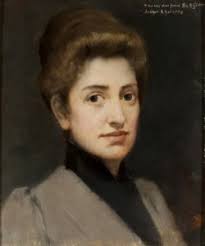
The main lobby of the grand establishment was crowded with local and state politicians, Native Americans, businessmen and their wives, enthusiastic patrons, and, of course Harvey Girls, those dedicated women who worked as wait staff at restaurants and hotels from Kansas to California. Among those celebrating the launch of La Posada was its architect, Mary Colter. The sixty-two-year-old designer beamed with pride as she surveyed the rambling earth tinted structure. Inspired by the great ranchos of old Mexico, the hotel was the embodiment of simplicity, spacious comfort and colorful interest, characteristic of early Spanish craftmanship.
One of Mary’s friends handed her a glass of champagne to toast the event, but, before she could raise her glass, a pair of rowdy, well-dressed cowboys on horseback burst into the entrance of the magnificent vestibule. One of the exuberant men rode over to Mary, hopped off his horse, scooped her up in her arms, and placed her on the check-in counter. The two cowboys celebrated Mary’s accomplishment by firing their guns into the air. Before the gathering had a chance to fully process the actions of the joyful pair, the cowboys quickly walked their horses out of the hotel.
Mary Elizabeth Jane Colter’s business relationship with Fred Harvey, the hotelier, restauranteur and retailer, and the Santa Fe Railway lasted more than forty years. The gifted architect and designer created numerous, large scale projects for the Harvey Company and the rail line. All of which helped promote both businesses and made train travel pleasurable for those heading west.
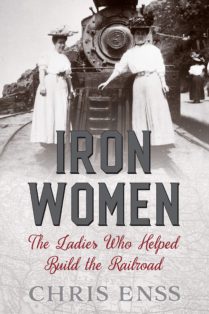
To learn more about Mary Colter and the other ladies who helped build the railroad read Iron Women
This Day…
1870 – US Army establishes US National Weather Service
Mary Louise Lawser, The Santa Fe Muralist
Enter now to win a copy of
Iron Women: The Ladies Who Helped Build the Railroad
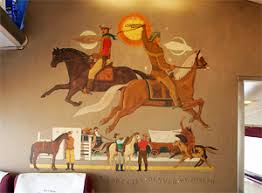
While attending college in Pennsylvania, Mary Lawser was part of a group comprised of several accomplished female artists. They were known as the Philadelphia Ten.
Among the members was a talented painter and sculptor named Mary Louise Lawser. Like Mary Colter, Mary Lawser was hired by a major rail line company to help promote westward travel.
Born in 1906 in Pennsylvania, she exhibited at a young age. She attended the Pennsylvania Museum School, the Pennsylvania Academy of Fine Arts, and the Ecole des Beaux Arts in Paris. Mary’s work was exhibited in galleries in Europe and New York. She was recognized by her peers as a gifted, bronze work artist. After graduation she took a position as an art instructor at Cedar Crest College in Allentown, Pennsylvania, and at Bryn Mawr.
In early 1940, she was hired to work for notable architect Paul Cret. The French-born, Philadelphia architect and industrial designer was impressed with Mary’s design and execution of bronze tablets found inside Alexander Hamilton’s home, The Grange. Commissioned by the American and Historic Preservation Society, the tablets were made to honor Alexander Hamilton, first secretary of the United States treasury. In addition to designing buildings on the University of Texas campus and the Pan American Union Building in Washington, D.C., Paul Cret designed railroad cars for the Burlington and Santa Fe rail lines. While Mary was employed by Cret, she contributed to decorating various railroad passenger cars with sculptures, wood carving, and mixed metal creations.
When Cret passed away in 1945, Mary was hired by another respected Pennsylvania architect, John Harbeson, to aid him in creating a new look for Burlington’s Pioneer Zephyr. Although in the employ of Harbeson, Mary was singled out by the Budd Company, a railroad industry manufacturer, to design murals for the interior of the passenger cars that would inspire ticket-buyers to go west.
To learn more about Mary Louise Lawser and other women who helped build the railroad read
Iron Women.
Kate Wins Gold at the Will Rogers Medallion Awards
This Day…
1863 – Samuel Clemens first uses the pen name Mark Twain in a Virginia City newspaper, the “Territorial Enterprise”.
Republic’s Leading Lady – Vera Ralston
Enter now to win a copy of
Cowboys, Creatures and Classics: The Story of Republic Pictures.
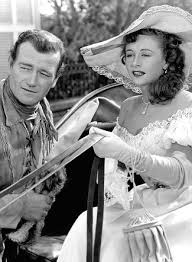
The most influential woman at Republic Pictures from the early 1940s to the studio’s demise in the early 1960s, was Vera Hruba. Born in Prague, Czechoslovakia, on July 12, 1919, the blonde beauty caught Republic Picture’s president Herbert Yates’ attention in 1939 when she toured the United States with an ice-skating show called Ice Vanities.
Vera was an exceptional ice skater, having placed 17th in the 1936 Olympics behind figure skater Sonja Henie. Yates was captivated with Vera’s talent and looks and believed she could be as successful as Ms. Henie who was one of the leading stars at 20th Century Fox. He cast Vera, and the entire company of the Ice Vanities, in a musical film entitled The Ice Capades. Critics called the picture “sheer enchantment on ice.” Vera was mentioned along with five other skaters as “spectacular”. Yates couldn’t have agreed more and in 1943 signed her to a long-term contract with the studio and added Ralston to her name. He added Ralston, a name borrowed from the cereal, because Hruba was difficult for moviegoers to pronounce.
The first movie Vera Hruba Ralston appeared as a star, minus the skates, was Republic Pictures’ 1941 horror film The Lady and the Monster. Her costars were Erich von Stroheim and Richard Arlen. Billed as “a picture from out of this world” the plot involves a millionaire whose brain is preserved after his death, and telepathically begins to take control of those around him. Von Stroheim portrays the diabolical Dr. Mueller who retrieves the brain of a financial genius who crashed to his death in an airplane mishap near the laboratory. The doctor carries out a fiendish plot to put the super brain to work for him. Richard Arlen plays the doctor’s assistant who falls in love with the doctor’s ward, Vera Ralston. The film reviewer for the Havre Daily News referred to Ralston’s debut as a dramatic actress as “the find of the season.”
Most did not agree with the critics who found the foreign ingénue to be a promising star. Many complained that her performance was wooden and that her accent was too thick. Yates ignored every voice but his own and quickly reteamed von Stroheim and Arlen with his discovery in another feature entitled Storm Over Lisbon. In this spy thriller Ralston played an allied operative in Lisbon and Arlen an American newspaper man who she helps get out of Portugal with important information. Audiences found Ralston attractive, but struggled to understand what she was saying.
Yates hired acting instructors and speech coaches for Ralston. While her English and her acting soon improved she could not lose her strong Czech accent. Yates felt that ticket buyers would eventually see how compelling the stunning blonde’s talent truly was and learn to embrace her way of talking in much the same way they did Marlene Dietrich. In order to help Ralston, gain a broader acceptance he paired her with an actor that had mass appeal – John Wayne.
To learn more about Vera Ralston and the other leading ladies of Republic Pictures read
Cowboys, Creatures, and Classics.
This Day…
Cowboys, Creatures and Classics: The Story of Republic Pictures
Enter now to win a copy of
Cowboys, Creatures, and Classics: The Story of Republic Pictures
Take one well-oiled effective killing machine, add a familiar hero on the ground, in the air, and on horseback; stir in a ghastly end that’s surely impossible to escape, add action, add passion, made on a shoestring budget at breakneck speed, and you’ve got the recipe for Republic Pictures. Who, after all, cannot forget The Atomic Kid, starring Mickey Rooney, or The Untamed Heiress, with an un-Oscar-worthy performance by ingénue Judy Canova?
Exploding onto the movie scene in 1935, Republic Pictures brought the pop culture of the 30s and 40s to neighborhood movie houses. Week after week kids sank into their matinee seats to soak up the Golden Age of the Republic series, to ride off into the classic American West. And they gave us visions of the future. Visions that inspire film makers today. Republic was a studio that dollar for dollar packed more movie onto the screen than the majors could believe. From sunrise on into the night over grueling six-day weeks, no matter how much mayhem movie makers were called upon to produce, at Republic Pictures it was all in a day’s work.
Republic Pictures was the little studio in the San Fernando Valley where movies were made family style. A core of technicians, directors, and actors worked hard at their craft as Republic released a staggering total of more than a thousand films through the late 1950s.
Republic Pictures was home to John Wayne for thirty-three films. Always inventing, Republic brought a song to the West. It featured the West’s first singing cowboy. Republic brought action, adventure, and escape to neighborhood movies houses across America. And they brought it with style. Scene from westerns such as The Three Mesquiteers and the Lawless Range gave screaming kids at the bijou a white-knuckle display of expert film making.
Republic Pictures became a studio where major directors could bring their personal vision to the screen. Sometimes these were projects no other studio would touch such as The Quiet Man (which brought director John Ford an Oscar) and Macbeth.
Killer Bs, Cowboys, Creatures and Classics: The Story of Republic Pictures is for anyone who likes B movies magic. It is the honest account of an extraordinary production house, one whose ability to turn out films quickly boded well for its transition into television production. Not only were its sets used for such shows as Leave it to Beaver and Gilligan’s Island, but stock footage from Republic’s movies was also used on such shows as Gunsmoke and The Life and Legend of Wyatt Earp.
To learn more about Republic Pictures read Cowboys, Creatures, and Classics
This Day…
1888 – The National Geographic Society is founded in Washington, D.C. for “the increase and diffusion of geographic knowledge”.