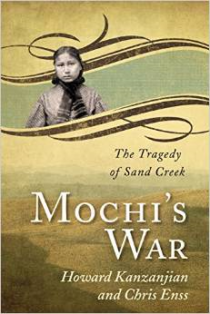
The Library Journal’s Review of Mochi’s War

Enter now to win a copy of Mochi’s War:  The Tragedy of Sand Creek


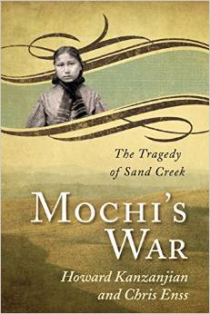
“Historians Enss and Kanzanjian (coauthors, None Wounded, None Missing, All Dead) succeed in personalizing one of America’s most troubling memories, the brutal and unprovoked massacre of a sleeping village of Cheyenne and Arapaho peoples at Sand Creek (present-day Colorado) by troops of the Colorado Volunteers in November 1864. This still controversial military engagement (see Ari Kelman’s A Misplaced Massacre) sets the background in which Mochi, a Cheyenne woman, lost her entire family and barely survived herself, by killing a soldier and then fleeing her camp. She reinvented herself as a Dog Soldier and member of the Bowstring Society, one of the few females to claim association in these elite Cheyenne warrior groups. She remarried, to Medicine Water, himself a military leader, and they in turn brutally raided and avenged themselves on American soldiers and settlers alike for over a decade. The authors have again collaborated to write Western history in an accurate yet accessible manner for mainstream readers. They provide a graphic account of the Plains Indian Wars from 1864 to 1875. VERDICT Highly recommended for adult readers of Western and Native American history, this biographical account provides a counterpoint to the many works that have mythologized such women as Pocahontas and Sacajawea.”

—Nathan Bender, Albany Cty. P.L., Laramie, WY


To learn more read Mochi’s War:  The Tragedy of Sand Creek

The Warrior, Mochi

Enter now to win a copy of

Mochi’s War:  The Tragedy of Sand Creek


The sun had not quite risen over the vast Kansas plains when John German heard a sound that tempted him from his work packing his family’s belongings into their wagon.  He surveyed the campsite with a careful eye.  His wife Lydia and their seven children were each going about their morning chores and preparing to continue their journey to Colorado.  The Germans were from the Blue Ridge region of Georgia and had spent the summer of 1874 traveling west.  They planned to reach their new home before winter.

John and Lydia’s oldest children, twenty-year-old Rebecca Jane and nineteen-year-old Stephen, were tending to the livestock in a field not far from the family campsite.  For a brief moment all seemed as it should be then, suddenly, a small herd of antelope darted across the trail, panicked.  Several shots rang out, and the antelope scattered in different directions.  Another shot fired and a bullet smacked John in the chest, and he fell in a heap on the ground.  Lydia ran toward her husband.  Nineteen members of the Bowstring Society rode hard and fast into the German family’s camp, whooping and yelling.  Lydia continued running.  A Cheyenne Indian on horseback chased her down and thrust a tomahawk into her back.

Rebecca Jane grabbed a nearby ax and attempted to fight off the warrior as they rode toward her.  She managed to hit one of the attackers in the shoulder before she was knocked unconscious with the butt of a gun, raped, and killed.


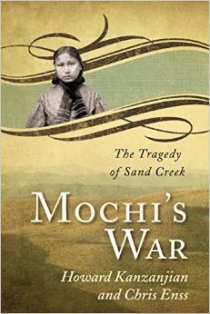
To learn more about the German family and the tragedy that drove Cheyenne Indian warrior, Mochi, read

Mochi’s War:  The Tragedy of Sand Creek


Mochi’s War: The Tragedy of Sand Creek

Enter to win a copy of

Mochi’s War: The Tragedy of Sand Creek


“Mochi was so distinguished for fiend-like fierceness and atrocity that it was not deemed safe to leave her on the plains. She was a fine-looking Indian woman but as mean as they come.”

Observation made by a military officer after Mochi’s arrest on March 5, 1875


Somewhere amid the high plain’s sage country, the Big Sandy Creek once ran red with the blood of dozens of Cheyenne and Arapaho men, women, and children. On November 29, 1864, hundreds of members of the Colorado Volunteers poured down upon a sleeping Indian camp, leaving in their wake the slaughtered remains of Native Americans who were scalped and mutilated.

The unprovoked attack on the Indian settlement was led by Colonel John Milton Chivington, who is said to have ordered every Indian at the scene killed. To those settlers and traders who had been terrorized by the Indians and because of exaggerated reports of Indian attacks on families and troops, the Sand Creek Massacre was regarded by some as proper retribution on the Indians, and Chivington was revered for his actions.

The event that forced frontiersmen and women to address the serious issues that had been building between them and the Indians occurred on June 11, 1864. Rancher Nathan Ward Hungate, his wife, Ellen, and their two little girls were slaughtered by Indians. Their mutilated bodies were brought to Denver and put on display in the center of town. The people there were thrown into a panic. In the following weeks, at the mere mention of Indians in the outlying areas, women and children were sent to homes that were fortified and guarded. Plains travel slowed to a trickle. The supply of kerosene was exhausted, and the settlers had to use candles.

A regiment of 100-day volunteers known as the Third Colorado Cavalry was organized and George L. Shoup, a scout during the Civil War, was named the outfit’s colonel. At the same time, John Evans, governor of the Colorado Territory, issued a proclamation stating: “Friendly Arapahoe and Cheyenne belonging to the Arkansas River will go to Major Colley, U.S. Indian Agent at Fort Lyon, who will give them a place of safety…. The war on hostile Indians will be continued until they are effectually subdued.”

On August 29, 1864, before the regiment saw active service, a letter from Cheyenne leader Black Kettle explaining the Indians had agreed to make peace was delivered to officers at Fort Lyon, 150 miles away from Denver. The letter noted that Cheyenne and Arapaho war parties had prisoners they would like to exchange for Indians being held by the volunteers.

Major E. W. Wynkoop of the 1st Colorado at Fort Lyon marched his troops to Black Kettle’s camp to collect the captives. While there, Wynkoop persuaded the chief to send a delegation to Denver to talk about the conditions for peace.

From Fort Leavenworth, Major General Samuel Ryan Curtis, commander of the Department of Kansas, telegraphed Chivington prior to the conference with the chiefs: “I shall require the bad Indians delivered up; restoration of equal numbers of stock; also hostages to secure. I want no peace till the Indians suffer more.” Chivington took the order to heart.


To learn more about Mochi and the vendetta war she started read

Mochi’s War: The Tragedy of Sand Creek



Iron Women

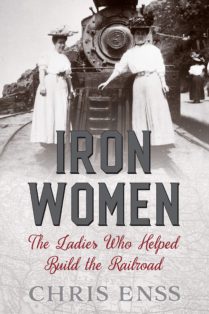
iron women book coverWhen the last spike was hammered into the steel track of the Transcontinental Railroad on May 10, 1869, at Promontory Point, Utah, Western Union lines sounded the glorious news of the railroad’s completion from New York to San Francisco. For more than five years an estimated four thousand men mostly Irish working west from Omaha and Chinese working east from Sacramento, moved like a vast assembly line toward the end of the track. Editorials in newspapers and magazines praised the accomplishment and some boasted that the work that “was begun, carried on, and completed solely by men.” The August edition of Godey’s Lady’s Book even reported “No woman had laid a rail and no woman had made a survey.” Although the physical task of building the railroad had been achieved by men, women made significant and lasting contributions to the historic operation.
However, the female connection with railroading dates as far back as 1838 when women were hired as registered nurses/stewardesses in passenger cars. Those ladies attended to the medical needs of travelers and also acted as hostesses of sorts helping passengers have a comfortable journey. Beyond nursing and service roles, however, women played a larger part in the actual creation of the rail lines than they have been given credit for. Miss E. F. Sawyer became the first female telegraph operator when she was hired by the Burlington Railroad in Montgomery, Illinois, in 1872. Eliza Murfey focused on the mechanics of the railroad, creating devices for improving the way bearings on a rail wheel attached to train cars responded to the axles. Murfey held sixteen patents for her 1870 invention. In 1879, another woman inventor named Mary Elizabeth Walton developed a system that deflected emissions from the smoke stacks on railroad locomotives. She was awarded two patents for her pollution reducing device. Their stories and many more are included in this illustrated volume celebrating women and the railroad.

Lincoln County Outlaw

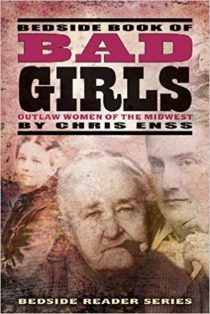
Enter to win a copy of the Bedside Book of Bad Girls:

Outlaw Women of the Midwest


Anne Cook's Poor House


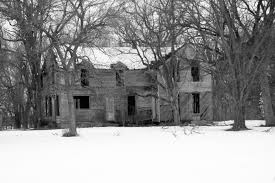
Anyone who knew Anne Cook thought she was cruel, unfeeling, and motivated by money.  The brothel she operated in North Platte, Nebraska, in the late 1920s was a profitable enterprise, but she wanted to amass a fortune and one house of ill repute would not be enough.  No legitimate business alone could make her rich either.  Anne hoped to fulfill her dream with a combination of both.  According to those who knew the Cook family well, Anne’s teenage daughter brought in a substantial amount of income working for her at the brothel.  Clients requested the thirteen-year-old on a regular basis.

By the time Clara was in her 30s she had fully adopted her mother’s quest for wealth and was equally ambitious.  In addition to entertaining callers, Clara had become a bookkeeper for Anne’s various illegal enterprises.  Among Anne’s nefarious business ventures was bootlegging, gambling, and extortion.  Clara used what she knew about her mother’s criminal behavior to extort money from Anne and grow her own bank account.  The pair often fought over the misappropriation of funds.  Clara misjudged how far Anne would go to maintain the property, money, and power she had acquired.

On May 29, 1934, Clara challenged her mother for the last time.  Family members at the sprawling farm where they lived in Lincoln County, Nebraska, told authorities that the pair had been arguing most of the day.  No one was certain of the nature of the quarrel only that Anne had settled the heated discussion by killing her daughter.


For more information about Anne Cook read the

Bedside Book of Bad Girls:  Outlaw Women of the Old West