
1932 – The Broadway musical “The Band Wagon” opened in New York City. The comedic musical film about an aging star that tries to revive his career in a Broadway production. The film ranked #17 in the American Film Institutes list of best musicals in 2006.
Making Matrimony Pay
Enter to win a book for history lovers and brides to be who believe the risk is worth it all –
Object Matrimony: The Risky Business of Mail-Order Bride Matchmaking on the Western Frontier.
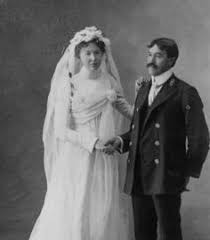
Long after an advertisement is placed in the newspaper by lonely hearts in need of a spouse, and once nerves have settled after meeting the bride or groom of choice for the first time, comes the challenge of making a mail-order marriage last. Matches that came about through a public announcement, marriage broker, or matrimonial agency in the mid-1800s were not necessarily unhappy. Though embodying more of the lottery element than the ordinary marriage is said to contain, they frequently yielded surprises to the persons involved.
Conscientious marriage brokers like Edgar Kaborchev of Bachmut, Russia, wanted his clients to be satisfied with their decision for a lifetime. Kaborchev resided in New York City and represented several men west of the Mississippi looking for a bride. According to the June 23, 1890, edition of the Longansport, Indiana, newspaper the Daily Reporter, Kaborchev provided photographs to those interested in marrying so “the individual who hired him could make a more informed decision about the person entering into such a sacred union.” Each photograph was accompanied by details concerning the social and financial standing of the person pictured.
The Daily Reporter noted that Kaborchev was “kindly received everywhere.” He was quick to point out to the eager men and women he had arranged to marry that he wanted them to be happy for years. “Knowing a potential spouse is attractive and of fair fortune before they exchange vows is the key to success,” Kaborchev proudly confessed.

To learn more about mail order brides and the advertisements they placed in various publications read Hearts West: True Stories of Mail Order Brides on the Frontier and Object Matrimony: The Risky Business of Mail Order Match Making on the Western Frontier.
This Day…
1889 – Architect Frank Lloyd Wright (21) weds socialite Catherine Tobin.
Object: Matrimony
Enter now to win a copy of
Object Matrimony:
The Risky Business of Mail-Order Matchmaking on the Western Frontier.
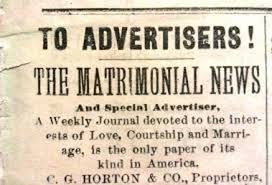
Desperate to strike it rich or eager for free land, men went into the frontier West alone and sacrificed many creature comforts. Only after they arrived at their destinations did some of them realize how much they missed female companionship.
One way for men living on the frontier to meet women was through subscriptions to heart-and-hand clubs. The men received newspapers with information about women with whom they could correspond—sometimes with photographs. Eventually a man might convince a woman to join him in the West, and in matrimony.
Complete with historic photographs and actual advertisements from both women seeking husbands and men seeking brides, Object Matrimony includes stories of courageous mail order brides and their exploits as well as stories of the marriage brokers, the mercenary matchmakers looking to profit off of the miners and settlers. Some of these stories end happily ever after; others reveal desperate situations that robbed the brides of their youth and sometimes their lives.

To learn more about the men and women looking for their perfect match read
Object Matrimony:
The Risky Business of Mail-Order Matchmaking on the Western Frontier.
This Day…
Leave No Fingerprints Behind
Enter now to win a copy of
Ma Barker: America’s Most Wanted Mother.
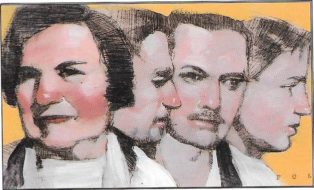
The heat generated by the kidnapping of bank president Edward Bremer—which resulted in $200,000 in ransom being paid after the wealthy man was released on January 7, 1934—chased the Barkers, or what was left of them, into hiding. Those who stayed in the Chicago area adopted easy disguises. Alvin Karpis and Fred Barker felt it necessary to take more drastic measures as they were too well-known to the FBI. In mid-March 1934, Karpis—nicknamed “Old Creepy” because of his expressionless eyes—and Fred Barker went to the secluded office of Doctor Joseph Moran to have their fingerprints altered and faces changed.
Doctor Moran had a respectable practice until he started drinking heavily, became an abortionist, and was eventually sent to Joliet prison. When paroled, Moran was hired as a physician for the Chicago Chauffeurs’ Teamsters’ and Helpers Union and set up practice in a hotel, where he led a double life, treating gangsters as well as ordinary patients.
The night he operated on Alvin and Fred he was a physical ruin. His fumbling fingers did little more than butcher his two patients, who were injected with morphine and sent off to recuperate.
Ma Barker gave them medical attention. Though Alvin was stoical, Fred often screamed from the pain and had to be restrained forcefully. In addition to nursing duties, Ma was completing arrangements with gangster Adelard Cunin, a survivor of the North Side mob in Chicago, to launder the $100,000 the Barker-Karpis Gang received as a ransom for kidnapping W. J. Hamm Jr., the president of Hamm’s Brewery in St. Paul, Minnesota. Adelard had agreed to handle the ransom money from the Bremer kidnapping job as well.
The Chicago branch of the Federal Bureau of Investigation was made the busiest field office in FBI history by the depredations of numerous well-known gangs, the perpetrators of the Kansas City massacre, and the normal flow of investigations. Melvin Purvis, the Special Agent in Charge, was the nominal chief. However, that spring of 1934 the office on the nineteenth floor of the Bangers Building was also the headquarters of a Special Squad which the Director of the FBI, J. Edgar Hoover, supervised personally.
Hoover’s dogged concentration on Midwest crime prompted Ma Barker to advise her sons and their outlaw companions to leave the city. She decided it was too dangerous for any member of the Barker-Karpis Gang, disguised or not, to remain in Chicago. Most of the gang scattered. By January 1935, FBI agents had disposed of Pretty Boy Floyd and John Dillinger’s gangs. Ma’s son Arthur had also been seized by authorities.
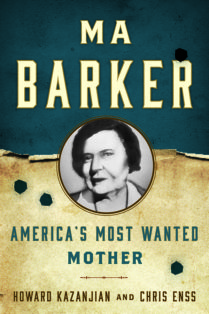
To learn more about Ma Barker and he Barker Gang read
Ma Barker: America’s Most Wanted Mother.
This Day…
1898 – US Congress passes the Private Mailing Card Act, allowing private publishers and printers to produce postcards, had to be labelled “Private Mailing Cards” until 1901, known as “souvenir cards”.
Pleasing Ma
Enter now to win a copy of
Ma Barker: America’s Most Wanted Mother
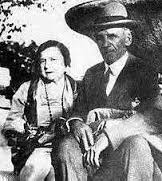
In a time when notorious Depression-era criminals were terrorizing the country, the Barker-Karpis Gang stole more money than mobsters John Dillinger, Vern Miller, and Bonnie and Clyde combined. Five of the most wanted thieves, murderers, and kidnappers by the Federal Bureau of Investigation (FBI) in the 1930s were from the same family. Authorities believed the woman behind the band of violent hoodlums that ravaged the Midwest was their mother, Kate “Ma” Barker.
Fred Barker sat in a dark corner at Tallman’s Grill in Kansas City, Missouri, enjoying the music of a jazz troupe. He was situated behind a lavishly decorated table loaded with steaks, oysters, and frogs’ legs. He was waiting for his date, Paula Harmon, also known as Polly Walker. She attracted more than casual attention when she finally arrived. The amply built, full-fleshed woman with reddish-blonde hair wore a stylish gown suited for an evening out. A silver fox-fur cape was draped over her shoulders, and on her left hand was a ring studded with eight diamonds. She was twenty-nine years old and had a reputation for treating men with flirtatious condescension, as if they were children.
In spite of objections from friends and family, Fred enjoyed Paula’s company. She possessed an average face, hazel eyes, and a scarred nose, which gave the impression that she had been struck by a heavy instrument. She greeted Fred with a kiss, and he helped her into her chair. The two always had a great deal to talk about; they had a lot in common. Fred liked to shower her with gifts as well, and Paula liked to accept them.
“Girls liked Freddie and he didn’t mind spending money on them,” Alvin Karpis wrote in his memoirs. “But he wasn’t always lucky in the type of broad who hooked him. Paula Harmon turned out to be a rotten choice, though you couldn’t tell that to Freddie when he got stuck on her. Paula was a drunk too.”
Fred wasn’t the first gangster to overlook Paula’s drinking. She was the widow of bank robber Charles Harmon. Charles died from a gunshot wound in the neck he received fleeing the scene of a bank robbery in Menomonie, Wisconsin. Paula, a native of Georgia, earned her living operating a house of ill –repute in Chicago. Patrons referred to her as “Fat Witted” because she had a sharp tongue when provoked.
Paula and Fred met at Herbert Farmer’s homestead near Joplin, Missouri, shortly after her husband died. The Farmers were good friends who helped her through the loss and protected her from questions the police might have wanted to ask her. Fred thought Paula was charming, and she liked the attention he gave her.
After helping rob the bank in Fairbury, Nebraska, Fred made it clear to his associates that he wanted to spend time with a woman, away from the business. Verne Miller’s paramour suggested he reacquaint himself with Paula. Fred and Paula met again in mid-April 1933 in St. Paul and then traveled to Kansas City for a brief vacation. The pair used the alias of Mr. and Mrs. J. Stanley Smith. Mrs. Smith was a housewife, and Mr. Smith posed as a salesman for the Federated Metal Company of St. Louis.
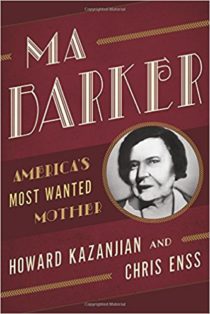
To learn more about Ma Barker and the Barker-Karpis Gang read
Ma Barker: America’s Most Wanted Mother.
This Day…
1929 – Al Capone is today in prison following his plea of guilty to the minor charge of carrying a concealed weapon, it is believed he pled guilty to these offences to help him stay safe in prison, he is best known for his domination of the Chicago Beer Runners and is believed to have been behind the St Valentines Day massacre.
Alvin Karpis, Ma Barker’s Other Son
Enter to win a copy of
Ma Barker: America’s Most Wanted Mother
In a time when notorious Depression-era criminals were terrorizing the country, the Barker-Karpis Gang stole more money than mobsters John Dillinger, Vern Miller, and Bonnie and Clyde combined. Five of the most wanted thieves, murderers, and kidnappers by the Federal Bureau of Investigation (FBI) in the 1930s were from the same family. Authorities believed the woman behind the band of violent hoodlums that ravaged the Midwest was their mother, Kate “Ma” Barker.
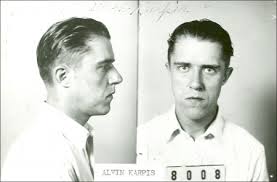
A dilapidated Ford Model T pickup slowed to a stop in front of the Barker home in Tulsa, Oklahoma, in mid-May 1931, and Alvin Karpis climbed out of the bed of the vehicle. Alvin was a tall, self-confident man, well dressed but not flashy. He carried a small duffle-style suitcase containing all the belongings he had in the world. He studied the weathered house in front of him, taking notice of its state of disrepair. The homes on either side were not in perfect condition; it was a low-income neighborhood, and everyone seemed to be struggling, but the Barkers’ house was in a sorry state in comparison. A man and woman inside the Barker home were arguing. The exact nature of the disagreement was not clear, but the sound of doors slamming and glass breaking made it apparent that the fight had escalated into a war.
Alvin removed a cigarette from his suit jacket pocket and lit it while contemplating what to do next. Ma Barker exited the front door carrying a hammer and nails. She didn’t pay much attention to Alvin. Her lower lip was bleeding, but she didn’t pay much attention to that either. She was focused on fixing a portion of the screen that had been torn from the corner of the door. “Are you Mrs. Barker?” Alvin asked, walking toward Ma and taking a drag off his cigarette. “I am,” Ma said turning around to face Alvin. “I want to get ahold of Freddie,” he told her. Ma looked Alvin over suspiciously. “Who are you?”
“I’m the guy who called with Freddie in Lansing,” Alvin told her.
“Oh, yes, he told me about you,” Ma replied. “He told me you’d be getting out soon. He came to visit me when he got out. He’s a good boy.” Ma let her guard down, and Alvin stepped onto the porch. He told her he was a thief and that he’d been sent to the Kansas State Penitentiary in Lansing for attempting to rob a pool hall. It was just one of many crimes Alvin told Ma that he’d committed.
To learn more about the life and violent death of Ma Barker
and her sons read
Ma Barker: America’s Most Wanted Mother