
This Day…
1896 – Tootsie Roll introduced by Leo Hirshfield.
This Day…
1828 – 1st American Indian newspaper in US, “Cherokee Phoenix” was published.
Arizona & Nevada: Two Paths to Suffrage
Enter now to win a copy of the new book
No Place for a Woman: The Fight for Suffrage in the Wild West.
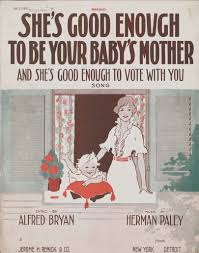
On September 18, 1909, Laura Gregg of the Arizona Equal Suffrage Campaign Committee rolled a sheet of letterhead into her typewriter and began an affectionate letter to Anna Howard Shaw, president of the National American Woman Suffrage Association. Shaw, who had been injured in an accident, was recuperating in Minneapolis, and Gregg wrote to her:
“If I had known that you were roasting on a bed of suffering in Minneapolis, I should certainly have sent you a little love note, as well as to send you all of the helpful thoughts that I could. At this late date, however, it is not too late to tell you how much I rejoice that your recovery has been so speedy, and that through it all you have had such Spartan courage to do such wonderful things as I am reading about, while you must have been suffering so much.”
Shaw, as head of the biggest national organization promoting woman suffrage, had been traveling the country stumping for the cause and speaking from her heart to the state organizations that had sprung up in nearly every state and territory. She had won the hearts of her fellow suffragists with her warm and intelligent rhetoric and open attitudes. And while she was working on the national stage, organizations like the Arizona Equal Suffrage Campaign Committee were going into homes, posing legal arguments, asking questions, and changing minds.
In the late nineteenth and early twentieth centuries, as the territorial governments of the West formed and territorial laws were established, and then as territories made the move into statehood, suffrage advocates across the country had their eyes on the opportunities that came with crafting the law of the land from the ground up. If women hadn’t been excluded from the vote by law in each territory, went the reasoning, they didn’t need to be under the new laws and statutes that were being written.
After the Civil War, the discussion about women and the vote had been firmly on the political table for almost two decades. Women all over the United States had been protesting, lobbying, and had even been arrested for attempting to vote in elections. Pressure grew, as early as the 1870s, for a national suffrage amendment in Congress. But faced with great opposition—or apathy—on a nationwide scale, many suffrage advocates saw the laws being written on the frontier as the best chance for the vote to take hold in law.
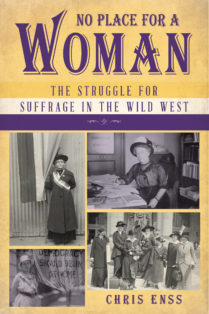
To learn more about how women won the right to vote in the West read
No Place for a Woman
This Day…
1856 – Tin-type camera patented by Hamilton Smith, Gambier, Ohio
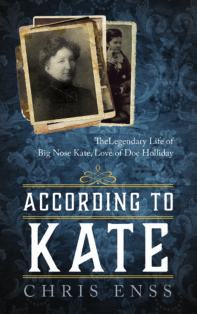
According to Kate 2020 Elmer Kelton Award Winner
This Day…
1897 – National Organization of Mothers forms (Parent Teacher Association)
Twice Won: Woman Suffrage in Utah
Enter now to win a copy of the new book
No Place for a Woman: The Fight for Suffrage in the Wild West.
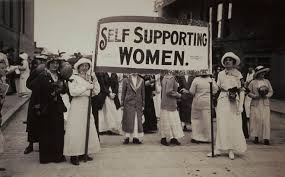
On April 5, 1895, the lavish Grand Opera House in Salt Lake City was filled to overflowing with a host of well-dressed ladies and gentlemen. Women engaged in serious discussions outnumbered the men filtering into the building. Musicians in the orchestra pit serenaded the preoccupied crowd standing, talking, and preparing to sit upon rows of waiting chairs. As the clock approached two o’clock in the afternoon, more than a dozen women filtered on stage and took their places among the plush seats stationed in front of a magnificent, hand-painted drop curtain. Conversations quieted, and the room slowly came to order. When the music faded, Mrs. J. A. Froiseth called the meeting of suffragists in the Utah Territory to order. The following articles were read to the audience.
“Whereas, a convention is being held in this city for the purpose of framing a constitution for the proposed state of Utah, and; whereas, the question is being considered by said convention of incorporating in said constitution a provision for women suffrage, and; whereas, no opportunity has been afforded the women of this Territory to manifest their opinion upon the matter; and whereas, by the adoption of a plank of favor of woman suffrage in the platforms of both political parties, no opportunity was afforded to the citizens of this Territory to indicate their approval or disapproval of the proposition, and; whereas, it is conceded alike by the advocates and the opponents of woman suffrage that in all intellectual attributes and attainments the women are entitled to vote, and if this is true, then they possess the necessary intelligence and attainments to enable them to determine for themselves whether they desire this privilege, and they should be given the opportunity to decide this question for themselves.”
The crowd of onlookers cheered and applauded the articles read aloud. They waved their hands in the air approvingly and congratulated one another for their dedication to the cause. Someone shouted, “Give me suffrage or give me nothing.” That single voice then led many in a chant of “Give me suffrage or give me nothing!”
An enthusiastic supporter of the cause leapt to her feet and proclaimed, “The fight is still on!” Fellow believers praised the sentiment. “Ninety percent of the people hesitate to try the experiment these men would force upon us,” the spontaneous orator announced. “You who propose to vote against statehood make your voice heard now, with no uncertain sound. If we are to have equal suffrage, let us have it equal. Let the women serve on juries, let them work their poll tax on the roads, make them subject to military service, let them be drafted and enlisted in time of war, let them be equal in all things!”
More than twenty-five years prior to the enthusiastic gathering at the Grand Opera House where women argued for their right to vote, a somber group of leaders in the Utah Territorial Legislature quietly passed an act giving women that entitlement. Sarah Young, grandniece of settler and Mormon Church leader Brigham Young, became the first women to vote in the region. She voted in a municipal election on February 14, 1869.
To learn more about how women won the right to vote in the West read
No Place for a Woman
This Day…
Becoming Citizens: Woman Suffrage in California
Enter now to win a copy of the new book
No Place for a Woman: The Fight for Suffrage in the Wild West.
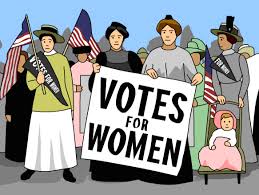
When suffragist Susan B. Anthony boarded the passenger car of the Union Pacific Railroad in Ogden, Utah, in late December 1871, the train was filled to capacity. Men, women, children, livestock, baggage, and crates containing food and supplies were being loaded onto the vehicle bound for Chicago. Weary and carrying an oversized satchel bulging with clothing, books, and papers, the fifty-one-year-old woman climbed aboard and began the slow procession past the throngs of people occupying various seats and berths. She snaked her way toward the semi-private compartments until she found the one she was to occupy for the duration of the trip. The pair Anthony would be traveling East with had already arrived and made themselves comfortable. She smiled at the congenial-looking couple as she entered. California congressman Aaron A. Sargent politely got to his feet to help her stow away her bag. He introduced himself, then introduced his accomplished wife, Ellen, to Anthony, who returned the kindness.
Not long after Anthony was settled, Ellen admitted to being familiar with her work. Anthony’s crusade to acquire the right to vote for women had been covered in the Sacramento newspapers as well as the publications in Nevada City, California, where the politician and his family lived. She had joined the fight for woman’s suffrage in 1852. Since that time, she had traveled from town to town, inspiring women to fight for equal rights. The crusade, which initially began in Seneca Falls in New York in 1840, had expanded westward. Once Wyoming granted women the privilege to cast their ballots, suffrage rose up in territories beyond the Mississippi to battle for the opportunity to do the same. Crusaders reasoned if women could gain that right state by state the federal government would be persuaded to pass an amendment making it law.
From June to December of 1871, Anthony had traveled more than thirteen thousand miles, delivered 108 lectures, and attended close to two hundred rallies on the issue of woman’s suffrage. There were others such as Emily Pitts Stevens, who helped form the California Woman Suffrage Association, and physician and minister Anna Howard Shaw who had joined the fight and were hosting meetings to inform and educate women about the movement. It was essential that the message of equality be heard in every mining community, fishing village, and major city from San Francisco to Los Angeles. Women needed to be encouraged to petition for enfranchisement. They needed to be reminded they were entitled to speak for themselves and stand against fathers and husbands voting for them. Anthony and the other dedicated suffragists had been able to share the message with women in Kansas, Wyoming, Utah, Washington, and Oregon; they had great hope the ladies in California would back reform.
Anthony couldn’t have found a more receptive audience for her message than Congressman Sargent and his wife. Ellen had founded the first suffrage group in Nevada City, California, in 1869, and Aaron was in full support of giving women the vote. The Sargents had moved to California from Massachusetts in 1849 and settled in Nevada City in 1850. In addition to owning and operating the newspaper the Nevada Daily Journal, Aaron was an attorney and former U. S. senator. Ellen was a homemaker and mother who was active in the Methodist Church. She firmly believed that women could not attain their highest development until they “had the same large opportunities and the same large chances as her brothers have.”
To learn more about how women won the right to vote in the West read
No Place for a Woman