
Soiled Dove in a Cow Town

Enter now to win a copy of the book According to Kate:

The Legendary Life of Big Nose Kate Elder, Doc Holliday’s Love

Along with a Kindle Paperwhite.


In the winter of 1872, Wendell Phillips, orator, attorney, and the soul of John Brown marching on, delivered a lecture to a large audience of concerned citizens in St. Louis, Missouri, about the social cancer that plagued society.  He pounded the lectern he stood behind while addressing the crowd and advised them to take a stand against intemperance, crime, and prostitution.  Phillips was appalled that city officials had legalized the profession and were issuing licenses to the owners of houses of ill repute and the bawdy women who worked there.  Almond Street, a popular thoroughfare five blocks west of the riverfront, was the location of many of those houses.  It was Phillips’ hope that after the residents of St. Louis heard his fiery speech they would demand the businesses be closed.

“The root of this vice is poverty,” Phillips proclaimed.  “It is because the poverty of a certain class makes them the victims of the wealth and leisure of another.  Give one hundred men anywhere an honest career and a chance at the grand opportunities of life, and ninety out of the hundred will distain to steal.  Give one hundred women a fair chance at the grand opportunities that their brothers have and ninety out of the hundred will disdain to barter virtue for gold.”  Mary Katherine Horony, now known as Kate Fisher, was one of those near Almond Street who bartered virtue for gold.  Poverty had played a part in her decision to become a sporting woman, but she was satisfied the work possessed possibilities beyond money.  Kate was a business woman — nothing more, nothing less.

St. Louis had given Kate and other sporting women the opportunity to do their job without fear that law enforcement would interfere.  The “social evil ordinance” the city had passed in March 1870 not only required prostitutes to obtain licenses but also mandated business women to submit to medical exams testing for venereal diseases.  Civic leaders hoped the controversial ordinance would ultimately reduce the spread of disease.  Many opposed the idea, arguing that it “encouraged the very vice which all good men and women destined to see suppressed.”  Many soiled doves never bothered to register.  Kate was one of those women.

The spirited, Hungarian woman must have been able to take care of herself against intoxicated and belligerent clients.  Prostitutes sometimes found themselves in the company of men who resented their services.  They hated themselves for hiring sporting women and blamed those women for the ills of society.  A listing of arrests in daily, St. Louis papers showed how many acts of violence against prostitutes occurred nightly.  The August 29, 1872, edition of The Macon Republican contained information about the circumstances surrounding the beating deaths of more than ten, bawdy ladies in the area of Popular Street in St. Louis.

“Eleven wretched criminals victimized prostitutes overnight,” The Macon Republican article began.  “A man named Burklin shot a sinful woman when crazed with drink and jealousy; another killed a woman with a grubbing hoe; a third tossed the prostitute out a third story window; three were stabbed to death; the seventh prostitute was beaten to death with a soda water bottle; two were strangled; two were hanged by the neck with a rope.”
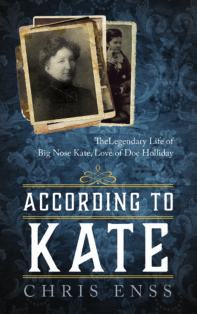
 

To learn more about Kate read

According to Kate:  The Legendary Life of Big Nose Kate Elder,

Doc Holliday’s Love
 

The Girl from Hungary

Enter now to win a copy of the book According to Kate:  The Legendary Life of Big Nose Kate Elder, Doc Holliday’s Love and a Kindle Paperwhite.


Kate Elder sat on the balcony of the Dodge House hotel in Dodge City, Kansas cradling a rifle in her lap.  It was a warm night in mid-June 1878.  She was wearing a white, cotton and lace slip dress that accentuated her curves and did little to cover her other assets.  The sound of an inexperienced according player squeezing out a tune mixed with the laughter from the patrons in the billiard hall next door filled the night air.

Kate studied a pair of drunken soldiers as they exited the billiard hall, climbed aboard their horses waiting for them, and rode off in the direction of Fort Dodge, the military post five miles east of town.  Once the soldiers were out of sight, she relaxed the hold she had on the gun and rubbed her tired eyes.  Kate had too much character in her face to be outright pretty, but she attracted men like flies.  At that moment, the only man’s affections she cared to attract were John Henry Holliday’s, a Georgia dentist and gambler prone to settle disagreements in a violent manner.

An unfortunate incident with the law had made it necessary for Kate and Doc to leave Fort Griffin, Texas, in a hurry and seek refuge in Dodge City.  Their abrupt exit from the southwestern cavalry fort had Kate worried the authorities would be searching for them and, when they were found, Doc would be made to return to answer for his wrongdoings.  Kate wasn’t going to let that happen.

Since arriving in Dodge City in late May 1878, Kate had reacquainted herself with the cow town where she’d lived and worked in 1875.  Dodge City was a wild burg that straddled the Santa Fe rails.  Cowpunchers found it to be the best place to end a drive.  The saloons were endless and always open.  Gamblers found numerous individuals to challenge, sporting women swarmed like bees, and bad men frequently sharpened their aim on citizens.  The men behind the badges in Dodge City were well-known Western figures.  Wyatt Earp, Bat Masterson, and Bill Tilghman all took a turn at maintaining law and order in the trigger-happy town.  How Kate Elder, from Pest, Hungary, came to be a fixture in a wide-open town primed with free-flowing money from the cattle trade and inundated by hordes of gunmen, outlaws, rustlers, and ladies of easy virtue was a question Kate pondered on a regular basis.

She shifted the gun in her lap and stared out at the massive, night sky and the stars that riddled the great expanse, contemplating a similar sky that hung over the steamer that brought her parents, brothers and sisters, and her from Bremen, Germany, to America when she was ten years old.  Kate remembered her life before when she was filled with hope and the promise of prosperity and success.


To learn more about Kate read

According to Kate:  The Legendary Life of Big Nose Kate Elder,

Doc Holliday’s Love
 

According to Kate

Enter now to win a copy of the book According to Kate:  The Legendary Life of Big Nose Kate Elder, Doc Holliday’s Love and a Kindle Paperwhite.


Kate Elder was a working girl.  Throughout most of her young life, she was employed as a soiled dove — a woman of ill fame, a sporting gal, a prostitute.  She wasn’t alone in that profession; hundreds of women entered the trade in the 1800s.  Some felt they had no other option but to become a lady of the evening, and others joined the fallen industry believing they could make a fortune capitalizing on the vices of intrepid cowboys and pioneers.

It was Kate’s relationship with John Henry (Doc) Holliday that brought her notoriety and lifted her out of the role as mere courtesan to that of common law wife to the well-known gambler, gunfighter, and dentist.

Kate’s story of her life on the frontier as a soiled dove and her time with one of the West’s most recognizable characters has value.  She was in her eighties when she dared to recall all that had transpired since leaving Hungary where she was born to the events leading up to the historic gunfight at the OK Corral.  There are those who insist that because of her age her recollections are faulty and that little of anything she said occurred the way she reported it.  I maintain it would be wrong not to share all the eighty-four-year-old Kate had to tell about an adventurous time in history merely because she was an octogenarian.  Some of us at fifty-seven can’t remember what day it is even though we’ve checked the calendar upwards of twenty times since starting work.  Yet, I can vividly recall that during seventh grade, music class Pam Green loudly pointed out that I was growing a mustache.  (It’s important to note here that I’m a woman, so this was extremely detrimental to my self-esteem at the time.)

According to Kate is a biography about the life and times of Kate Elder.  She would have written the book herself if a publisher would have been willing to pay her handsomely for her tale.  Kate believed her story was worth a great deal.  No one besides Kate saw it that way.  Throughout the book I’ve used all the information contained in Kate’s journals, personal letters, and interviews to tell of her life from her childhood in Hungary to her waning years at a retirement home for the elderly in Arizona.  Where some of her details were ambiguous, I used newspapers and historical documents to corroborate her story.


To learn more about Kate read

According to Kate:  The Legendary Life of Big Nose Kate Elder,

Doc Holliday’s Love

This Day…

1838 – Sep 23, Victoria Chaflin Woodhull (d.1927), American presidential candidate (1872), was born into a family of charlatans in Ohio. Woodhull, a militant suffragist, advocated free love and was Wall Street’s first female broker after attracting Cornelius Vanderbilt. She was the first woman to address Congress. Her story is documented in “The Woman Who Ran for President: The Many Lives of Victoria Woodhull” by Lois Beachy Underhill. In 1998 Mary Gabriel published “Notorious Victoria: The Life of Victoria Woodhull, Uncensored. In 1998 Barbara Goldsmith published “Other Powers–The Age of Suffrage, Spiritualism and the Scandalous Victoria Woodhull.”

Wicked Woman Mollie Moses

According to Kate is coming to bookstores everywhere on October 1.

In honor of her imminent arrival this month is dedicated to

Wild Women like Kate Elder.


Mollie Moses, a disheveled woman in her 40s, sat alone in her rundown Kentucky home, crying.  She wiped her eyes with the hem of her tattered black dress and glanced up at a portrait of William Cody hanging over a cold fireplace.  On the dusty coffee table in front of her lay several letters carefully bound together with a faded ribbon.  The woman’s feeble fingers loosened the tie and slowly unfolded one of the letters.  Tears slid down her cheeks as she read aloud.

My Dear Little Favorite…I know if I had a dear little someone whom you can guess, to play and sing for me it would drive away the blues who knows but what someday I may have her eh!…  I am not very well, have a very bad cold and I have ever so much to do.  With love and a kiss to my little girl – From her big boy, Bill.

William Cody – 1885

Mollie closed her eyes and pressed the letter to her chest, remembering.  From the moment she first saw Buffalo Bill Cody at a Wild West performance, she had been captivated by him.  He was fascinating – a scout, hunter, soldier, showman, and ranchman.  Mollie was swept away by his accomplishments, reputation, and physical stature.

In September of 1885 the enamored young woman from Morganfield, Kentucky, set about to win the heart of the most colorful figure of the era.

Mollie was an attractive widow, intelligent and sophisticated.  The letters she wrote to Cody reflected her maturity and interested Buffalo Bill.  Her correspondence did not read like that of a love-struck girl but of an experienced woman.  The death of her husband and only child many years prior had transformed the once impetuous girl into a driven, determined woman.  Mollie was also educated and well read, and an accomplished artist and seamstress.

Cody found those aspects of her character quite appealing.  He responded to her letters often, forwarding his itinerary to her as well, with hopes the two could meet at some point.  When at last they did, he was pleased to see that she was as lovely as she was intelligent.  On November 11, 1885, the couple began a six-month affair.

Your kind letter received.  Also, the beautiful little flag which I will keep and carry as my mascot, and every day I wave it to my audiences I will think of the fair donor.  I tried to find you after the performances yesterday for I really wished to see you again…It is impossible for me to visit you at your home much as I would like to have done so.  Many thanks for the very kind invitation. 

I really hope we’ll meet again.  Do you anticipate visiting the World’s fair at New Orleans if you do will you please let me know when you are there…Enclosed please find my route.  I remain yours.

William Cody – November 1885

As the romance between Mollie and Bill grew, she extended numerous invitations for him to come and visit her.  Managing the Wild West Show demanded a lot of his time, and he was unable to get away as often as Mollie wanted.

My Dear…you say you are not my little favorite or I would take the time to come to see you.  My dear don’t you know that it is impossible for me to leave my show.  My expenses are $1,000 a day and I can’t.  I would come if it were possible and I can’t say when I can come either, but I hope to someday.

William Cody – March 1886

Cody could not break free from his business, but Mollie persisted.  She requested that some of his personal mementos be sent instead.

“If you cannot be here, I must have something of you near me,” she wrote him.

My Dear Little Favorite…Don’t fear I will send a locket and picture soon.  Little Pet, it’s impossible for me to write from every place.  I have so much to do.  But will think of you from every place.  Will that do?  With Fond Love…Will.

William Cody – April 1886

Molly worried about Cody’s wife, Louisa, and the hold their twenty-year marriage had on him.  In one of Cody’s letters to Mollie, he tried to ease her troubled mind and heart.

My Dear Little Favorite…Now don’t fear about my better half.  I will tell you a secret.  My better half and I have separated.  Someday I will tell you all about it.  Now do you think any the less if me?  I wish I had time to write you a long letter to answer all your questions and tell you of myself, but I have not the time and perhaps it might not interest you…With love and a kiss to my little girl from her big boy.

William Cody – April 1886

Despite his constant reassuring, Mollie was not convinced that Cody and his wife were destined for divorce.  When it became clear to her that Cody could not or would not fully commit to her, she requested a spot in his show.

She reasoned that this was the only way she would be able to be with him all the time.  Mollie was not without talent.  She was a fine horsewoman, and that, along with her romantic involvement with Cody, helped persuade him to invite her to join his troupe.

Mollie and Buffalo Bill were to meet in St. Louis, a scheduled stop for the show.  Mollie was to come on board as a performer at that time.  To make her feel welcome and show his affections, Cody purchased his lover a horse.  The act endeared him to her even more.

My Dear Mollie…I presume you are getting about ready to come to St. Louis.  Wish you would start from home in time to arrive in St. Louis about the 2nd or 3rd of May.  Go to the St. James Hotel if I ain’t there to meet you.  I will be there any how by the 3rd.  I have got you the white horse and fine silver saddle.  Suppose you have your habit.  Will be glad to see you.  With love, W.F.C.

William Cody – 1886

Mollie’s days with Wild West Show were difficult.  Adapting to the rigorous traveling schedule was hard and riding her horse day after day left her stiff and sore.  Eventually Mollie lost interest in the famous program and tired of trying to win over the heart of its general manager.

Within a few years after parting with Cody, Mollie’s financial situation worsened dramatically.  Mollie Moses returning to her home in Kentucky, where she fell into a life of poverty.  She was forced to sell off many of the mementos Cody gave her and live off the generosity of strangers to keep herself in food.  The two souvenirs she would never part with were the silver saddle and Cody’s picture.

Rodents shared her house with her – rats she called her “pets.”  One evening her pets bit her severely, causing her to become ill.  She eventually died of complications from the bites.  She was forty-three years old.  Historians speculate that the demise of her relationship with Buffalo Bill left her despondent and without the will to live.


According to Kate arrives in book stores on October 1.

Enter to win a copy of Kate’s story now.


Wicked Woman Belle Siddons

According to Kate is coming soon to bookstores everywhere. 

In honor of her imminent arrival this month is dedicated to

Wild Women like Kate Elder.  


Blood spattered across the front of the dark-eyed, brunette gambler Belle Siddons, as she peered into the open wound of a bandit stretched in front of her. Biting down hard on a rag, the man winched in pain as she gently probed his abdomen with a wire loop. She mopped up a stream of blood inching its way to the crude wooden table where he was lying.

Two men on either side of the injured patient struggled to keep his arms and legs still as the stern-faced Belle plunged the loop further into his entrails. “How do you know about gunshots,” one of the rough looking assistants asked? “My late husband was a doctor and I worked with him,” Belle replied. “Is he going to die,” the other man inquired? “Not if I can help it,” Belle said as she removed the wire loop. She shifted through the tissue and blood attached to the instrument until she uncovered a bullet. She smiled to herself as she tossed it into a pan sitting next to her and then set about stitching the man’s wound closed.

When Belle decided to go west in 1862, she envisioned a comfortable frontier home, a life-long husband and several children. But fate had other plans for the head-strong woman many cowhands admitted was a “startling beauty.”

Belle’s story began in Jefferson City, Missouri where she was born sometime in the late 1830s. Her parents were wealthy land owners who made sure their daughter was well educated. She attended and graduated from the Missouri Female Seminary at Lexingtion, Missouri. Belle’s uncle was the state’s Governor, Claibourne Fox Jackson. She spent a great deal of time with him traveling in elite circles that elevated the charming teenage to the toast of society.

When the war between the states erupted, Missouri residents were divided between support for North and South. Belle and her family were Southern sympathizers, actively seeking ways to crush the Union’s agenda. The attractive, young Ms. Siddons, fraternized with troops training in the area, hoping to glean valuable information from them. They were enamored with her and in their zeal to impress her, shared too much about military plans and the position of soldiers. Belle passed those secrets along to rebel intelligence.

Her deceptive actions were found out by General Newton M. Curtis of the Union Brigade from New York. A warrant was issued for Belle’s arrest in 1862 and she was apprehended 50 miles south of St. Genevieve on the Mississippi. When Belle was captured, she was found with proof of her duplicitous behavior in her possession. She had detailed plans of the stops of the Memphis and Mobile Railroad. The rail line was being used by the Union Army to transport supplies and weapons. When questioned about the crime Belle proudly admitted being a spy. She was tried, found guilty and sentenced to a year in prison. She was released after having only served 4 months.


According to Kate arrives in book stores on October 1.

Enter to win a copy of Kate’s story now.