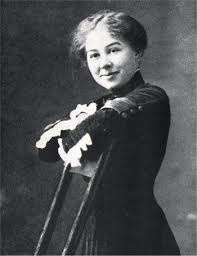
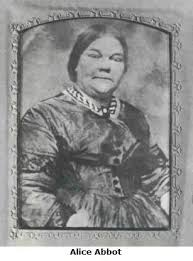
Big Alice Abbott Shot by Etta Clark

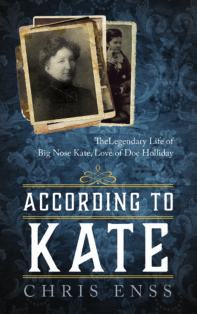
According to Kate is coming soon to bookstores everywhere. 

In honor of her imminent arrival this month is dedicated to

Wild Women like Kate Elder.  


It wasn’t uncommon in the Old West for sporting women to fight with one another over territory or money.  In El Paso, Texas, competition was especially keen between two popular madams, Big Alice Abbott and quick-tempered Etta Clark across the street.  The continuous argument finally erupted in a fight, the mention of which brought uproarious guffaws in the saloons for months to come.  Around 9:30 on the warm spring evening of April 18, 1886, a police squad was sent to investigate a disturbance at one of the houses on Utah Street.  The whole area was in an uproar as a huge woman lay shot and bleeding in the dusty street, while a petite redhead, cruelly beaten, sobbed hysterically in one of the houses.

The officers somehow pieced together the story.  Bessie Colvin, one of Big Alice’s in-residence girls, owed her $125 “back rent,” but refused to pay up.  Bessie, full of whiskey and false courage, stood firm as she and Alice put on a screaming and cursing match which awed all passersby.  Bessie flounced out, dashed across to Etta Clark’s brothel, and offered her services.  Redheaded Etta promptly accepted, so Bessie tore back to her former home, told Big Alice she was leaving, then promptly took off again.  Big Alice, with her girls Nina Ferrall and Josie Connaly at her heels, huffed and puffed across the street.  Alice yelled and pounded on Etta’s door until it was opened a crack.  Big Alice flung herself against the door, ripping it from the hinges and mashing Etta’s face in the process.  At this moment, Alice spied her former girl walking out of Etta’s sitting room.

Enraged, Alice stomped on through the broken door, shoving Etta violently aside.  The redheaded Etta, deciding she needed protection, reached for a brass gas-lighter.  (This was a heavy wick-tipped rod 2 ½ feet long and ½ inch in diameter, used to light the gas burners.)  The tiny Etta drew herself up and shook the lighter in Big Alice’s face.  Bessie was whimpering in the corner.  Now Alice, blind with anger, raised her huge fist and hit Etta in the face as hard as she could.  Bessie ran to help Etta, but was grabbed by Alice, who ran out the door, pulling Bessie along with her.

Etta ran to her room and came back with a Colt .45 in her hand.  She pointed the weapon at Big Alice, who was facing her on the porch.  The gun went off, enveloping both women in a cloud of smoke.  Alice looked down in horror at the blood spreading from a spot between her thighs.  She staggered to the center of the street as Etta fired again and missed.

It took six strong men to carry the big woman to her house.  It made a dramatic scene:  the helpless female, the girls weeping and wailing, and the men straining and stumbling under their mammoth burden.  Doctor A. L. Justice was called and, upon arriving at the scene, reported that Big Alice was seriously wounded.  Etta Clark was put in jail pending a hearing.

By April 27, nine days later, Big Alice was out of danger and the preliminary trial was held in her room.  Justice L. H. Clark bound Etta over to the Grand Jury under $2,000 bond.

Nothing funny about this, you say?  True enough-but it was the aftermath of this unfortunate incident that sent El Paso rocking with laughter.  The Herald’s story was printed under a banner headline with all the details in typically turgid prose.  The reporter, trying to be precise in pinpointing Alice’s wound, wrote that Big Alice had been shot in the “public” arch.  In Alice’s case, this anatomical description was precise, indeed.


To learn more about soiled doves of the Old West read

Wicked Women.


Wicked Woman Rosa May

According to Kate is coming soon to bookstores everywhere. 

In honor of her imminent arrival this month is dedicated to

Wild Women like Kate Elder.  


Rosa May sat beside the bed of a dying miner and wiped the sweat off his feverish brow. She looked around his rustic, one-room cabin, past the sparse furnishings, and fixed her eyes on a tattered photograph of an elderly man and woman. “Those are my folks,” the man weakly told her. “They’re in Marshall County, Illinois. Where are your folks?”

The question stunned Rosa. No one ever asked about such things. No one ever asked her much at all. Conversation wasn’t what men were looking for when they did business with her. Rosa glanced out the window at a couple of respectable, well-dressed women. They watched her through the clouded glass, pointed, and whispered. She knew what they were saying without hearing it.  Rosa was just one of a handful of “sporting women” living in Bodie, California, in 1900 and she knew what people thought of her. It used to bother her years ago, but not now. It was an occupational hazard she’d learned to live with.

“Don’t you have people anywhere?” the miner asked. Rosa dabbed the man’s head with a cloth and smiled. “I don’t know anymore,” she answered. “If I did have, they’d be back in Pennsylvania.”  Rosa’s parents were Irish – hard, strict people. Rosa had dreamed of the day she would be out of their puritanical household. She had left home in 1871, at the age of sixteen and soon found there weren’t many opportunities for a poor, petite, uneducated girl with brown eyes and dark, curly hair. She ended up in New York, hungry, homeless, and eager to take any job offered. The job offered was prostitution and five years later she came west with other women of her trade, hoping to make a fortune off the gold and silver miners.

Prostitution was the single largest occupation for women in the West. Rosa hoped to secure a position at a posh brothel with crystal chandeliers, velvet curtains, and flowing champagne. The madams who ran such places were good to their girls. They paid them a regular salary, taught them about makeup, manners, and how to dress, and they only had to entertain a few men a night. If a high-class brothel wasn’t available, Rosa could take a job in a second-class house and work for a percentage of the profits, turning as many tricks as she could each night. If all failed, she could be a street walker or rent a “crib” at a boardinghouse. Cribs, tiny, windowless chambers, had oilcloths draped across the foot of the bed for customers in too big of a hurry to take off their boots.

Rosa May arrived in Virginia City, Nevada, in 1875 and went to work for a madam known as Cad Thompson. Cad was a widow who ran several parlor houses in town, including a three-story, brick structure called the “Brick House.” Cad and Rosa became fast friends, confiding in one another and talking about meeting their Prince Charming. “Whores dream of falling in love, too,” Cad frequently told Rosa.


To learn the rest of Rosa May’s story read
Wicked Women:
Notorious, Mischievous, and Wayward Ladies from the Old West


Wicked Woman Diamond-tooth Lil

According to Kate is coming soon to bookstores everywhere. 

In honor of her imminent arrival this month is dedicated to

Wild Women like Kate Elder.  


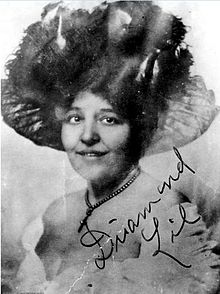
The soiled dove with the heart of gold is a stock character in thousands of stories about the Old West, and Idaho had such a character.  “Diamond-tooth Lil” was her name, and she was more famous for her tooth of gold than for her heart of gold.  Like most characters in western lore, Lil devoted her lifetime to perfecting her own legend and image.  Her gold tooth, prominent in the middle of her smile, was set with a large diamond to gain Lil instant recognition in any company.  And Lil loved it.  From childhood she had thirsted for fame.

All we know about Lil’s colorful life comes from her own stories, recounted through the years to just about anyone who would listen.  Whether her stories were true or not does not seem too important, for they make good telling.  Mae West’s characterization of “Diamond Lil” was based on the life of Idaho’s Lil, and in all accounts of her life, the stress lay on Diamond-tooth Lil’s beauty and glamor.  Words like “fabulous and exciting” are regularly used to describe her, although it was not Lil’s looks but her vitality and sense of showmanship which evoked such adjectives.

Evelyn Hildegarde was born Katie Prado near Vienna, Austrian, about 1880.  It appears that she and her parents-an Austrian father and a Bohemian mother-came to America when Katie was six-years-old.  When Katie ran away from home, she was only thirteen, but she was quite mature for her age and looked sixteen.  She had eloped with nineteen-year-old Percy Hildegarde and used his last name the rest of her life.

By her own account, Lil had a total of eight husbands, never worrying about ridding herself of a husband, but just taking another when the mood struck her.

Among the men in her life were some pretty colorful characters:  prizefighter Kid McCoy, Spider Kelly, Diamond-field Jack Davis, Tex Rickard, and Tom Sharkey.  Diamond-tooth Lil’s friendship with Diamond-field Jack was a natural.  The swaggering Jack had plenty of color all his own; although notorious as a gunman, his chief claim to fame was that he was almost hung for a murder he did not commit.  Perhaps Jack was the inspiration for Lil’s famous tooth, for she did not have one when they met in 1907 in the boomtown of Goldfield, Nevada.

Lil had been singing and dancing in music halls and gambling palaces for several years before she ran up against Jack.  She was the “toast of the Barbary Coast,” and a star at the St. Louis World’s Fair in 1904, singing at the Anheuser-Busch Pavilion.  But somewhere along the way she got in on the gold rush to Alaska, then came back south to Silver City, Idaho.  Boise was her home from 1909 until 1943, during which time she ran rooming houses and opened the Depot Inn in 1933.  Diamond-tooth Lil’s experience as a “business woman” began years before, for she claimed she was a madam from the time she was thirteen, and ran large houses in Chicago, St. Louis, New York, and Seattle.

One of her “’bosses” in Chicago was said to be Al Capone, and it is no surprise that Lil was not repelled by the violence of the gangster era.  Lil herself had had a taste of violence years before, when she was shot at by an ex-husband in El Paso, Texas.  Charitable and generous, Lil felt a special sympathy for orphans, and when she left Boise for the warmer climate of California, she promised to will her famous tooth to the Boise Children’s Home.  But she died in California in 1967 at age eighty-nine, and the tooth which made her famous, was buried with her.


 According to Kate: The Legendary Life of Big Nose Kate, Love of Doc Holliday

arrives in bookstores everywhere October 1.



Virginia City’s Wicked Woman

According to Kate is coming soon to bookstores everywhere. 

In honor of her imminent arrival this month is dedicated to

Wild Women like Kate Elder.  


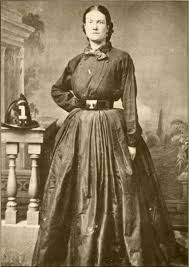
The cold, grey January sky above Virginia City, Nevada, in 1867 unleashed a torrent of sleet on a slow-moving funeral procession traveling along the main thoroughfare of town. Several members of the volunteer fire department, Virginia Engine Company Number One, was first in a long line of mourners following after a horse drawn carriage transporting the body of soiled dove Julia Bulette. The Nevada militia band shuffled behind the hearse playing “The Girl I Left Behind Me.” Black wreaths and streamers hung from the balconies of the buildings along the route which the remains of the beloved thirty-five-year-old woman was escorted. Miners who knew Julia wept openly. Out of respect for the deceased woman all the saloons were closed. Plummeting temperatures and icy winds eventually drove the majority of funeral-goers inside their homes and businesses before Julia was lowered into the ground.

Julia Bulette was murdered on January 19, 1867 at 11:30 in the evening in her home on North D Street in Virginia City. The fair but frail prostitute told her neighbor and best friend Gertrude Holmes she was expecting company, but did not specify who the company might be. Twelve hours later Gertrude discovered Julia’s lifeless body in bed. She had been beaten and strangled. Gertrude told authorities that Julia was lying in the center of the bed with the blankets pulled over her head and that the sheets under her frame were smooth. She told police that it appeared as though no one had ever been in the bed with Julia.

The authorities believed the scene had been staged. Marks on Julia’s body and tears on the pillow used to smother her indicated she struggled with her attacker. The murderer then set the room to look as though nothing was out of the ordinary. He covered Julia’s body in such a way that at a passing glance she would merely appear to be asleep. It had fooled the handyman she had employed to come in and build a fire for her each day. When the gentleman entered Julia’s home at eleven in the morning, he believed she was sleeping. He explained to law enforcement officers that he was quiet as he went about his work and left when the job was done. A search of the modest home Julia rented revealed that many of her possessions were missing. The citizens of Virginia City were outraged by the crime.


According to Kate: The Legendary Life of Big Nose Kate, Love of Doc Holliday

arrives in bookstores everywhere October 1.  


Whiskey and Wild Women

According to Kate is coming soon to bookstores everywhere. 

In honor of her imminent arrival this month is dedicated to

Wild Women like Kate Elder.  


With the end of the Mexican War in 1846 and the discovery of gold at Sutter’s Mill in California two years later, the West was opened with a rush.  Thousands upon thousands of Easterners – adventurous, avaricious, or discontented – left their homes to try their skill and luck in the wild West.  It was long before the names of such boomtowns as San Francisco, Deadwood, Tombstone, Leadville, and Denver became bywords back East.

Soon after the birth of any new boomtown, it was ready to swing into its first phase of growth.  Hustle was the name of the game.  Hustle to get the choice town lots.  Hustle to get the first shipment of new merchandise.  Hustle to build the first saloon, the first gambling palace, the first brothel.  There were great profits to be made, but the gamble was equally great.  The old warning of “haste makes waste” was never in the thoughts of the boomtown entrepreneurs.  Their only object was to dig the gold and silver from the miners’ pockets before someone else did, to get a piece of the trail hands’ hard-earned cash before it was all spent.

In the rush, all types of people appeared.  The first was the prospective saloonkeeper, who knew he was starting a sure thing.  Not long after him came the girl of the “line,” the row of small houses on the outskirts of town where prostitutes plied their time-honored trade.  A successful and ambitious chippy might aspire to become a fancy madam, operating a first-class parlor house.

Typically, the first saloon in a nascent boomtown was a tent in which a board was set across two barrels to form a bar.  The saloonkeeper ladled out his whiskey in tin cups to the thirsty men.  By the time the proprietor shifted his established to a sturdier structure, he might have procured a few girls to sell their services to the patrons of the bar.  The saloonkeeper’s next step was the acquisition of a piano, and pianist, both brought into the boomtown at great trouble and expense.

At the time of the Mexican War, the keyboard virtuosos were playing “Clarin de Campana” or “The Trumpet of Battle.”  Then when the California gold rush came along, the favorite was “Hang town Gals.”  Through the 1880’s and 1890’s, saloon music was quieter and more romantic: “Little Annie Roonie,” “You’re the Flower of My Heart, Sweet Adeline,” “She’s More to be Pitied Than Censured,” “A Bird in a Gilded Cage.”  At the turn of the century, after Scott Joplin wrote his “Maple Leaf Rag,” the popular songs the “Professor” played all had a ragtime jingle – except when both pianist and patrons were weepily drunk.  At such times, usually in the wee hours of the morning, the man at the ivories would play, with many eloquent and fanciful hand gestures, the sentimental and slower-paced songs of Stephen Foster, or perhaps “Genevieve,” “After the Ball,” or “Only One Girl in the World for Me.”

When a preacher invaded the dim precincts of demon whiskey to bring “The Work” before it was too late, he was treated with courtesy, even when his host was assailed as “a fiend in human form.”  The poker players threw in their cards and pocketed their chips and the bar was closed as the evangelist mounted the Keno platform.  The proprietor and the bartenders stood with folded arms during the devotions, then joined heartily in song as the piano played “Jesus, Lover of My Soul.”

There was no architectural standard for the early Western saloon.  The tent served for a year or so, until it could be replaced by a structure of log or clapboard, or adobe.  In short, the saloon was fashioned from whatever was most readily available.  Seldom did the exterior have visual appeal, and never did it need it.  Visual appeal was to be found inside, at the foundation of the entire business – the bar

From about 1840 to 1880, bar-making was one of the country’s significant crafts, with many a wood smith reaching the pinnacle of his art in designing the fixtures for a saloon.  Crude chairs and tables were good enough for gambling, but the bar – had to show a richness which would suggest quality to the men who were bending an elbow.  As a saloon prospered and acquired tone and class, the decorations grew more elaborate.  Not uncommon were such grand features as red plush curtains, thick rugs instead of sawdust, and fancy chandeliers which sprayed a mist of perfume on the sweaty dancers below.

In almost every saloon the major attraction was a nude and nubile girl painted life-size on a canvas which hung just above the eye level of the men at the bar.  Many a proprietor would bet that in any given twenty-four-hour period no patron would enter his place without casting a glance at the nude.  And no one has heard of a bartender who lost that bet.  In the bigger saloons, one might see as many as a dozen examples of Saturday-night art.

Some emporiums would sell beer for a nickel a mug and whiskey for a dime a shot; others would charge as much as two bits for a glass of rotgut.  Signs on the Cyrus Noble Saloon in West Texas proudly advertised, “Fire Water and Poor Cigars.  Whiskey guaranteed under the National Pure Food Law.”

Fancy establishments prided themselves on stocking expensive imported beers.  In 1880, Lowenbrau wholesaled out of Chicago at $15.25 for a case of fifty bottles, so the retail price of a bottle must have been upwards of sixty cents – more than it costs today!  But it is hard to generalize about the retail price of booze in the Old West.  The price depended on the brand, the year, and what the traffic would bear.

Many establishments advertised a “free lunch” to attract customers and, once attracted, keep them thirsting for more refreshment.  The food was salted very liberally.  Buffet tables filled with sliced bread, hot sausages, beef, pork, crackers, pretzels, and cheese were open to all who invested in a glass of beer.

The saloon was the hub of the Western town.  Bar, restaurant, gambling house, town hall, hotel, brothel, and sometimes courtroom or church, the saloon was the first building constructed and the last business to go broke.  In the early days of the frontier town, there was no lodge, club, or pool hall where the men might gather.  So, when our rugged Western individualists felt the need for communal activity, they surged through the only doors available – the bat-wing doors of the saloon.

Since the leaders of the town hung around at the saloon, people went there to find them.  If a miner was shot, his wife rushed to the saloon to get the Doc or the sheriff, or the mortician.  If there was a nasty accident on the ranch, the injured man’s friends stuffed a dirty cloth in the wound, threw him across a horse and galloped into town and the saloon.

Death often visited the saloon.  Take the case of Ezra Williams, who got himself badly shot in California.  He was toted inside the local bar and stretched out on a table, under the hanging lamps, while Dr. Thomas D. Hodges removed the bullet.

Ezra groaned in pain.

“He’s mighty bad off,” said a gambler, “and I’ll bet he dies before sun-up.”

Doc Hodges, whose pride was deeply touched, angrily snapped back, “Fifty dollars says he don’t!”

“You’re on,” the gambler leered.  “Anybody else want to bet?”

Within a few moments, over $14,000 was wagered on Ezra’s life or death.  Dutch Kate, who later became a stagecoach robber, ambled in and bet a cool $10,000 Ezra would be on his feet before the sun shone again.  For hours everybody crowded around to watch the man and the ticking clock.  Finally, Ezra obliged Dutch Kate and checked out of the saloon only minutes before sun-up.

According to Kate: The Legendary Life of Big Nose Kate, Love of Doc Holliday

arrives in bookstores everywhere October 1.  
 

Follow Me

facebook twitter youtube instagram
History of the Old West | Wild West Costume | Great Women in History | Wild West Outlaws | Famous Women Biologists | American Old West | What Was the Role of the Pioneer Women | American History West | American Gold Rush 1800s California | 1800's West | Wyatt Earp Biography

© 2026 Chris Enss | Privacy Policy | Design by Winter Street Design Group | Login