
Rio Grande

Enter now to win a copy of

Cowboys, Creatures and Classics: The Story of Republic Pictures


Based on the 1933 Saturday Evening Post story by Maurice Walsh, The Quiet Man was a romantic drama set in Ireland. The tale centered on an Irish-born American who returned to his homeland to reclaim his family’s farm and birthplace in Innisfree. John Ford read Walsh’s story when it was released and purchased the rights for ten dollars. Walsh was paid another twenty-five hundred dollars when Yates and Republic Pictures joined the quest to bring the story to the screen. Walsh would earn an additional $3,750 when the film was made.

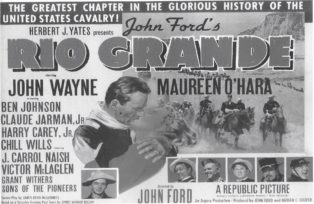
Republic Pictures agreed to finance the film with Maureen O’Hara and John Wayne starring and John Ford directing only if they agreed to first film the western Rio Grande. Yates was taking a chance, albeit a small one, backing Ford and Wayne in anything other than a western, and he wanted to hedge his bets. Whatever funds would be used to make The Quiet Man must first be made doing the film Rio Grande and its subsequent success.

Rio Grande is an almost balletic story of the relationships among a man and his two loves: his wife and the cavalry. John Wayne plays Lieutenant Colonel Kirby York who finds his son Jeff among his new recruits at his command in the West. Kirby and his wife Kathleen, portrayed by Maureen O’Hara, have been separated since the Civil War, when in the line of duty as a Northern officer he was required to burn her estate. They meet again for the first time in sixteen years when Kathleen comes to the fort to buy Jeff’s obligation, which neither father nor son allow her to do.

Based on another story from the Saturday Evening Post entitled Mission With No Record by James Warner Bellah, Rio Grande completes a loose trilogy about Ford’s beloved Seventh Cavalry.

In addition to Wayne and O’Hara, Rio Grande also featured Ben Johnson, Harry Carey Jr., Chill Wills, Victor McLaglen, and Claude Jarman Jr. Jarman portrayed Trooper Jefferson York, Wayne and O’Hara’s son in the picture. It was Jarman’s first adult part. He had risen to fame playing Jody in the Academy Award–winning film The Yearling. He was twelve when that classic was released. At sixteen, he was six feet, two inches and stood nearly eye to eye with Wayne in the Ford classic.

Rio Grande was popular with moviegoers, and the healthy box office receipts provided Yates with a financial reserve to draw from in case The Quiet Man didn’t fare well. Reviewers gave the movie high marks for its acting, music, and cinematography. Filmed in Monument Valley, the motion picture was lauded as a “scenic triumph” as well as an exceptional western story. The October 30, 1950, edition of the Hollywood Reporter called Rio Grande “the year’s finest outdoor screen adventure.”
 

To learn more about the many films Republic Pictures produced read

Cowboys, Creatures and Classics: The Story of Republic Pictures
 

Republic’s Jungle Girl

Enter now to win a copy of

Cowboys, Creatures and Classics: The Story of Republic Pictures


Zombies of the Stratosphere was one of three movies Republic produced dealing with a Mars invasion. Another profitable serial the studio made was Panther Girl of the Kongo. When wildlife photographer Jean Evans discovers a giant crab-like creature in the jungles of southern Africa, she sends word to a big game hunter and friend Larry Sanders for help. The pair soon learn these large crustaceans are the work of a mad scientist who wants to scare the population away from the area to operate a diamond mine. Jean, nicknamed the Panther Girl by the tribal locals because she shot a panther that had been terrorizing the village, and Larry are determined to find the mad scientist and stop him. Along the way, the pair must battle oversized sea urchins, wild animals, creepy henchmen, and inclement weather. They must survive gun battles, falls into quicksand, the roaring rapids, poison darts, and angry gorillas.

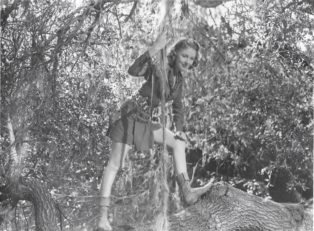
Panther Girl of the Kongo starring Phyllis Coats was the most expensive serial Republic Pictures produced in the 1950s. A great deal of footage used to make this film had been originally shot in 1941 for the movie Jungle Girl. Frances Gifford, the star in Jungle Girl, was the first female lead in a Republic serial, and Phyllis Coats was the last female lead in a Republic serial. In fact, Phyllis Coats wore the same outfit in Panther Girl that Frances Gifford wore in Jungle Girl.

The director of Jungle Girl was studio favorite William Witney. From 1935 to 1956, Witney practiced the philosophy Herbert Yates taught which was “make em’ fast and make em’ cheap.” Witney was a specialist in outdoor action and stunt direction. He directed or co-directed more Republic serials than any other company hire. He is considered the greatest action director in B movies.

Witney traveled to Los Angeles from Lawton, Oklahoma, to visit his sister and brother-in-law in 1933. His brother-in-law was a director for Mascot Pictures, and he got Witney a job at the studio as an office boy. After Mascot merged with Republic in 1935, Witney was promoted to script clerk and then to film editor.

In 1937, while Witney was working in Utah on a western serial, the director was fired, and twenty-one-year-old Witney was asked to take his place. Witney went on to direct the studio’s principal western, science fiction, and horror serials. From the Drums of Fu Manchu to the Mysterious Doctor Satan, he was able to masterfully put action sequences together for the screen

Among Witney’s fans are directors Steven Spielberg and Quentin Tarantino. Tarantino gave Witney high praise for his rough and believable action scenes and visual style. Witney’s Republic serials served as the inspiration for Spielberg’s Indiana Jones movies.


To learn more about the many films Republic Pictures produced read

Cowboys, Creatures and Classics: The Story of Republic Pictures


The Quiet Man

Enter now to win a copy of

Cowboys, Creatures and Classics: The Story of Republic Pictures


The rising popularity of television was of concern for several motion picture studios, not the least of which was Republic. By late summer 1948, the company had experienced a noticeable decrease in ticket sales. Audiences were choosing to stay home and watch the Milton Berle Show and Kraft Television Theatre rather than venture out to the cinema. In September 1948, Yates announced the layoff of extraneous personnel in all departments. Only workers essential to ongoing productions were retained. By the end of 1950, it was clear to Yates that he could no longer take a gamble on such arthouse-style projects like Macbeth. He would focus on familiar storylines with proven talent both in front and behind the camera. Yates would use the production funds built up between 1941 and 1945 to hire John Ford and John Wayne to make The Quiet Man.

Based on the 1933 Saturday Evening Post story by Maurice Walsh, The Quiet Man was a romantic drama set in Ireland. The tale centered on an Irish-born American who returned to his homeland to reclaim his family’s farm and birthplace in Innisfree. John Ford read Walsh’s story when it was released and purchased the rights for ten dollars. Walsh was paid another twenty-five hundred dollars when Yates and Republic Pictures joined the quest to bring the story to the screen. Walsh would earn an additional $3,750 when the film was made.

Republic Pictures agreed to finance the film with Maureen O’Hara and John Wayne starring and John Ford directing only if they agreed to first film the western Rio Grande. Yates was taking a chance, albeit a small one, backing Ford and Wayne in anything other than a western, and he wanted to hedge his bets. Whatever funds would be used to make The Quiet Man must first be made doing the film Rio Grande and its subsequent success.

Rio Grande is an almost balletic story of the relationships among a man and his two loves: his wife and the cavalry. John Wayne plays Lieutenant Colonel Kirby York who finds his son Jeff among his new recruits at his command in the West. Kirby and his wife Kathleen, portrayed by Maureen O’Hara, have been separated since the Civil War, when in the line of duty as a Northern officer he was required to burn her estate. They meet again for the first time in sixteen years when Kathleen comes to the fort to buy Jeff’s obligation, which neither father nor son allow her to do.

Based on another story from the Saturday Evening Post entitled Mission With No Record by James Warner Bellah, Rio Grande completes a loose trilogy about Ford’s beloved Seventh Cavalry.

In addition to Wayne and O’Hara, Rio Grande also featured Ben Johnson, Harry Carey Jr., Chill Wills, Victor McLaglen, and Claude Jarman Jr. Jarman portrayed Trooper Jefferson York, Wayne and O’Hara’s son in the picture. It was Jarman’s first adult part. He had risen to fame playing Jody in the Academy Award–winning film The Yearling. He was twelve when that classic was released. At sixteen, he was six feet, two inches and stood nearly eye to eye with Wayne in the Ford classic.


To learn more about the many films Republic Pictures produced read

Cowboys, Creatures and Classics: The Story of Republic Pictures.


Republic’s Catman of Paris

Enter now to win a copy of

Cowboys, Creatures and Classics: The Story of Republic Pictures


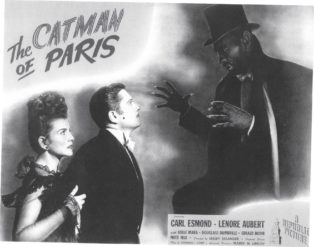
In April 1946, thrill seekers were looking forward to the release of The Catman of Paris. The gruesome mystery melodrama involved a man suffering from a loss of memory who was accused of being a feline killer operating in Paris.

The tagline read: “Walks like a man. Attacks like a cat. Who is the Catman of Paris.” The plot involved author Charles Regnier returning to 1896 Paris after exotic travels, having written a best seller that the Ministry of Justice would like to ban. That very night, an official is killed on the dark streets . . . clawed to death! The prefect of police suspects a type of cat, but Inspector Severen thinks there is nothing supernatural about the crime and thinks Regnier is responsible for the murder. Regnier denies he had anything to do with the crime but begins to doubt himself when he has a hallucinatory blackout during a second killing.

Vienna-born stage actor Carl Esmond played the troubled author Regnier. Lenore Aubert, the female lead in the movie, was also from Vienna. The press packet Republic Pictures circulated to theaters and media across the country contained plenty of information about the film as well as background information about the picture’s stars. Aubert’s story of how she made it from Vienna to Hollywood could have been a movie on its own.

According to the November 8, 1946, edition of the Mount Carmel Item, the actress had just finished making her third movie when the Nazis occupied her homeland. She and her mother fled to France where they hoped to begin a new life. There she continued studying and acting for a year until the downfall of Paris.

“The experience Miss Aubert underwent in getting from France, through Portugal, to Spain would alone defeat most people,” the Mount Carmel Item article read. “However, Miss Aubert realized her one hope for happiness could be found in America. After six months of ceaseless efforts, she was able to get a priority on a Portuguese boat.”

Critics were complimentary of Aubert’s performance and the film itself, calling both “satisfying” and “entertaining.”

Chills, thrills, suspense, and murder awaited moviegoers who dared to see Valley of the Zombies starring Republic’s contract players Robert Livingston and Lorna Gray. Debuting in May 1946, the film was about a prominent brain surgeon who is killed; law enforcement suspects the culprit was his associate Dr. Terry Evans. Doctor Evans and his sweetheart nurse embark on a quest to prove his innocence. In trying to clear himself, the doctor and his girlfriend visit hospitals, morgues, embalming establishments, and an eerie estate where a few more murders have been committed for good measure. While searching the estate, the doctor and nurse happen onto a gruesome figure that is a zombie. The zombie’s condition can only be reversed with large quantities of blood. The caretaker of the undead individuals traverse the woods and mental hospitals at night looking for unwilling blood donors.

Directed by Philip Ford, nephew of award-winning western director John Ford, Valley of the Zombies was void of any valleys and, apart from one undead creature, any zombies. It was a picture that was produced quickly to cash in on the zombie craze.


To learn more about the many films Republic Pictures produced read

Cowboys, Creatures and Classics: The Story of Republic Pictures.


Republic’s Captain Marvel

Enter now to win a copy of

Cowboys, Creatures and Classics: The Story of Republic Pictures


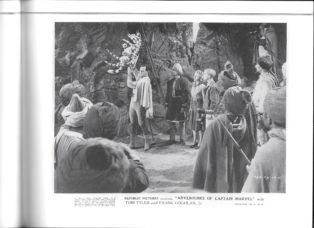
A popular character Republic Pictures was allowed to introduce in one of its chapter plays was Captain Marvel. Also known as Shazam, the superhero was created in 1939 by artist C. C. Beck and writer Bill Parker for Fawcett Comics. Captain Marvel was the most popular comic book superhero of the 1940s. He was also the first to be adapted into film. The film was entitled Adventures of Captain Marvel.

In an interdepartmental memo passed from various executives at Republic to Herbert Yates, the project was touted as having “massive potential to be a box office hit.” The twelve-part series premiered in March 1941. The plot of the chapter play was described in the following way:

To a remote section of Siam, jealously guarded by unconquered native tribes, comes the unwelcome Malcolm Scientific Expedition seeking knowledge of the ancient Scorpion Dynasty. Billy Batson, assistant to a radio expert, is the only one of the party who does not enter a forbidden chamber. As a result he is awarded the power to transform himself into a superman, Captain Marvel, upon uttering the word “Shazam.”

After a dozen spine-tingling chapters, Billy is bound and gagged so he cannot utter the word. He tricks the Scorpion into releasing the gag in order, as he pretends, to explain to him the secret of his invulnerability. Once released, he cries, “Shazam” and becomes Captain Marvel. He is able to free himself and his friends and expose the Scorpion once and for all.

Adventures of Captain Marvel was a huge success for Republic Pictures. Critics called the production “roaring good entertainment.” Many film aficionados consider the serial to be the best ever made.

The collaboration between Republic Pictures and Fawcett Comics continued after the release of the Captain Marvel serial. In 1942, the two entities brought the character Spy Smasher to the screen. Spy Smasher is a costumed vigilante and freelance agent who battles a Nazi villain known as the Mask. The Mask heads a gang of saboteurs determined to spread destruction across America. According to author and film historian Alan G. Barbour, the Mask was the first in a long line of stereotypes that pictured hard-faced Nazis as propagandist tyrants.

Spy Smasher was a twelve-part serial that was shot in thirty-eight days. Production began on December 22, 1941, just a few days after the Japanese bombing of Pearl Harbor. The Spy Smasher wore a cape, leaped from bridges onto fast-moving cars, outgunned Nazi devils, and escaped from all types of death traps, from burning tunnels to compartments slowly filling with water. Spy Smasher used a number of gadgets, among them being various laser beams and his fire-resistant cape, to foil the Nazis’ plans.

Daredevils of the Red Circle was a twelve-part serial that included a cape-wearing villain. The suspenseful, spine-tingling, mystery film told the tale of diabolical mastermind Harry Crowel, a.k.a. Prisoner 39013. Crowel escapes from prison and, aided by a seemingly endless supply of henchmen, sets out to destroy all holdings of industrialist Horace Granville, the man who put him in prison. One target is an amusement park, home of three Daredevils of the Red Circle who perform death-defying stunts. When head Daredevil Gene’s kid brother is killed in Crowel’s attack, the three heroes swear to capture Prisoner 39013. Unbeknownst to them, he is holding the real Granville captive and, with a near perfect disguise, has taken his place. A mysterious cloaked figure known as the Red Circle aides the daredevils in their crusade.


To learn more about the many films Republic Pictures produced read

Cowboys, Creatures and Classics: The Story of Republic Pictures