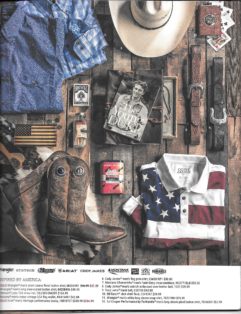
Very pleased to see The Young Duke
featured in one of the layouts in the most recent Boot Barn catalogue.
Most everyone loves John Wayne and The Young Duke does make a nice
Father’s Day gift.

1868 “Decoration Day”, later called Memorial Day is first observed in Northern US states.
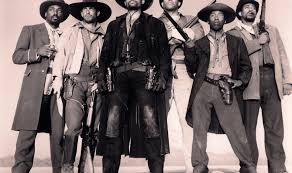
Five riders moved swiftly across the open country through Granite Pass in southwest New Mexico. An electrical storm lit up the sky around them, and a deluge of hail broke free from the clouds, pelting the men in their saddles and their horses. Sounding like a troop of demons advancing, the wind howled and screamed as it pushed over the massive walls of rock the riders passed.
Former peace officer Jefferson Davis Milton rode in front of the others. He was a tall man with sloping shoulders, his granite like visage partly hidden by a dark mustache that curled around to meet his thick sideburns. George W. Scarborough, a blue-eyed, gruff-looking, one time law man from El Paso, Texas, took a position on Jeff’s left. Eugene Thacker, a youthful son of a railroad detective, rode on Jeff’s right side. Directly behind the three were Bill Martin and Thomas Bennett, Diamond A ranch cowboys turned bounty hunters. The men pulled their slickers around their necks and urged their mounts on through the tempest. Claps of thunder ushered in another downpour of hail.
The determined riders, members of a posse pursuing a gang of train robbing outlaws, were soaked to the bone once they reached Fort Apache, a military post near Coolidge Lake. No one said a word as they made camp outside the garrison’s gates. Discussing the obstacles on the way to achieving that goal wasn’t necessary. Their focus was on capturing Bronco Bill Walters and his boys.
William E. Walters, also known as Bronco Bill Walters, was from Fort Sill, Oklahoma. What he did before being hired at the Diamond A ranch in 1899 is anyone’s guess. It’s what he did after getting a job as a cowhand that warranted attention. The Diamond A was a five hundred square mile spread nestled in the boot heel of New Mexico. The magnificent acres of grass there made it the perfect spot for raising cattle. The ranch was always in need of workers. Cowpunchers that dropped by looking for employment were generally hired on the spot. It was considered a rude violation of the proprieties of a cow camp to inquire into a man’s connections or character. Just wanting to work was enough. Bronco Bill Walters wanted to work, and that’s all that mattered and all the foreman at the Diamond A would have cared about if Bronco Bill hadn’t have desired more than the job had to offer.
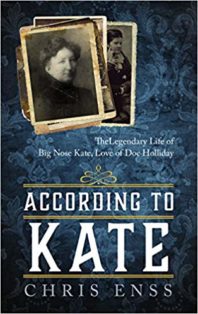
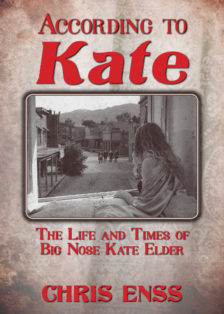
Doc Holliday’s paramour Big Nose Kate could never get a publisher to give her the big bucks she demanded to tell the story of her life, but that didn’t mean she didn’t collect material she wanted to use in a biography. Over the fifty years Mary Kate Cummings, alias Big Nose Kate, traversed the West she saved letters from her family, musings she had written about her love interests, and life with the notorious John Henry Holliday. Using rare, never before published material Big Nose Kate stock-piled in anticipation of writing the tale of her days on the Wild Frontier, the definitive book about the famous soiled dove will finally be told.
Kate claims to have witnessed the Gunfight at the OK Corral and exchanged words with the likes of Wyatt Earp and Josephine Marcus. There’s no doubt she embellished her adventures, but that doesn’t take away from their historical importance. She was a controversial figure in a rough and rowdy territory. What she witnessed, the lifestyle she led, and the influential western people she met are fascinating and represent a time period much romanticized.
A light, frigid rain tapped the dirty windows of a small store located along the banks of the San Joaquin River near the town of Millerton, California. A half dozen ferryboat operators were inside soaking up the warmth emanating from a fireplace. Four of them were huddled around a table playing cards; the other two were enjoying a drink at a makeshift bar, while an unkempt clerk arranged a row of canned goods across a warped shelf.
The clerk was entertaining the preoccupied men in the room with a song when the shop door swung open. He was the last to notice the figures standing in the entranceway. He looked up from his work after being conscious of his own loud voice in the sudden silence. He slowly turned to see what everyone else was staring at.
The outlaw Tiburcio Vasquez entered the store with his pistol drawn. Three other desperadoes, all brandishing weapons, followed closely behind. Vasquez, a handsome man of medium height with large, dark eyes, surveyed the terrified faces of the patrons as he smoothed down his black mustache and goatee. “Put up your hands,” he ordered the men. The clerk quickly complied, and the others reluctantly did the same.
Two more of Vasquez’s men burst into the store through the back entrance and leveled their guns on the strangers before them.
“You don’t need a gun here,” the clerk tried to reason with the bandits. Vasquez grinned as he walked over to the man.
“Yes, I do,” he said as he placed his gun against the clerk’s temple. “It helps quiet my nerves.”
Vasquez demanded the men drop to the floor, facedown. After they had complied, their hands and feet were tied behind them. One of the men cursed the desperadoes as he struggled to free himself. “You damned bastard,” he shouted at Vasquez. “If I had my six-shooter I’d show you whether I’d lie down or not.”
The bandits laughed at the outburst and proceeded to rob the store and its occupants of $2,300. The November 10, 1873, holdup was one of more than one hundred such raids perpetrated by the thirty-eight-year-old Mexican and his band of cutthroat thieves and murderers in their violent careers. The desperadoes escaped the scene of the crime, eluding authorities for several months before they were caught.
1900 – President William McKinley signed the Lacey Act, 16 U.S.C. § 3371–3378, to defend fauna from poachers. It banned the illegal commercial transportation of wildlife. The conservation law was introduced by Iowa Rep. John F. Lacey. It has been amended several times. The most significant times were in 1969, 1981, and in 1989.
Nighttime overtook the Union Pacific train traveling west from Kansas City, Missouri, to Denver, Colorado, through Nebraska. The straight, single track stretched for miles over the desolate, shadeless, featureless land whose only trace of civilization was found in patches of plowed earth, rich and black, alternating with unfenced fields of young grain, and in a few lonely settlements of a half dozen houses. It was along this section of railroad in late September 1877 that the train relaxed its head long speed to a slower rate. It would run smoothly and steadily toward the water station of Big Springs, Nebraska. The passengers on board would get a respite from oscillating curves and erratic jolts and jars. The journey promised to be fairly uneventful with nothing to see apart from a lone tree in the sleepy town in the far distance.
Just before 10 o’clock, the Union Pacific train stopped in Big Springs. Station employees were not on hand to greet the vehicle as they usually did. Three armed gunmen, Jack Davis, Sam Bass, and Joel Collins, had tied up the station agent and his assistant and locked them in a closet. Before the engineer had a chance to leave the train to find the agent, Joel Collins jumped on board brandishing a weapon and demanded the engineer and the fireman throw up their hands. The cocked six-shooter aimed at their heads persuaded them to do as they were told.
With guns drawn, Sam Bass and Jack Davis boarded the express car and were ransacking its contents when they came upon a couple of safes. One of the safes was partially opened, and a large quantity of gold was inside. The thieves took possession of the gold and turned their attention to a second safe that was locked. Jack ordered the messenger to open the safe. He informed the gunman he didn’t have a key, but Jack didn’t believe him. He slugged the messenger over the head with the butt of the gun then thrust the revolver into the man’s mouth, knocking out one of his teeth in the process. Jack threatened to blow the top of his head off if he didn’t open the safe. All the man could do was shake his head. Sam convinced Jack the messenger was telling the truth and that they should move on.
1865 Flag flown at full mast over White House for the first time since Lincoln was shot.