
Midwest Book Review
From the Midwest Book Review
The American History Shelf
Lone Star Books/TwoDot/Globe Pequot
www.globepequot.com
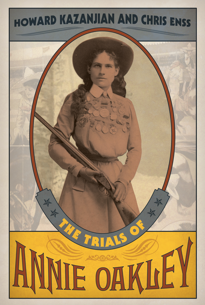
Two fine history books are recommended picks for history collections. Howard Kazanjian and Chris Enss’ The Trials of Annie Oakley (9781493017461, $24.95) provides a biographical coverage that focuses on the feisty independent woman who advanced the image of women in American history both through her performances in Buffalo Bill Cody’s Wild West show and in her advocacy efforts. The latter – which included advocating for the US military and fighting for orphans – may be lesser-known episodes in her life, but here they are brought to the forefront in an account that reads with the lively immediacy of fiction but gathers a range of facts about Oakley’s performances and life. Bill Groneman’s Eyewitness to the Alamo (9781493028429, $18.95) gathers over a hundred descriptions of the Battle of the Alamo by those who were eyewitnesses, and traces the legends, realities and events of one of the most famous battles in American history. Discussions comment on reviews of the Alamo’s struggles and add the social and political background necessary to place these events in proper historical perspective. Both are recommended picks for any American history holding.
TwoDot/Globe Pequot
www.globepequot.com
Sherry Monahan with Jane Perkins’ The Golden Elixir of the West: Whiskey and the Shaping of America (9781493028498, $24.95) could have been featured in our Food and Wine section, but is reviewed here for its larger and central theme on the shaping of the West and how liquor – whiskey, in particular – played a big role in that history. From the evolution of the saloon business in the booming West to how California merchants became big whiskey shippers and how opulence developed in places whiskey was consumed, this provides a lively and thought-provoking story of the history of booze in the west. Sherry Monahan’s Tinsel, Tumbleweeds, and Star-Spangled Celebrations: Holidays on the Western Frontier from New Year’s to Christmas (9781493018024, $24.95) provides a lively history of holidays on the Western frontier and covers everything from traditions surrounding gifts and events to songs, poems, decorations and food and drink recipes. These come from firsthand stories of parties and events culled from journals, memorabilia, and newspaper reports, and covers the six major yearly holidays from New Year’s and Easter to Christmas and home-cooked to restaurant fare. Few books provide such an inviting approach as this; especially given the wealth of vintage illustrations throughout. Charlie Seemann’s Way Out West: Photographs from the Farm Security Administration 1936-1943 (9781493027279, $24.95) provides a lively history of the American ranch in the West, and is a ‘must’ for any Western Americana collection. While vintage black and white images are the backbone of this discussion, equally powerful and hard-hitting are surveys of dude ranches, individuals in the Farm Security Administration, bunkhouses and automobiles, and more. These are all top recommendations for any holding strong in Western Americana and American history.
This Day…
The Posse After Juan Soto
Enter to win a copy of
The Principles of Posse Management:
Lessons from the Old West for Today’s Leaders.
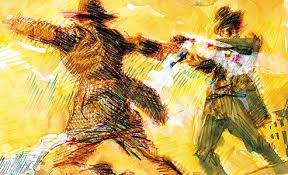
Sheriff Harry Morse removed a Model 1866 Winchester, carbine rifle from the leather holster on his saddle and cocked it to make sure he had a bullet in the chamber. He surveyed the sprawling canyon deep in the depth of the Panoche Mountain, more than fifty miles outside of Gilroy, California. In the distance below were three, small, adobe houses, and Morse had every reason to suspect members of outlaw Juan Soto’s gang were inside one of the buildings.
High above the sheriff and his eight member posse was a seemingly inexhaustible mat of black, rainless clouds moving steadily across the world. Morse watched the sun disappear behind the billows and exchanged a determined look with Captain Theodore Winchell on horseback next to him. Winchell, an undersheriff from Alameda County, had been riding with Sheriff Morse for several months in search of the fugitive. San Jose sheriff Nick Harris and six other deputies made up the rest of the posse. All the lawmen had years of experience tracking lawbreakers through the northern California terrain. Each was an exceptional shot and could hold his own in hand to hand combat.
Harry Morse had been sheriff of Alameda County for more than nine years. From 1864, when he took the job, to April 1871, when he peered down on the possible hiding place of Juan Soto’s men, Morse had traversed the hills and plains of eastern and northern Alameda County in search of horse thieves, highwaymen, and cutthroats. Until Morse took the job at twenty-eight years of age, most lawmen were afraid to venture too far to catch outlaws. Worried they would be outnumbered the criminals went about their business unconcerned they would ever be apprehended. Sheriff Morse, along with Nick Harris and Theodore Winchell, changed all that.
The officers and their deputies familiarized themselves with the haunts of the outlaws and the topography of the country where the bad guys were known to roam. They learned the locations of ranches, springs, and mountain trails as well as acquainted themselves with the inhabitants and their occupations. They knew where to hide and wait along trails for lawbreakers to pass, and, armed with that knowledge, they knew what to do to avoid an ambush.
Juan Soto, the man Sheriff Morse and his posse were tracking, was a thief and a murderer. He had a reputation as a brutal man who would stop at nothing to get what he wanted. Soto mainly operated in the central part of California but, like the other bandits before him, went wherever the possibility of loot beckoned him. For more than four years, the 6’2, two-hundred twenty pound, half-Indian, half-Mexican man had terrorized the area from the Livermore Valley to San Luis Obispo. Soto and his gang of desperadoes robbed stages, stage stops, lone emigrants, and prospectors. Their victims were often beaten or killed. Soto’s dark features and general express of animal ferocity earned him the name “the human wildcat.” He had black, slightly crossed eyes, a mane of black hair, and a bushy beard and mustache. The April 10, 1871, edition of the San Francisco Chronicle described his appearance as the “physical manifestation of as cruel a spirit as ever animated a human being.”
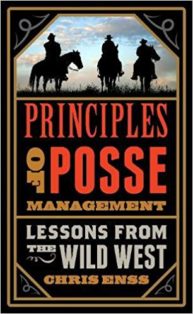
To learn more about the great posses of the frontier read
The Principles of Posse Management:
Lessons from Old West for Today’s Leaders.
The Collection
This Day…
The Posse After the Doolin-Dalton Gang
Enter to win a copy of
The Principles of Posse Management:
Lessons from the Old West for Today’s Leaders.
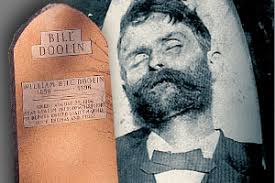
One of the grizzliest battles between outlaws and lawmen took place on September 3, 1893, twelve miles east of Stillwater, Oklahoma, at the town of Ingalls. More than ten people who were situated on the eastern edge of Payne County only a few miles from the rocky retreats and nearly inaccessible wooded areas of Creek County were killed. For some time it had been the spot where a gang of bandits, murderers, train robbers, and horse thieves known as the Doolin-Dalton Gang had made their headquarters.
The two-hundred-fifty people that resided in Ingalls had decided it was better business and safer to accept the outlaws who had overtaken the town than to fight them. In return for not robbing local merchants, outlaws could get drunk in an Ingalls’ saloon without having to shoot their way out, and they could rent a bed in Mary Pierce’s hotel (with or without a girl in it) and not have to worry about waking up with a sheriff’s gun in their chests.
The Doolin-Dalton Gang was the last great bandits of the old West. Bill Doolin and William Dalton worked to together at the HX-Bar Ranch in Oklahoma Territory. In 1891, they decided life as ranch hands was too sedate and traded in their legitimate jobs to rob trains and banks. Federal marshals began pursuing the gang in October 1892, after the daring outlaws attempted a double band holdup in Coffeyville, Kansas. The gang was comprised of more than eight men. In addition to the Dalton boys and Bill Doolin, there were also George Newcomb, alias Bitter Creek, Tom Jones, also known as Roy Daugherty, William “Texas Jack” Blake, and Dan Clifton, alias Dynamite Dick.
To learn more about the great posses of the frontier read
The Principles of Posse Management:
Lessons from Old West for Today’s Leaders.
This Day
Posse Praise
Enter now to win a copy of
The Principles of Posse Management:
Lessons from the Old West for Today’s Leaders.
“Chris Enss’s engaging new book, The Principles of Posse Management, takes you back in time to the Old West, where with incredible detail and fun anecdotes, she reveals many universal leadership tools that were surprisingly effective in keeping order at such a lawless time. Subsequently, many of these same tools are needed today within our own corporate climate. Read this fascinating books and reconnect with these powerful principles from the past.”
Sean Covey, executive vice president, Global Solutions and Partnerships, Franklin Covey.
“Posses were created very strategically to catch the outlaws that sure had a ‘never give up’ way of life. I was fascinated by the stories of bravery that built our Western lifestyle.”
Lisa Bollin, CEO and director of design, Cowgirl Tuff Company