Twelve Million Angry People


So many of us are quick to anger and quick to speak, or these days, quick to email and text. Our hair-trigger society has a fuse shorter than the attention span of Bo Radley. People are furious and instead of getting to the heart of what they’re most angry about they lash out in areas that have nothing to do with the reason for their fury. I’m guilty of that myself. For years the Federal Bureau of Prisons stood by and watched as my brother was beaten and raped and suffered with Parkinson’s disease. The more I tried to stop the madness the worse his treatment grew. I wanted to give back to the prison officials all they did to my brother, but it wasn’t possible or logical. Instead, on one particular occasion, I took my frustrations out on the woman paying in pennies at, of all places, Penneys. My response was over the top and I still feel horrible about making the comments I did. Quick to anger, quick with the snide one-liners. Years of dealing with hecklers in the audience while doing standup comedy helped sharpen the tongue.

Anger and intolerance leads people to do strange things: go to war, burn books, riot at soccer games, and eschew lactose, and there’s never any logical reason for any of these actions. Most arguments made by intolerant or angry people who can’t rightly channel their rage have all the consistency of space-shuttle Thanksgiving gravy. Why can’t anyone just shut up and listen anymore? Whatever happened to the genteel art of sitting back and letting someone go on and on thinking he’s right while you while you bask in the knowledge that he is completely full of crap?

Tolerance doesn’t mean you agree with everything other people say, or that you subordinate your best instincts to the tyranny of mass opinion. It simply means you pretend not to know that everyone on the planet but you is a total moron. The most unforgivable thing about intolerance is that, by its inherent assumption that one group, belief, profession, or lifestyle is superior to another, it fails to take into account the ultimate truth that binds us all. The fact that, at the end of the day, we are all equal pains in the behind in the eyes of the Lord.
 

The Posse After Tom Bell

Enter to win a copy of

The Principles of Posse Management:

Lessons from the Old West for Today’s Leaders.

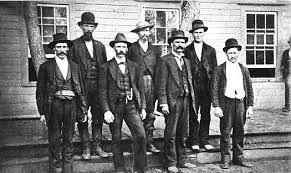
A pair of tired, dust-covered detectives escorted outlaw Tom Bell to a noose dangling off a limb of a sycamore tree. No one spoke a word as the rope was slipped around his thick neck. More than fifteen lawmen from Sacramento, Marysville, and Nevada City, California, made up the posse that apprehended Bell at his hideout at Firebaugh’s Ferry near the San Joaquin River. The ruthless highwayman and his gang had eluded the law for more than a year. Bell’s reign of terror would end here – a mere four hours after he was captured on Saturday, October 4, 1856.

Bell held in his hand a pair of letters his executioners allowed him to write before they administered justice. Outside of the firm grip he had on his correspondence, he didn’t show the least bit of fear. Judge Joseph Belt, the self-appointed hangman and head of the posse, sauntered over to Bell and looked him in the eye. “Do you have anything to say for yourself?” he asked.

“I have no revelations to make,” Bell replied. “I would be grateful, however,” he added, “to drink to the health of this party present and hope that no personal prejudice has induced them to execute me.” Judge Belt nodded to one of his men who stepped forward with a bottle of whiskey and offered it to Bell.

Bell lifted the bottle to the men and thanked them for their thoughtfulness. “I have no bitterness toward anyone of you,” he said. He took a drink and handed the bottle back to the lawman. “If you let me now…before I go. I’d like to read aloud the letter I wrote to my mother.” Judge Belt scanned the faces of his men; no one seemed to have any objections. “Go on,” Belt told the bandit. Tom unfolded one of the letters in his hand and began reading.

“Dear Mother, I am about to make my exit to another country. I take this opportunity to write you a few lines. Probably you may never hear from me again. If not, I hope we may meet where parting is no prodigal career in the country. I have always recollected your fond admonitions, and if I had lived up to them I would not have been in my present position; but dear mother, though my fate has been a cruel one, yet I have no one to blame but myself.

“Give my respects to all old and youthful friends. Tell them to beware of bad associations, and never to enter into any gambling saloons, for that has been my ruin. If my old grandmother is living, remember me to her. With these remarks, I bid you farewell forever. Your only boy, Tom.”

Bell refolded his letter and bowed his head in prayer. Two lawmen stepped forward, took the letters from him, and tied his hands behind his back. Tom lifted his head and nodded to Judge Belt. His horse was whipped from under him, and he swung into space. Judge Belt’s posse was one of three notable posses assembled between March 1856 and October 1856 to track down Tom Bell and his gang of highwaymen terrorizing settlers in the Gold Country.

To learn more about the great posses of the frontier read

The Principles of Posse Management:

Lessons from Old West for Today’s Leaders.


The Posse After the Reno Gang

Enter to win a copy of

The Principles of Posse Management:

Lessons from the Old West for Today’s Leaders.


Newspaper readers from Hartford, Connecticut, to Portland, Oregon, were shocked to read about the bold and daring robbery of the Ohio and Mississippi Railroad on October 6, 1866. It was the first robbery of its kind. Banks and stage lines had been robbed before, but no one had perpetrated such a crime on a railroad. According to the October 20, 1866, edition of the Altoona Tribune, three masked bandits entered the car stopped at a station near Seymour, Indiana, with the idea of taking money from the Adams Express safe. They entered the car from the front platform, leveled their revolvers at the head of the guard on duty, and demanded he hand over the keys to the safe. He did so with no argument. While one of the bandits stood guard, the others opened and removed the contents of one of the three safes which included more than $20,000 in cash. When the job was done, the desperadoes moved one of the safes to the door of the car, opened it, and tossed the box out.

The heavy safe hit the ground hard, rolled, and came to a stop. One of the masked men pulled on the bell cord, and, as the engineer replied with the signal to apply the brakes, the robbers jumped out of the train and made their escape. The engineer saw the bandits leap off the train and speculated they were headed in the direction of Seymour. The train slowed to a stop and one of the agents for the Adams Express Company who was on the train hopped off and ran back to the station with the news of the robbery. He commandeered a handcar and recruited a few men to help him collect any evidence left behind by the thieves. On the agent’s way back to the train, he found the safe tossed from the car. The $15,000 inside had not been touched.

The Adams Express Company offered a $5,000 reward for the arrest and conviction of the robbers. A witness aboard the train the evening it was robbed told authorities he recognized the desperadoes who stole the money as the Reno brothers, John and Simeon, and one of their friends, Frank Sparks.

To learn more about the great posses of the frontier read

The Principles of Posse Management:

Lessons from Old West for Today’s Leaders.


Riding with a Posse

Enter to win a copy of

The Principles of Posse Management:

Lessons from the Old West for Today’s Leaders.


In nearly every Western film prior to 1950, you’ll find a sheriff hastily assembling a group of men to track down an outlaw or two. Area ranchers, or whoever was in the saloon after a shooting in the middle of the street, were quickly deputized. The posse would then mount their horses and take off in search of the bad guys. No one asked if the posse members could shoot straight—if they had their own guns and ammunition, or if they’d had experience hunting fugitives. How long they could stay in the saddle. How long they could be away from their homes, farms, or businesses. It would appear all that was needed was a collection of outraged citizens. Exactly what went into forming an effective posse was much more refined than motion pictures presented.

The original term for posse was posse comitatus, taken from the Latin, meaning the “force of the country.” Any law officer could order anyone to help him “keep the peace” or to chase and arrest a felon. People who wouldn’t help do that were fined. The history of sheriffs forming posses began in Anglo-Saxon England. The word sheriff is a combination of the Anglo-Saxon words for “shire” (what today we call a “county”) and “reeve” (meaning “guardian”). Those who guarded English counties were responsible for organizing communal defense.

According to David Kopel, a law professor from Denver University, the office of sheriff in England was declining by the time the American colonies were being settled. The office had resurgence in popularity once the colonies were solidified. It was decided then that the law enforcement agent would be elected to the position by popular vote. “The Americans also strongly reaffirmed the traditional common law understanding of the sheriff ’s powers and authorities, especially the sheriff ’s autonomy and independence,” Professor Kopel noted in a Washington Post article from May 15, 2014. “During the latter nineteenth century, elections and other common law principles were often formally constitutional zed in the new states. Legally speaking, the Office of Sheriff in most states has changed little since the nineteenth century.”


To learn more about the great posses of the frontier read

The Principles of Posse Management:

Lessons from Old West for Today’s Leaders.


Success Found Using The Principles of Posse Management

Enter now for a chance to win

The Principles of Posse Management:

Lessons from the Wild West


Pat Garrett and Wyatt Earp, management experts? Solid management skills were necessary to quickly organize a group of law enforcement officers in order to keep the peace and pursue and arrest felons.

The actual work of transforming the frontier into farms and cities was carried on by the stream of settlers, but working with, or sometimes ahead of them, were the business people who directed the conquest of the wilderness and law enforcement officials like Garret and Earp who helped protect their interests.

While businessmen laid out town sites and planned cities, started industries, and developed mines, often times their efforts were thwarted by criminal elements who kept the materials and funds from their appointed destination. Posses were formed, and, directed by lawmen made sure fleeing desperados were brought to justice. In the process, civility was brought to the lawless territory as well.

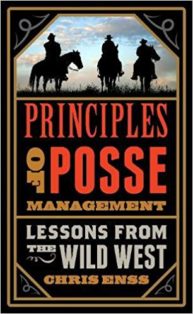
Using the examples set by those who helped bring order to the chaotic western frontier, The Principles of Posse Management offers pointers on how any to start up a focused team and run it smoothly and efficiently to completion of a task.


The Principles of Posse Management: Lessons from the Wild West