
1868 – Jesse and Frank James, Cole and Jim Younger, and four other thieves robbed the bank in Russellville, Kentucky, and shot the banker, Nimrod Long in the head. The robbers made off with a booty of twelve thousand dollars in a wheat stack. Nimrod recovered from his scalp wound.
Defending a Nation
Enter to win a copy of the award winning book
Sam Sixkiller: Cherokee Frontier Lawman
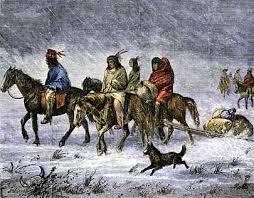
A springboard wagon topped a ridge surrounded by a grove of ancient juniper trees seven miles outside Muskogee. The wagon was weighted down with several heavy crates and made little sound. The contents inside the crates slouched as the vehicle slogged through the rain-soaked turf. The soft ground muffled the hardworking wheels and the horse’s hooves. Solomon Coppell, an unshaved man dressed in a dirty, fawn-tan suit with a long-tailed coat, drove the wagon over a crude trail cut deep in mud and dirt. His roving button eyes scanned the scene in front of him, looking for anything out of the ordinary.
Just beyond Solomon’s line of sight, tucked behind a thicket of brush, Captain Sam Sixkiller sat on his horse watching him.1 Sweat rolled down the lawman’s face as the sun in late spring of 1883, riding up into a leaden sky, empty and cloudless, and touched the captain with a sticky heat. Solomon was uncomfortable too. He pulled off the flat-brimmed $50 hat on his head and backhanded a bead of perspiration off his hairline. He then put his hat back on as he continued along his way. The captain waited for just the right moment and then in one fast, flawless movement spurred his horse onto the trail directly in front of Solomon’s team.
A stunned Solomon quickly jerked back on the reins of the animals and brought the skittish horses to a stop. “Hold it, Coppell!” Captain Sixkiller announced in a sober, stern voice. “You’re under arrest.” Solomon glanced at the cargo he was hauling and back to the captain. The lawman was alone and the bootlegger was confident he could survive a confrontation with his wagon load intact. Solomon stared at the captain for a moment shaking his head. “I got a tip you were bringing booze into the Nation,” the captain informed him. Solomon didn’t reply and showed no signs of cooperating “Surrender, Coppell,” Captain Sixkiller warned him again. “Throw your guns out in the road.” The captain was empty-handed, his leg gun still resting in a holster on his thigh. Coppell made a grab for the shotgun on the wagon seat.2 The captain’s hand whipped forward in a short, small arc. There was no strain. He saw Coppell’s face, distorted and desperate. His gun kicked back against his wrist. One shot. He saw Coppell’s body jerk. Captain Sixkiller’s gun exploded before it cleared his coat. He saw the flame of the shot lick through the fabric and curl to form a smoldering ring. Coppell swayed and fell into the trace chains and wagon tongue. The team reared and snorted and pawed at the air. The captain calmed the horses and kept them from running away.3
Most Muskogee residences agreed that Captain Sixkiller was an effective policeman, quick to enforce the laws regarding the buying and selling of alcohol. Some thought the rules should be relaxed. Cherokee Indian business owners believed they should have the right to purchase liquor to be sold to white railroad workers and settlers passing through. Indian leaders maintained such measures would lead to an increase in violence on the Nation and insisted that troublemakers who peddled whiskey were to be stopped.4
Although Captain Sixkiller was never accused of being too harsh on those who violated the law, there were Indians like former chief of the Cherokee Nation, Lewis Downing and Indian agents like John B. Jones who thought that the United States marshal and his deputies went too far in upholding the law. “Some deputy marshals make forcible arrests,” Chief Downing told Indian agent Jones in a letter, “without regard to circumstances or the facts of the case, and without any of the forms of law.”5 Smugglers occasionally planted whiskey on innocent people making their way across the Nation. If they were stopped by Captain Sixkiller or his deputies and alcohol was found in their possession they were arrested and taken immediately to Fort Smith, Arkansas, to be prosecuted. Chief Downing strenuously objected to the captain’s rush to judgment and believed in those instances such individuals should be given the benefit of the doubt.6
To learn more about the life and times of Sam Sixkiller read
Sam Sixkiller: Cherokee Frontier Lawman
This Day…
Mayhem in Muskogee
Enter now to win a copy of the award winning book
Sam Sixkiller: Cherokee Frontier Lawman
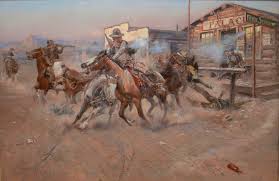
A hot sun beat down on the busy residents of Muskogee, Oklahoma, in June 1880. A heavy veil of humidity, like a stifling blanket hung over the town as well.1 The primitive railroad stop was slowly coming into its own. More than five hundred people called the area home, among them were employees of the Missouri-Pacific Railroad. The workers gathered by the score and milled about the hamlet of lean-tos, tents and cabins. Gamblers had pitched their canvas dwellings in prime spots, and crowds flocked around their tables. Quarrels flared up between slick poker dealers and inexperienced card players. Soiled doves prowled around the gaming tents and curious male bystanders like panthers. They enticed men looking for a fight to their crude dens then stripped them of any funds they had not lost in a crooked card game. Unsuspecting shoppers and their families roamed in and out of the heated arguments that made it into the street. They gawked warily at the chaos while on their way to and from various stores.2
City officials watched the scene play out in disgust. Bootleg alcohol was usually sold to the railroad crews and the houses of ill repute, and the clientele had a hard time controlling the amount they consumed. More often than not customers who frequented bawdy houses and who drank to excess were prone to violence.3 They terrorized the neighborhood surrounding the brothels, recklessly firing their guns at women and children and brawling with townsmen who challenged them to put away their weapons.4
In spite of repeat warnings from law enforcement officers like Colonel J.Q. Tuffts, a United States Agent for the Union Indian Agency in Muskogee, to the madams who ran the brothels to shut their businesses down voluntarily, no efforts had been made by them. Brothels were considered a necessary evil; a portion of the income spent at such houses supported public services such as the police department.5 Agent Tuffts didn’t care about that. He considered the bordellos a hangout for criminals and delinquents from all over the area. When Agent Tuffts made Sheriff Sixkiller captain of the Indian police in early February 1880, he made ridding Muskogee of such houses a priority for Sam’s administration.6 Anxious to prove himself in Muskogee since leaving office under a cloud of turmoil in Tahlequah, Sixkiller was eager to accept the job and the challenge.7
Captain Sixkiller and seven deputies, representing the full force of the police force, marched through the streets of Muskogee to a house in the red light district occupied by the most sought after working women in town. A sign in front of the structure read Hotel de Adams.8 Captain Sixkiller and his men stopped short of the building and studied their next move carefully. A couple of cattle punchers tromped out of the enterprising establishment and headed off in the opposite direction of the lawmen unaware anything out of the ordinary was about to happen. Laughter wafted out through the open windows of the building. Captain Sixkiller motioned for deputies on his left and right to cover the back of the business. When he thought the men had time to get into place he moved up the dusty path to the front door with the other lawmen.9
Use this form to enter to win!
To learn more about the life and times of Sam Sixkiller read
Sam Sixkiller: Cherokee Frontier Lawman
This Day…
Trouble in Tahlequah
Enter to win a copy of the award winning book
Sam Sixkiller: Cherokee Frontier Lawman
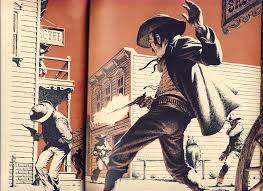
Willis Pettit a tall, well-built black man sunk his spurs into his horse’s backend and the animal, already moving at a fast pace, quickened his stride. The anxious rider chanced a glance over his shoulder to see if he was being followed. In the landscape he left behind there was no sign of any other rider. A flash of relief passed over his face.
Sheriff Sam Sixkiller was in pursuit of Willis and had anticipated the route the fleeing criminal would take and was waiting for him at a ford in the Illinois River several miles outside of Tahlequah. The sheriff’s horse carried him over the rocks in the shallow section of water then dropped his head into the liquid and eagerly drank. Sam swung himself crossways in the saddle, lifted the canteen hanging off the horn, opened the container and took a long swig. He carefully scanned the scenery around him as he hopped off his horse and plunged his canteen into the water to refill it. The sound of a fast approaching horse made him pause for a moment. The sheriff returned the canteen to his saddle then lifted his rifle out of a holster. Turning slowly toward the sound, he leveled his gun in the direction of the oncoming steed.
Willis and his ride emerged from the thicket that flanked the river on both sides and followed the incline to the water’s edge. The horse spooked and reared back when it came up on Sheriff Sixkiller, and Willis was thrown in the process. Before he could get to his feet, he was staring down the barrel of the sheriff’s gun. He raised his hands in surrender, cursing his luck in the process.
On May 15, 1876, Sheriff Sixkiller arrested Willis Pettit for “assault with intent to kill Emanuel Spencer with a pistol.” It was the first of many arrests for Willis in the Cherokee Nation during Sam’s time in office. Willis, a former slave, aligned himself with other ex-slaves who believed they were entitled to land given to the Five Civilized Tribes. Their belief was based on the fact that slaves owned by the Cherokee, Chickasaw, Choctaw, Creeks, and Seminoles who were freed after the Civil War should be granted a part of the territory for their own exclusive use. Not every tribe agreed with the idea, and conflict sparked controversy, and at times, violence.
Use this form to enter to win a copy of Sam Sixkiller: Cherokee Frontier Lawman
To learn more about the life and times of Sam Sixkiller read
Sam Sixkiller: Cherokee Frontier Lawman
This Day…
Fame & Elwood P. Dowd
I took part in the Tucson Book Festival this past weekend and in many respects it was a sweet experience. I spent time with old friends and talked about writing, old western movies, and Seinfeld episodes. I met readers who were great fans of the western genre and were happy to share their thoughts about their favorite western authors from Dorothy Johnson to Johnny Boggs. I also met a few celebrated authors behaving badly. I was initially excited to make their acquaintance and found myself wanting to be within earshot of their tales about the books they’ve written and the literary giants they frequently come in contact. As the evening progressed and one insulting remark after another was made about the struggling western authors they’ve had the displeasure to be around or read I found myself less enamored of the big shots and more and more ashamed that I held them in high regard at all.
Why is it that I’m so quick with adulation for the banal, yet so begrudging with respect for the truly consequential? I should have been satisfied to spend an evening with those writers who had a true love of the Old West rather than a couple who had a true love for themselves and westerns were merely a footnote. Very poorly done, Chris, very poorly done.
You know, all I can figure that so many of us feel so anonymous, so powerless, and so insignificant that we howl and yelp at the mere hint of notoriety, like dogs watching the moon rise in the night sky. Hey, forget the guy who is setting at a booth all day peddling his western books to passersby and his wife who is working the register, when is that guy that’s been in numerous documentaries and has been working on the same western novel for six years going to get here?”
Will the doctor with the cure for cancer please sit the down, here comes the multi-award winning author who has penned yet another book about Wyatt Earp.
Look…in the penumbra between absolute obscurity and worldwide renown there exists a shadow region filled with a seething horde of pan flashers, dime store magicians and Holiday Inn cover bands hoping for a big slice of adulation quiche. And while most of us are content to rubberneck the carnage on the side of the road, too many people are desperately striving to actually be the car wreck, and I’m not sure we should feel compelled to recognize them. I know I’m going to work on that.
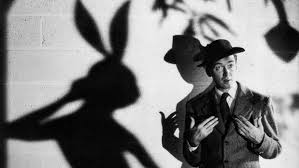
There’s a great line from the movie Harvey that played over and over again in my head this weekend. Elwood P. Dowd, Jimmy Stewart’s character in the film, explains his philosophy of life in the following way: “In this world, you must be oh so smart or oh so pleasant. Well, for years I was smart. I recommend pleasant.” Not only am I going to surround myself with writers who behave in such a manner I’m going to demand that behavior in myself.
This Day…
1878 – Frank Baker and Billy Morton were in the custody of a Regulator Posse led by Dick Brewer for their participation in the murder of John Tunstall. In an attempt to escape at Steel Springs, New Mexico, posseman William McCloskey was killed by Morton, but Morton and Baker were both quickly shot by the remaining posse members.
Principals of Peace
Enter to win a copy of the award winning book
Sam Sixkiller: Cherokee Frontier Lawman
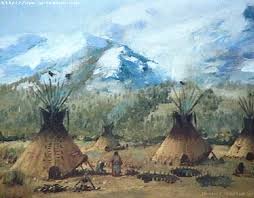
The sweeping prairie lay quietly under the heat of a brassy sun as a lone wagon topped a grassy knoll that afforded an arresting view from every direction. Redbird Sixkiller drove the team of two horses pulling the vehicle toward the town of Tahlequah, Oklahoma Territory, in the near distance. His four-year-old son, Sam, sat beside him captivated by the sights and listening intently to the stories he told him about his ancestors and the origin of the Sixkiller family name. Redbird shared with Sam a tale about one of their fearless relatives. The ancestor was engaged in battle against the Creek Indians and had killed six braves and then himself before allowing another band of hostile Creek Indians that surrounded him to attack. The Cherokee Indian warriors who witnessed the daring act referred to the warrior as Sixkiller.1
Conversation between father and son died down as they rode into Tahlequah. Thousands of Cherokee Indians from the eastern and western portions of the state had descended upon the location to attend a convention that promised to unite the two factions. Since being removed from the Native homes, divided and sent to live at opposite ends of the territory, the Cherokee people were battling among themselves.2 The central theme of the convention was “one body politic under the style and title of the Cherokee Nation.”3 Redbird and Sam attended the ambitious meeting in September 1846 along with more than two thousand other Indians.4 Redbird wanted his son to see the efforts being made to resolve the violent conflict that had erupted between the groups. The factions did not agree on the concessions that should be made to the United States government over the land. The Cherokees in the east were opposed to leaving their homeland no matter what the government promised in exchange. Those in the west were in favor of the removal of the Cherokee to Oklahoma Territory, the funds and improved provisions that accompanied the move.5 Redbird was in favor of the Cherokee people coming together as one. He felt the prosperity and welfare of the Indian Nation and his family depended upon an undivided front.
Use this form to register to win!
To learn more about the life and times of Sam Sixkiller read
Sam Sixkiller: Cherokee Frontier Lawman