
1877 – John Larn resigned as Sheriff of Shackleford County, Texas because he and John Selman were found to be stock thieves.
A Killing in Tahlequah
Enter to win a copy of the award winning book
Sam Sixkiller: Cherokee Frontier Lawman
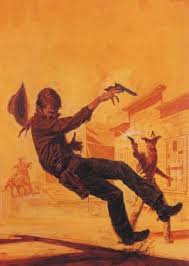
Although his exploits on the job were as courageous as Wild Bill Hickok or Wyatt Earp, the name of Sam Sixkiller is scarcely recognized today. The criminal class that invaded the Indian Nation in the region now known as Oklahoma from 1870 to 1886 had to contend with an Indian police force known as the Lighthorsemen, of which Sam Sixkiller was a member. His ability to fearlessly handle horse thieves, bootleggers, murderers, and rapists that perpetrated such illegal acts on Indian land earned him the respect of his people and fellow officers.
As High Sheriff in Tahlequah, the capitol of the Cherokee Nation, Sixkiller apprehended white lawbreakers selling rot-gut whiskey to Indians and squared off against hostile mixed-bloods like “Badman Dick Glass.” Glass had a reputation that rivaled Jesse James; some said he was even more ruthless. The sheriff wasn’t intimidated by the outlaw and did what was needed to bring him in. Sam Sixkiller not only arrested outlaws and placed them in jail, but also served as the warden of the very facility that housed the lawbreakers.
From Tahlequah, Sixkiller moved on to Muskogee, in present-day Oklahoma where he was promoted to Captain of the Lighthorsemen and helped to bring peace to the volatile area. When the railroads sliced through the landscape, Captain Sixkiller was named a special agent to the rail lines, thwarting attempted robberies and staying off whiskey peddlers hoping to transport their goods across the region. Isaac Parker, the famous 12th Judicial Circuit Judge that held court at Fort Smith, Arkansas from 1868 to 1898, was so impressed with Captain Sixkiller’s tenacity and dedication to law and order he recommended the officer be given a commission as a United States Deputy Marshal. These additional responsibilities further exposed the lawman to some of society’s most dangerous characters.
A legal altercation between Sixkiller and a pair of violent repeat offenders named Richard Vann and Alf Cunningham sparked a vendetta that led to the lawman’s death. Off duty and unarmed, Sixkiller was ambushed and killed by the criminals on Christmas Eve in 1886.
The death of Captain Sixkiller exposed a serious void in the federal law as it pertained to those who murdered Native American U.S. Deputy Marshals. There was nothing on the books that made it a federal offense to kill an Indian officer. Although legislation to correct this heinous oversight eventually passed, it came too late to affect the cowards that robbed Sixkiller of his life.
Sam Sixkiller died a martyr to the cause of law and order. His story is not only about his life and untimely demise, but also about the everyday life of a frontier lawman and the duties he performed, from the mundane to the perilous.
Use this form to enter to win.
To learn more about the life and times of Sam Sixkiller read
Sam Sixkiller: Cherokee Frontier Lawman
This Day…
Comes a Lighthorseman
Enter to win a copy of the award winning book
Sam Sixkiller: Cherokee Frontier Lawman
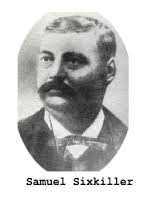
Lawman Sam Sixkiller led his horse through a belt of sparse timber along the Illinois River in Southeast Oklahoma. He was a stocky, dark-skinned, heavy-shouldered man with a neatly trimmed, droopy mustache, and small dark eyes that were flatly calculating.1 They shifted purposely from the streams of sunlight off a growth of blackberry bushes to the rocky path dancing before him. Apart from the sound of his roan’s hooves slowly moving through the sweet-gum shrubs and short grass, there was a mingling of a trio of agitated voices wafting through the warm air.2
Sam urged his ride into a clearing where three half-blooded Cherokee-Seminole Indians sat playing dice.3 In between rolls of the die the men drank from an amber-colored bottle they eagerly shared with each other. Scattered beside the men were four empty bottles of liquor. The drunken Indians barely noticed Sam slowly inching his horse into their crude camp.
The men were undisturbed by Sam’s presence and continued with their game. They argued over whose turn it was, nearly coming to blows over which player went next. Sam watched them toss the dice on a thick blanket. At first glance, the blanket appeared to be draped over a log. The closer he got to the action the more it became clear the make-shift table was actually the body of a fourth Indian. A stream of dried blood had trickled out from under the covering and pooled around a stand of butterfly weeds.
Sam scrutinized the scene more carefully and spotted a massive knife within reach of the Indian closest to him. Sam casually pushed his jacket over the six-shooter strapped on his side, revealing not only the weapon, but the slightly tarnished badge that showed he was a member of the Cherokee Nation police force. One by one the men turned and looked at the lawman. For a breathless instant Sam watched the knife, expecting one of the Indians to snap it up. Without saying a word the three got to their feet, wavering a bit as they did so. Sam pulled his gun out of his holster and leveled it at the men as he lifted his five feet eight inch frame off his horse. He motioned for the men to back away from the body, and they reluctantly complied. Disgusted, Sam walked over to one of the bottles and kicked it hard. It spun into a nearby rock and broke. What little booze was left inside it spilled out and quickly soaked into the dry land.
Sam made his way to the motionless man on the ground and, using the toe of his boot, rolled him out from under the blanket. The man was dead. There was a deep cut across his throat, and his limbs were stiff.
Use this form to enter to win!
To learn more about the life and times of Sam Sixkiller read
Sam Sixkiller: Cherokee Frontier Lawman
This Day…
Cherokee Lawman
Enter now to win a copy of
Sam Sixkiller: Cherokee Frontier Lawman
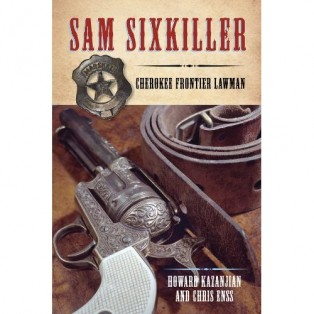
Sam Sixkiller was one of the most accomplished lawmen in 1880s Oklahoma Territory. And in many ways, he was a typical law enforcement official, minding the peace and gun slinging in the still-wild West. What set Sam Sixkiller apart was his Cherokee heritage. Sixkiller’s sworn duty was to uphold the law, but he also took it upon himself to protect the traditional way of life of the Cherokee. Sixkiller’s temper, actions, and convictions earned him more than a few enemies, and in 1886 he was assassinated in an ambush.
This biography takes a sweeping, cinematic look at the short, tragic life of Sam Sixkiller and his days policing the streets of the Wild West. Sam Sixkiller: Cherokee Frontier Lawman was honored by the Oklahoma Historical Society as the Most Outstanding Book on Oklahoma History in 2012.
To learn more about
Sam Sixkiller and his career as a fearless peace officer read
Sam Sixkiller: Cherokee Frontier Lawman
This Day…
Dear Mr. Gable
Last chance to enter to win a copy of
Entertaining Women:
Actresses, Dancers, and Singers in the Old West
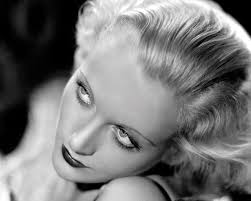
When movie star Carole Lombard died suddenly at the age of 33, some said it was the end of an era-not just of her hilarious brand of screwball comedies like My Man Godfrey and Twentieth Century but off-screen , too, where her raucous and profane wit made her one of the most fun people in Hollywood. She was the type of star little girls dreamed of becoming: not only was she beautiful and glamorous, she was also married to Clark Gable, creating one of the most sensational love matches in Hollywood’s golden days.
The pair were so well liked that it made perfect sense for them to be asked to headline the first war-bond drive after Pearl Harbor. The campaign would peak in Indianapolis, in Lombard’s home state, so she decided to go anyway after Gable declined and took along her mother instead. On one night, January 15, 1942, Lombard helped raised more than $2 million, four times what organizers hoped for. Afterward, Lombard was eager to get back to California, so she instructed her agent to book them on an airplane flight instead of the train. Lombard’s mother was most reluctant. She had never flown before and her numerologist had told her that January 16 was an unlucky day for flying.
Lombard flipped a coin, an after the star called tails and won, the two women and the press agent took off at 4 a.m., Friday, January 16, on a flight that included several stops and was to take seventeen hours. One stop Friday afternoon was in Albuquerque, New Mexico, where several military officers wanted to board and displace civilian passengers. Four passengers got off the plane, but Lombard, pointing out that she had just raised $2 million for the war effort, convinced the pilot to add three seats and let her and her companions continue the flight.
The plane made one last stop, in Las Vegas, to refuel, then took off at 7:07 p.m. headed for Los Angeles. About a half hour later workers at the Blue Diamond Mine south of Las Vegas reported seeing a bright flash atop a distant mountain and then heard an explosion. It seems the pilot, who had been reprimanded several times before for disobeying flight regulations, was flying off course over the mountains to try and make up for lost time from all the previous stops. The plane grazed a rocky projection than slammed into a wall of Table Rock Mountain near its peak at 8,000 feet.
It took rescue workers, led by a local 70-year-old Indian, almost a day to climb the steep cliffs and read the crash site, surrounded by snow several feet deep. There was no snow near the destroyed plan. Many of the nineteen passengers and three crew members, including Lombard, were so badly burned, they couldn’t be identified. It was several days before all the bodies could be removed from the mountains.
Gable, who had flown to the area and paced nervously until it was clear there were no survivors, soon afterward enlisted in the Army Air Force as a 41-year-old private.
To learn more about Carole Lombard’s and about the other talented performers of the Old West read
Entertaining Women: Actresses, Dancers, and Singers in the Old West.
This Day…
The Emotional Actress
Enter now to win a copy of
Entertaining Women: Actresses, Dancers, and Singers in the Old West
Winners will be announced on February 28, 2016
Long before actors were vying for an Oscar nomination and world wide fame thespians were trying to carve out a modest living entertaining prospectors and settlers of the Old West. Today the curtain goes up on a woman entertainer who captured the hearts of the western pioneers.
Ladies and gentlemen, Charlotte Thompson,
The Emotional Actress
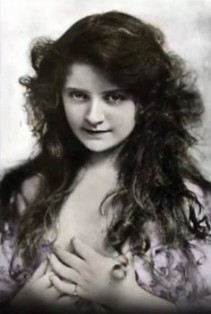
Among the many talented, intrepid actresses who performed in the Old West were London born Charlotte Thompson. She came to the United States with her father in 1850s. Jane Eyre was one of her major roles. She played the part in 1874, 1883-85 and toured several eastern U.S. as Jan Eyre from 1875, 1877, 1885, 1887.
Miss Charlotte Thompson. It is a pleasure to announce the coming to San Antonio next week of this charming lady. Miss Thompson is one of the best emotional actresses of the American stage, especially in the noble passion which make womanhood admirable. None can see Miss Thompson, in her impersonations, without loving and respecting woman more and more, and on the account, we consider her a great actress, and one certainly whom everyone should come out to patronize. These are our thoughts of her most recent work.
“A large audience was amply rewarded last evening for its attendance at the opera house, in the play Drifting Clouds as produced by the well known emotional actress, Charlotte Thompson, and her excellent company. The character of Phyllis Denoir, impersonated by Miss Thompson, was one of the most exacting nature, but the role suffered nothing at her hands. It was a very strong piece of emotional acting carried out with strict propriety and without any of the very ragged bits of passion so often seen in like situations. The drama itself is a powerful one, and without the few humorous moments with which it is so pleasantly interspersed, would, with Miss Thompson’s acting, be almost too tragically intense to afford pleasure. While the art of the author carries on the plot throughout with interest the happy denouncement leaves nothing to be desired at its termination.”
San Antonio Times March 19, 1890
To learn more about
Charlotte Thompson’s illustrious career and her performances across the Old West read
Entertaining Women: Actresses, Dancers, and Singers in the
Old West.