
1856 – Mabel Loomis Todd, American editor and author (d. 1932)
Thanksgiving – A Lively Celebration of Life
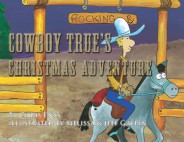
Time to enter to win a copy of the children’s book Cowboy True’s Christmas Adventure.

A woman is credited with launching a successful campaign to have thanksgiving declared a national holiday. She was Sara Josepha Hale, editor of a lady’s magazine which was the most widely read periodical of her time.
Mrs. Hale wrote letters to influential people in every walk of life, including public officials, urging a national Thanksgiving Day observation. In 1858, she stepped up her efforts in hopes that such a day would help avert civil war. She persisted, and finally, in 1863, President Lincoln issued a national Thanksgiving Day proclamation. Every President since then have done the same and so have the Governors of all the states.
To learn more about how Cowboy True celebrated the holidays read
Cowboy True’s Christmas Adventure.
All proceeds raised from the sale of the book go to benefit
UC Davis Children’s Hospital.
Thanksgiving in Wyoming
Enter to win a copy of the children’s book
Cowboy True’s Christmas Adventure.

The following Thanksgiving poem was written by a rancher’s wife in Pinedale, Wyoming in 1905.
Thanks be to Thee, 0 God ! Not that Thou set the darkened sky with light. Of countless stars, framed in solemnity — But that some soul who suffers in the night. Sees one star through the window’s little pane. And, by that gleam of hope, first prays to Thee. Thanks be to Thee, O God ! For throbbing music which the world’s voice thrills;
But most for melody which sings, alone. The bird in deepest wood-—or song that stills. A child to sleep, far from the grand refrain
Of Fame’s great chorus, chanting tunes well known. Thanks be to Thee, O God ! For wondrous beauty which Thou gave the earth,
But most for loveliness in baron sod; A green spot in the parched grass—the birth. Of some pure, saintly life not lived in vain. In haunts of wickedness which know not God. Thanks be to Thee, O God !
For Autumn harvest men have toiled to reap; For love, for home, for laughter through our tears, But most of all for seeds which, in the sleep Of Winter, wait for sun and Spring-time rain, holding potential growth for coming years.
To learn more about how Cowboy True celebrated the holidays read
Cowboy True’s Christmas Adventure.
All proceeds raised from the sale of the book go to benefit UC Davis Children’s Hospital.
The Proclamation
Win a book for the holidays. Enter to win a copy of the children’s book
Cowboy True’s Christmas Adventure.

A thanksgiving proclamation from 1855. WHEREAS, The People of the State of California have, during the past year, been significantly blessed with health, abundant harvests, and all the elements of true happiness and substantial prosperity. AND WHEREAS, It is the duty of a people thus blessed with the protecting care of Almighty God, in an appropriate manner to address devout gratitude, thanksgiving and prayer to the Great Ruler of the Universe, for the manifold blessings He has during the year been pleased to bestow. Now, therefore, I JOHN BIGLER, Governor of the State of California, do hereby appoint and set apart, THURSDAY, THE 29th DAY OF NOV. A. D. 1855, as a day of thanksgiving and prayer to the Almighty God, and all good citizens of the State are hereby requested to observe the same as such. Witness my hand and the Great Seal of the State, at the City of Sacramento this the 5th day of November, A. D 1855. JOHN BIGLER.
To learn more about how Cowboy True celebrated the holidays read
Cowboy True’s Christmas Adventure.
All proceeds raised from the sale of the book go to benefit
UC Davis Children’s Hospital.
This Day…
Where Thanksgiving Traditions Are Still Observed
Win a book for the holidays. Enter to win a copy of the children’s book
Cowboy True’s Christmas Adventure.
Prospectors and mining camp followers in the Gold Country in 1869 began making plans for lavish Thanksgiving celebrations in late October. According to the October 20, 1869 edition of the Daily Alta newspaper, boarding house owners attracted Argonauts and camp followers for miles around to enjoy the holiday with them. “Judging from the number of Balls coming off, the people of El Dorado seem determined to have a happy time at the “Thanksgiving Ball” that is to be given at the Nevada House in Georgetown,” the Daily Alta article read. “The managers will accept your thanks with a purchase of a ticket. In addition to the ball a feast will be served including turkey and all the trimmings. The history of Thanksgiving Day reaches back to the early colonial days, when a little band of strong hearted and earnest men and women who had ventured across the seas in search of freedom and life and liberty came to this country.”
To learn more about how Cowboy True celebrated the holidays read
Cowboy True’s Christmas Adventure.
All proceeds raised from the sale of the book go to benefit
UC Davis Children’s Hospital.
Staring Down a Rattlesnake
Last chance to enter to win a copy of Tales Behind the Tombstones: The Deaths and Burials of some of the West’s Most Nefarious Outlaws, Notorious Women, and Celebrated Western Actors and Law men.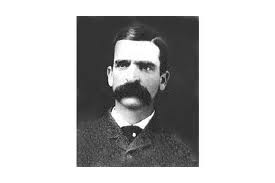
It wasn’t a bullet from an outlaw’s six-shooter or an enemy soldier in the Spanish-American War that claimed the life of one of the fiercest lawmen in the history of the Dakotas. Seth Bullock died of colon cancer. The accomplished businessman, rancher, politician, and lawman suffered with the disease for years and when he died in September 1919 at the age of sixty-two, he was remembered for his strength of character as well as the influence he had on the wild frontier.
Born in Amhertberg, Ontario, Canada in August 1876, Bullock was described by his good friend President Theodore Roosevelt as a “splendid looking fellow with his size and subtle strength, his strongly marked, aquiline face with his big mustache, and the broad brim of his soft hat drawn down around his hawk eyes.”
According to the September 28, 1919 edition of the Kansas City Star, before Seth Bullock made his mark on the Black Hills of Dakota he was a pioneer in Montana. He was the first sheriff in Helena, Montana and a member of a famous vigilance committee which rid the region of a desperate band of horse thieves.
Upon hearing that gold had been discovered in the Black Hills, Seth and some of his friends decided to go to that area of the country in the summer of 1876. In March 1877, he became Lawrence County, Dakota’s first sheriff. The gold camp contained some of the most notorious, cut-throat criminals in the country. Many were intimidated by the lawman.
Seth dressed like a minister, had the stare of a mad cobra, and was silent as a confidential clerk working for Rockefeller. In the beginning, his ability to effectively do his job in Lawrence County was challenged by an outlaw who disliked the lawman intensely. He gave orders that Seth should leave the camp and never return. The man threatened to shoot Seth if he didn’t go. After being warned by friends, the sheriff borrowed a squirrel gun from an old hunter and proceeded down the street to the saloon where the desperado was waiting. When the man saw Seth unafraid and coming right for him he backed down and fled the scene.
As a representative of law and order the Dakota lawman tracked down a number of stage robbers, gamblers, and murderers, and according to the October 1, 1919 edition of the Fort Wayne Journal Gazette killed more than twenty-five lawbreakers who refused arrest.
In addition to his career in law enforcement, (Seth also served as a United States Marshal in Western Dakota Territory) he co-owned and operated a hardware store and warehouse in Deadwood with his business partner Sol Star. It was one of the most prosperous companies in the Black Hills.
Seth met Theodore Roosevelt in 1884. Roosevelt was a deputy sheriff in Medora, North Dakota and had tracked a criminal to Seth’s jurisdiction. The two lawmen became fast friends. He became one of Roosevelt’s Rough Riders in the Spanish-American War and was named captain of one of the future President’s troops.
Seth was an elected representative to the Senate and introduced the resolution to set aside Yellowstone as a national park. He was the first forest supervisor of the Black Hills and the cofounder of the mining town Belle Fourche.
Seth was serving his third term as United States Marshal for the District of South Dakota when he was diagnosed with cancer. Friends and family noted that in spite of his health he refused to be complacent. He continued on with his work regardless of the debilitating illness.
When President Roosevelt died in January 1919, Seth decided to erect a monument in his friend’s honor. He oversaw the building of a stone tower known as Mount Roosevelt on Sheep Mountain located five miles from Deadwood. The tower was completed in June 1919. Seth died on September 23, 1919 at his home surrounded by his loved ones. He was buried at Mount Moriah Cemetery in Deadwood. His grave faces Mount Roosevelt.
To learn more about the death of legendary characters read Tales Behind the Tombstones: The Deaths and Burials of some of the West’s Most Nefarious Outlaws, Notorious Women, and Celebrated Western Actors and Lawmen.
Down Went the Duke
Giveaway! Enter to win a copy of Tales Behind the Tombstones: The Deaths and Burials of some of the West’s Most Nefarious Outlaws, Notorious Women, and Celebrated Western Actors and Lawmen
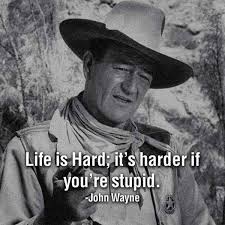
After acting as either a cowboy or a soldier in nearly one hundred films, John Wayne finally won a best actor Oscar in 1969 for True Grit. The quintessential macho man was himself exempt from service during World War II owing to a problem with his shoulder. Winning the Oscar, some say, added another ten years to his life. Although he was a longtime smoker, averaging four packs a day, Wayne nevertheless died of gastric cancer at age seventy-two in 1979. In 1955 John Wayne was among two hundred twenty cast and crew member who worked on the film The Conqueror. It was shot on a location in Utah, which was contaminated by radioactive fallout from atomic bomb tests. Much of the soil was transported back to Hollywood for studio scenes. By 1980 more than ninety of those who worked on the movie contracted cancer; forty-six died. Even though Wayne knew of the danger, often carrying a Geiger counter onto the set, he believed the risk insignificant.
To learn more about the death of legendary characters read Tales Behind the Tombstones: The Deaths and Burials of some of the West’s Most Nefarious Outlaws, Notorious Women, and Celebrated Western Actors and Lawmen.
This Day…
Death of the Cowboy Philosopher
Enter to win a copy of Tales Behind the Tombstones: The Deaths and Burials of some of the West’s Most Nefarious Outlaws, Notorious Women, and Celebrated Western Actors and Lawmen
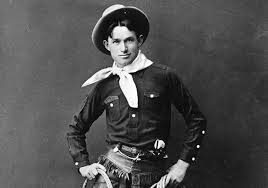
It looks like the only way you can get any publicity on your death is to be killed in a plane. It’s no novelty to be killed in an auto anymore.” Will Rogers had the knack to turn anything into a joke and get away with it. Part Cherokee, Rogers took his lariat tricks from Indian territory in Oklahoma to Broadway, where his shy grin and classic drawl – “All I know is what I read in the paper” – made him the most popular folk hero of his time. He wrote a nationally syndicated newspaper column starting in 1926 and would file it six times a week no matter where he happened to be – which was likely to be anywhere in the world.
In August 1935, Rogers happened to be in Alaska, casually flying around the territory with Wiley Post, a famous globetrotting aviator. “Was you ever driving around in a car and not knowing or caring where you went?” Rogers wrote in his column August 12. “Well, that’s what Wiley and I are doing. We sure are having a great time. If we hear of whales or polar bears in the Arctic, or a big heard of caribou or reindeer, we fly over and see it.” The two men had plans to fly over the Arctic to Siberia and on to Moscow to explore the possibility of making it a regular air route. But they kept their mission secret.
The two men took off from Fairbanks on August 15 for a 500-mile trip to Point Barrow, a barren outpost at the northern tip of Alaska. During the flight Post noticed the plane was heavy in front and had a tendency to pitch forward at low speeds.
There immediate concern on August 15 was the weather. They had been warned of dense fog along their route but Post just said, “I think we might as well go anyway.” Rogers agreed and pointed out, “There’s lots of lakes we can land on.” About 50 miles from Point Barrow the fog got bad enough that Post did indeed land but, unsure of their route, they landed on a shallow river 15 miles from Point Barrow to ask directions from some Eskimos.
At 5 p.m. they took off, again. About 50 feet in the air, before they had even reached the end of the water, the engine sputtered. Post turned sharply to the right, then the plane plunged nose-first into the edge of the stream into about two feet of water. The right wing was torn off and the plane came to a rest upside down. Both men were killed instantly. Post was crushed by the engine, which had been forced back into the cockpit. Rogers was also killed by the impact, thought he had been seated farther back in the plan, probably to try to counterbalance the front-end heaviness. It was unclear why the engine misfired, but some have speculated that the plane was out of gas.
After the crash an Eskimo who had given them directions ran 15 miles to Point Barrow to report what he had seen. It took him three hours. It was dark by the time a U.S. Army sergeant set out in a whale boat through the icy waters. He towed the bodies back to Barrow in a skin boat.
Will Rogers was buried in his hometown of Claremore, Oklahoma.
To learn more about the death of legendary characters read Tales Behind the Tombstones: The Deaths and Burials of some of the West’s Most Nefarious Outlaws, Notorious Women, and Celebrated Western Actors and Lawmen.