
1884-King Fisher and Ben Thompson were drunk and full of fun at the Variety Theatre in San Antonio, Texas when they were both playfully gunned down by friends of a man that Thompson had killed there two years previously.
The Most Popular Actress in the World
From Child Star to Beloved Actress
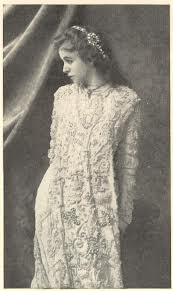
Maude Adams in The Masked Ball.
The Palmer Theatre House in New York was jammed to the doors by a curious clientele all there to see the new actress working opposite the most celebrated actor of the day, John Drew. It was October 3, 1892 when the stunning, elfin-like Maude Adams took to the stage in the play “The Masked Ball.” At the end of the evening Drew would be congratulated on his admirable acting job, but Maude would score a hit that would be greater than his entire career. Her performance was so successful the applause lasted for a full two minutes after she made her exit. She was on her way to becoming a star and local newspapers predicted her talent would be talked about for years to come.
Maude Adams’s stage career began at the tender age of nine months. The play was called “The Lost Child” and the baby that was playing the lead became fussy and could not continue in the show after the first act. Maude’s mother, Annie, who was the female lead in the production, suggested her daughter take the child’s place. Maude was so good that the other baby received her two weeks’ notice immediately after the play ended. For the remainder of that season all the infant roles were played by little Miss Maude.
Maude Ewing Adams Kiskadden was born on November 1, 1872 in Salt Lake City. Her mother, Annie, was a leading lady in the stock company that played in the local Social Hall. Her father James Kiskadden worked for a bank and also in the Alta mines. Although Maude had been quite a success as a baby actress, James was reluctant to allow his daughter to go into the theatre. “She’s my only daughter,” he told his wife. “And I’ve no intention of letting her go on the stage and make a fool of herself.“ Now five years of age, Maude informed her father that she would like to go on the stage and promised that she would not make a fool of herself. James reluctantly gave in to the child’s request and allowed Annie to help her prepare Maude for her second stage appearance.
Maude was to play the part of the small boy, Little Schneider, in “Fritz.” She had nearly a hundred lines to speak in the play, but she memorized them in a couple of days. Critics hailed her first night as letter perfect. The theatre managers were so impressed with her talent they began to bill her on the program as “Little Maudie,” and it was by that name that she was known in the West throughout her career as a child actress.
By the age of seven “Little Maudie” was the reigning child actress of the Pacific Slope. David Belasco, known as the greatest American stage manager, became the child star’s manager. He was captivated by her talent and charm, and along with Annie would help shape Maude into the acting legacy she became.
Annie doted on her child and was immensely proud of her acting ability. When the parts were given out to the company, she was always letter perfect in Maudie’s lines long before she attempted to learn her own. Everywhere the mother and daughter team went they were practicing lines and Annie was helping her daughter understand the character she was to play on stage. They practiced in their dressing rooms, on the street cars and at their home. Maude had an exceptional memory and was a quick study. David was inspired by Annie’s attention to her daughter’s career and years later recalled how he could never see the child on stage without a picture rising up before him of her hardworking, self-sacrificing mother.
David Belasco’s management skills combined with Annie Adams’ tutelage helped make Maude Adams one of the most successful child stars in the West. Quick growth spurts made it impossible for Maude to continue playing children’s parts after a time. She turned 10 in 1882 and her mother decided Maude needed to semi-retire from the theatre and attend school. Annie enrolled her gifted daughter in the Presbyterian Collegiate Institute in Salt Lake City. For four years Maude studied drama and all matters of theatrical production. She was proficient at the harp and learned to speak French fluently. At the age of fourteen she had accomplished so much that she was within a year of graduating.
Maude missed her mother terribly during her years at the Institute. She missed her home and the stage as well. She wrote Annie begging her to let her return to her ‘old work.’ School was fine, but it wasn’t fulfilling to the actress.
Annie gave in to her daughter’s urgings. Maude left school and returned to her mother by the summer. The stage life she had left as a child was not the same when she returned. Her accomplishments as a child actress were merely a novelty now. She found herself a mere nonentity; to her professional friends she was merely “Annie Adams’ daughter.” Annie’s standing as an actress could do little more for her at first than to secure her some temporary engagements as an extra girl. Maude did not take lightly any role she was given, no matter how small. She studied, she watched, she learned many parts. She believed that someday she would be able to use all she had been taught by her mother and other members of the stock company.
Annie’s faith in her daughter’s future never wavered for an instant. She decided to take the teenager to New York, where theatrical parts were abundant. Annie believed Maude might be offered more challenging roles there. After auditioning for several shows, Maude landed a role in the play “The Paymaster.” She had developed into a captivating young girl and was now billed as Miss Maude Adams. David Belasco was in the audience the night the play opened. He had not seen Maude for seven years.
At the end of the run of Midnight Bell, Maude was a much talked- about actress. In all parts of town people were asking each other if ‘they had seen the new little girl in Hoyt’s play at the Bijou?’ Everyone agreed that she was sweet. Offers began pouring in for Maude to star in various productions around town. Charles Hoyt was willing to let her name her own terms if she would sign a five year contract with him. He knew he had struck gold with her talent. Maude declined Hoyt’s offer and signed with manager Charles Frohman. She had decided she wanted to focus on doing serious dramas and Frohman promised her the opportunity.
Frohman hired professional playwrights to create roles for Maude that would give her the chance to exercise her talent to the fullest. The first result was Nell, the lame girl, in a play called “The Lost Paradise.” It was a charming role that showed for the first time what Maude could do in the way of pathos. The favorable reviews led Charles to team the actress with the most popular actor of the day, John Drew. It was a stroke of management genius – one that would help launch Maude as one of the most popular American actresses in the world. Critics and audiences alike raved about her performance and flocked to the theatre to see her every chance they got.
John Drew and Maude Adams worked together in six different plays. Newspaper reviewers wrote that ‘she arrived on the other side of her teaming up with Drew as one of the most accomplished and womanly artists of all the younger actresses.’ It was at this point that Frohman decided the time was now ripe for Maude to come out as a star.
Charles Frohman set about searching for a vehicle that would secure his client’s position as a rising star in the theatre. He hired the well-known Scottish author J.M. Barrie (author of “Peter Pan”) to turn his popular novel “The Little Minister” into a play. Barrie delivered a powerful manuscript and both Frohman and Maude agreed it would make for a stellar debut. After a week of preliminary performances in Washington, Miss Adams made her first metropolitan appearance as a star at the Empire Theatre in New York on September 28, 1897. “The Little Minister” was a huge success, in which Maude Adams as an artist and J.M. Barrie as a playwright shared almost equally. New York critics praised her work.
That performance at the Empire began one of the most remarkable successes in theatrical history. Maude took her Lady Babbie role in “The Little Minister,” west in 1898. Sunday schools cried for her and clergymen of all denominations flocked to see the play.
From coast to coast of the United States the verdict of the playgoers seemed universal: there was only one thing greater than “The Little Minister,” and that was Maude Adams herself. Her popularity soared. Clever businessmen cashed in on that popularity naming the products they sold or manufactured, from children’s toys to corsets and cigars, after the star.
Maude was uneasy with the fame she had earned. She was pleased with the attention, but was fearful audiences would never accept her in any role other than Lady Babbie. She decided to study Shakespeare and by the end of the season she had mastered the role of Juliet. Frohman was galvanized by her dedication and drive and decided to hire a special company of actors and produce “Romeo and Juliet.” By May 1898, Maude’s interpretation of Juliet had been seen in all the leading cities across the country. She deviated from the traditional presentation of the character and decided to play Juliet as a simple, girlish creature of infinite charm. Her performance was recognized by the masses as being ‘the master-stroke of a very clever woman.’ Maude approached her career with a renewed sense of confidence, having proven to herself that audiences appreciated her talent regardless of the part she was playing.
Maude followed up her performance in “Romeo and Juliet” with lead roles in the plays “L’Aiglon,” “Quality Street” and “Joan of Arc.” In between shows she returned to Utah to visit her family. She spent a lot of time with her grandmother, finding great inspiration in their conversations and in the lovely valley of Salt Lake.
Very little is known about Maude’s personal life. She was intensely private and took great pride in the fact that there was scarcely a woman on stage the public knew less about. Historians record that she loved horses and was an exceptional rider. She owned a homestead and farm on Long Island and suffered a nervous breakdown from overwork in the early 1900s. It is rumored that she was deeply in love with her mentor and manager Charles Frohman, but as she drew the line very distinctly between her stage career and her private life, little can be substantiated with regards to an affair between the two.
In an interview done for a national magazine in 1894, Maude commented on her reasons for wanting to keep her personal life personal. “I don’t see why an actress must give her personality to the world, though it seems to be expected, and those who curiously investigate her personal life are not always careful how they use their information.”
In 1904 Maude starred as Peter Pan in one of the most enduring and beloved children’s plays ever written. J.M. Barrie adapted the part especially for her and conveyed in a letter to the actress that she inspired the character of the boy who refused to grow up.
Maude performed the leading role in “Peter Pan” in more than 1,500 performances. During the play’s run, she never left the theatre if children might be waiting outside because she didn’t want to spoil their illusion of the magical, flying boy by letting them see she was a woman. When she played the role in Salt Lake City, children from local orphanages were invited to a matinee. The director of St. Ann’s Orphanage later said that “The only trouble is that it has kept the entire corps of nurses busy trying to prevent the children from flying out the windows.”
Maude followed up her success as “Peter Pan” in starring roles in three more plays by Barrie: “The Pretty Sister of Jose,” “The Jesters” and “What Every Woman Knows.” Outside of the Metropolitan theatre in San Francisco, one of her favorite venues to perform in out west was the Hearst Greek Theatre of the University of California at Berkley. There she introduced audiences to a variety of intriguing characters created by playwright Edmond Ronstand. Audiences consistently hailed her performances as remarkable.
Maude’s accomplishments as a thespian were exceptional, but she excelled in the art of stage lighting as well. She had always been fascinated with the technical aspects of a show and long experience, research, a natural flair for the mechanics involved and a sense of color had given her an advantage. The gifted actor Lionel Barrymore remarked in his autobiography that Maude “could not resist supervising the lights for any given performance.” She felt proper lighting would give the actors on stage a better look and enhance their on-stage presence.
During her thirty plus years in the theatre, Maude spent considerable time in the development of stage illumination. She made so much progress in the study that many engineers looked upon her as an expert. With the help of a skilled electrician she created the widely used dimmer box, a main switch board that controls every light used in the production of the show, including the spotlights.
In 1921, Maude parlayed her love of stage lighting into a job working for General Electric Laboratories. There she experimented with color lamps for movies. She invented a high-powered incandescent lamp that eventually made colored movies possible. An electrical inventor at the lab filed a patent on the product, giving her no credit at all for her contribution. She was advised to sue but refused to pursue litigation and later noted in her diary that she thought herself an “idiot” for her decision.
In 1915, Maude was forced to deal with a series of devastating tragedies. Her mother, grandmother and her manager, Charles Frohman, all died within a short time of one another. The loss of Charles was particularly hard on the actress. Frohman was a passenger on the Lusitania, the passenger ship sunk by a German U-boat. Her grief over his death was a major factor in her decision to temporarily retire from acting. Being independently wealthy at this point in her career, she could afford to do so. She was persuaded to return to the stage only two more times before retiring altogether. Thirteen years after Charles’s death she portrayed the character Portia in the “Merchant of Venice” in Ohio. Her final stage performance was in 1934 at the theatre in Maine, playing Maria in “Twelfth Night.”
In 1937, Maude was invited to join the staff of Stephens, a girl’s junior college in Columbia, Missouri. She was the head of the drama department for six years. She retired from teaching in 1950. Three years later she was hospitalized with complications from pleurisy. So many cards and letters poured in that a large pillowcase was needed to hold them. Though she had been out of the public eye for twenty years, people had not forgotten her.
Maude Adams passed away on July 17, 1953 at her home in Tannerville, New York. She was eighty-one years old. She was buried in the private cemetery at the Cenacle Convent at Ronkonkoma, Long Island.
To learn more about Maude Adams and other famous entertainers on the frontier read Gilded Girls: Women Entertainers of the Old West.
Available everywhere books are sold.
Looking Like Lillian
In the Image of Lillian Russell.
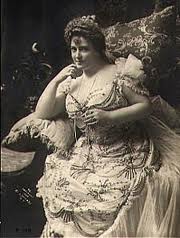
Lillian Russell added sugar to everything – even milk.
Condensed milk was invented by Gail Borden in 1853. After one bad invention followed by another, he finally hit on the idea of food concentrates as an economical way to safeguard the food supply. He once said he conceived the notion by observing his wife adding sugar to her milk to keep her full-figured voluptuousness, a sign of beauty and wealth at the time. Lillian Russell had the full-figure look women tried to emulate. Before, milk was shipped in unsanitary oak barrels, and its spoiled quickly. Although he didn’t invent the tin can, his marketing skills in effect launched the canned food industry. Canning food diminished the possibility of food-storage spoilage, subsequent short supplies from the whims of natural elements, and contamination by vermin. He died in Borden, Texas, of gastrointestinal flu (possibly from drinking from a dented container) in 1874 and had his body packed in a tin can of a railroad car to be buried in Woodland Cemetery in New York.
To learn more about the fascinating Lillian Russell and other entertainers on the frontier read Gilded Girls: Women Entertainers of the Old West.
Available everywhere books are sold.
This Day…
Success and Sadness
The tragedienne who attracted huge audiences…
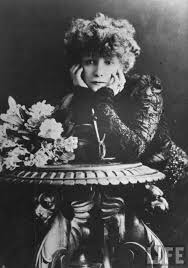
No one played tragedy with such believable intensity as Sarah Bernhardt, and no one brought as much passion and enthusiasm to the pursuit of pleasure. From fishing on the southern California coast to bear hunting in the woods outside Seattle, on every western tour the French actress indulged in some kind of adventure. Sarah Bernhardt threw herself into life with the same characteristic energy she put into her stage appearance. Yet she often slept in a coffin, preparing for that final sleep.
She was born in Paris, France, on October 23, 1844. Named Henriette-Rosine Bernard, she was a thin, sickly child, alternately deeply depressed or shouting for joy. At the age of eight, seeing her aunt’s carriage stopped in the street near the house where her mother had left her for months, and being forbidden to leave by her caretakers, she forced open a second-floor window and jumped out in front of the carriage. Although the fall resulted in a dislocated shoulder and shattered kneecaps, her aunt was compelled to pay attention to the child’s hysterical pleadings to be taken away.
Sarah’s mother and her aunt sent her to school, and later, she was trained in dramatic arts and began her career at the Comedic Francaise. Eventually Sarah performed throughout Europe and in 1880 toured the United States. She was a huge success in major cities like Salt Lake, Denver and San Francisco. Audiences flocked to see Sarah perform. She was known across the West as “The Divine Sarah.”
Sarah Bernhardt died on March 26, 1923. She was buried in a rosewood coffin her mother purchased for her at her insistence when she was but fifteen years old.
To learn more about “The Divine Sarah” and other entertainers on the frontier read Gilded Girls: Women Entertainers of the Old West.
Available everywhere books are sold.
This Day…
The Restless Soul of Jeanne Eagels
An illuminating glimpse at the colorful and often scandalous…
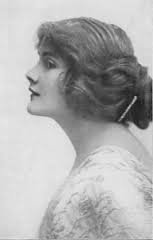
Actress Jeanne Eagels
In 1929 Jeanne Eagels was nominated for a best actress Oscar for The Letter after she died earlier that year at age thirty-nine from alcohol and heroin complications. Eagels had started as a Ziegfield Follies girl, but her talent and beauty soon moved her from the chorus line to center stage. Tabloids of the time followed her progress and her secret marriage to a Yale football star, and they especially liked her temper, her no-shows, and her quitting plays whenever she felt like it. At one point she was banned from appearing on stage by Actors Equity, which had forced her to move to Hollywood to make the “talkie” The Letter, one of the first films that showed the true dramatic possibilities of audio in cinema. In the fall of 1929 she checked into a private drying-out hospital in New York City a week before the stock market crashed; unfortunately she left via the morgue.
For more information about legendary frontier actresses read Gilded Girls: Women Entertainers of the Old West.
This Day…
The Actress Langtry
The Royal Aquarium in Westminster, England, was a hub of activity on April 6, 1876. Many members of London’s wealthy aristocratic society were on hand for the gala opening of the magnificent structure built entirely underwater.
Dignitaries, barristers, popular sculptors, artists, and photographers were there to witness the occasion and to be inspired by the colorful coral reefs, graceful marine life, and crystal-blue waters. Their attention, however, was drawn away from the oceanic scenery when a tall, curvaceous young woman with Titian red hair entered the room. She was adorned in a simple black gown. Her azure eyes scanned the faces staring back at her, and she smiled ever so slightly. Within moments of her arrival, visitors descended upon the woman to admire her beauty.
Eminent portrait painters and photographers approached the unassuming woman and asked her to sit for them. Poets sought introductions and then recited blank verse about her arresting features. By the end of the evening, Lillie Langtry was the toast of Great Britain-a Professional Beauty to be reckoned with.
Emile “Lillie” Charlotte LeBrenton was born to William Corbet and Emilie Martin LeBreton in October of 1853 on the Isle of Jersey, a few miles off the coast of Saint-Malo, France. She was the only daughter in a family of six children.
Beauty alone was responsible for Lillie Langtry’s initial renown. Her photographs were printed in England and American newspapers, and by the time she was twenty-seven years old she was as famous in those countries as she was in her own.
The writer Oscar Wilde, whom Lillie had met at society parties, convinced her that the theatre was her calling and helped her get her start in the business. Lillie took the stage for the first time on December 15, 1881 in the play She Stoops to Conquer at the Theatre Royal. She was an instant hit.
Theatre managers throughout Europe clamored for a chance to star the famous beauty in one of their shows. After touring London and Scotland, performing for full houses nightly, she traveled to America. She appeared in a variety of productions in theatres from New York to San Francisco.
The Jersey Lily (a nickname she acquired because of where she was born) was romantically linked to the Prince of Wales, gambler Diamond Jim Brady, and actor Maurice Barrymore. Everywhere she went men found her shockingly attractive. Among her famous admirers was Judge Roy Bean of Texas. Bean fell in love with Lillie after seeing her photograph posted on a playbill. Soon the walls of Judge Bean’s saloon courthouse in Vinegaroon, Texas were covered with her pictures and press clippings. He renamed that town Langtry and Lillie visited the town named in her honor in 1904. Judge Bean had died not long before. She toured his Jersey Lily Saloon and drank a toast in his honor. Langtry residents gave her Bean’s pet bear, which had been chained for years to the foot of his bed, and the animal ran off as soon as it was released. Lillie was then presented with the Judge’s revolver, the same one he’d used to keep order in his court.
Everywhere Lillie performed across the West she packed venues and received excellent reviews. At times her theatrical performances were upstaged by her beautiful costumes and dazzling jewelry. Thousands of women bought seats in the hope that they would attend a performance in which Lillie wore her fabulous gems.
World-famous Lillie Langtry retired from the theatre in 1919 and made her home in Monaco. She died on February 12, 1929 from influenza. She was seventy-six years old. News of her death spread quickly through the United States. The front pages of newspapers across America recalled her contributions to the theatre, and some editorials declared her passing as “an era that has come to an end.”

The World Famous Lily Langtree