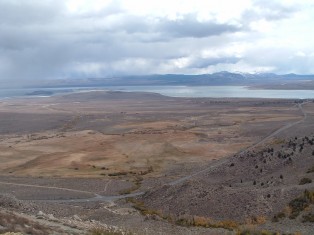
Hopeful sojourners trekked thousands of miles West to find gold.

Hopeful sojourners trekked thousands of miles West to find gold.
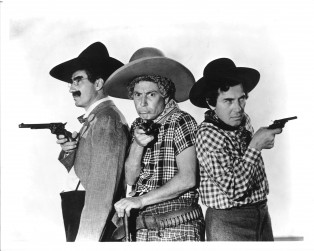 This weekend let your troubles “Go West” with the Marx Brothers. Groucho, Chico and Harpo make even “Dead Man’s Gulch” come to life in this film released in 1940. The movie begins with Groucho attempting to fleece Chico and Harpo of the ten dollars he needs to make up the price of a railway ticket and being completely outsmarted. It’s hilarious. The movie contains a Keystone Cops-like chase in which the boys demolish a train in pursuit of the villains. Also funny. Go West features some of Groucho’s best lines. As he’s romancing a saloon girl he says, “Why don’t you let me go? But no, let’s keep this a perfect memory, and someday this bitter ache shall pass, my sweet. Time wounds all heals. You know, there’s a drunk sitting at the first table who looks exactly like you-and one who looks exactly like me. Dull, isn’t it? He’s so full of alcohol, if you put a lighted wick in his mouth, he’d burn for three days. So, let’s go somewhere where we can be alone. Ah, there doesn’t seem to be anyone on this couch.” This was one of the Marx Brothers last films and they only agreed to do Go West because Chico was in trouble. He gambled a lot and needed financial help. Go West helped him get out of debt, but in a short time he was back in the same situation and the brothers had to go to work again. There wasn’t anything the Marx Brothers wouldn’t do for one another.
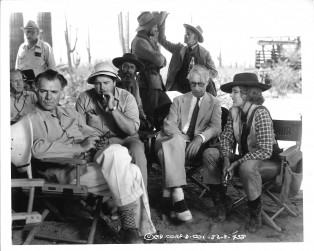 There’s nothing more satisfying for me than watching a great western. More often than not criminals in a good western do not die by the hands of the law. They die by the hands of other men. The men they wronged. The outlaws in a great many westerns I watch know they won’t get away. They know they ultimately can’t get away. I once knew a man who committed no crime, but was sentenced to prison because he was persuaded to take a plea. He’d been severely beaten and raped at a penitentiary transfer station. So they put him in a hospital to make him better so that they could make him worse. He was destined to be beaten and raped again. During the eight years he was gone, he collapsed a number of times as a result of Parkinson’s disease, and the doctors put him in the hospital again. He became friends with the nurses and the doctors, and after a while they helped him to get well enough to go back and take more punishment. I saw him after the brutal attacks and he was a broken man. The spirit of the man was gone. The person sitting next to me during the visit with the man said, “This country’s law and their stinking judges! Isn’t anyone going to do something about them?” Staring into the hollow face of the beaten man I once knew as my brother I said, “I don’t want the people who made the law, and I don’t want the people who passed the sentence. The only ones I want to see get theirs are those that falsely accused and caused this pain.” I am convinced that will never really happen. A good western soothes my soul in the midst of the conflict raging in my mind. Last night I enjoyed watching Arizona. Released in 1940, Arizona is more memorable for the thousands of feet of stock footage it provided for other films. For this tale of the development of Arizona, Columbia reconstructed Tucson as the mud-adobe town it had been while the movie’s director, Wesley Ruggles, created set-pieces in the style of De Mille. In one of the movie’s best scenes, the town’s inhabitants watch the Union troops setting light to everything in their wake, as they withdraw. Gary Cooper and Jean Arthur starred in the picture.
1892-Following discovery of rich veins of silver in southern Colorado by NC Creede, there is a minor rush to the area, as land grants are auctioned off. The town that springs up overnight on this site is named Creede and soon becomes a typical wild mining town. It is here, this year, that Robert Ford, who had killed Jesse James in 1882, will be killed in his own saloon.
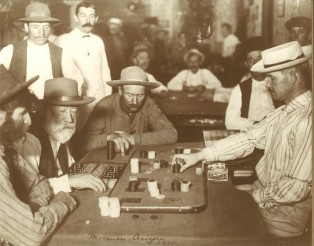 American’s oldest diversion deteriorated into a vice. In the turn of a card or the roll of a dice for all or nothing, there was a kind of daring that touched the American spirit. “The lust for work is matched…by the lust to gamble.” The affluent risked thousands of comforts; the poor risked bread money on gaming tables in slum taverns. The gambling fever produced two opposing species. First were the predatory card sharps and confidence men who understood human weakness and how to exploit it; second were the masses, eternally gullible to the lure of something for nothing. Throughout the nation these adversaries met-in lotteries, over tables, at racetracks, in casinos, cockpits-and the result was nearly always the same. The suckers lost. In 1890, San Francisco had an estimated 2500 illegal gambling houses, which produced, as they did elsewhere, crime and degeneracy. And while these are hardly the by-products one would expect of a leisure activity, it should be remembered that vice can become a pastime for people who had little alternative resource. Starting with the Gold Rush era, the West from the Rio Grande to Canadian border knew no way to spend free hours except gambling. Judge or laborer, clergyman or clerk, all elbowed their way into the gambling tents.
1869-James Oliver patents a chilled-iron plow equipped with a smooth-surfaced moldboard that can slip through the hardened prairie soil without clogging. Other inventors will improve on his basic implement by covering the blade with an edge of tempered steel that can be removed for sharpening. By 1877 completely modern plows will be used.
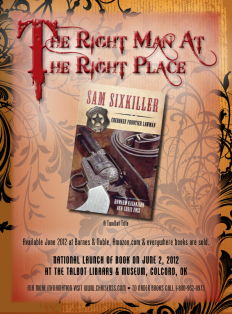 Old West partners to reckon with…Cherokee Lawman Sam Sixkiller and a six-shooter. Besides being a US deputy marshal, Sixkiller was a detective for the Missouri Pacific Railroad and in 1880 became the first captain of the US Indian Police (USIP), which was headquartered at Muskogee, Creek Nation. The USIP served under the Indian agent for the Five Civilized Tribes. Sam Sixkiller came out of this milieu of politics, crime, and upheaval and brought a sense of justice and fairness to the people who lived in the Cherokee Nation and the Indian Territory. Sixkiller became widely known and praised for his law enforcement skills, commitment, and understanding of duty to the job. The Oklahoma Historical Society plans to present its Outstanding Book on Oklahoma History (published in 2012) to Globe Pequot Press and Howard Kazanjian and Chris Enss, publisher and authors of Sam Sixkiller: Cherokee Frontier Lawman during our Annual Awards Luncheon on April 19, 2013. For more information about the book Sam Sixkiller: Cherokee Frontier Lawman visit www.chrisenss.com.