
 Another great Old West partnership -Nat Love and roping. Nat Love (1854-1921) was born to slave parents on the Robert Love plantation in Davidson County, Tennessee. He was freed at the end of the Civil War, just after he turned eleven. At fifteen, he found a task he enjoyed, taming colts for a dime a head. Fortune smiled with a $100 raffle win, giving him enough bucks to split the winnings with his mother and head west. Outside Dodge City, after a wild audition on the back of a foul-tempered bronco called Good Eye, Love found work with the Duval cattle outfit from Texas. For three years, he was based in the Texas panhandle near the Palo Dura River. In 1872, he was in Arizona’s Gila River country working for Pete Gallinger as the resident authority on reading brands. In 1876, Love’s outfit received an order for 2,000 longhorns to be delivered to Deadwood in Dakota Territory. In Deadwood on the 4th of July, Love won a mustang roping contest and a shooting match. In addition to the prize money, the excited residents bestowed upon him the title of Deadwood Dick. In a time when men were known by their buckskin nicknames – Buffalo Bill, Wild Bill, Texas Jack – Love saw his dubbing as a badge of honor. Back in the Southwest, his party was attacked by warriors. Wounded in the leg, he passed out, only to awake in the camp of Yellow Dog. According to Love, he was told he was “too brave to die” and plans were made to adopt him. His ears were pierced with a bone from a deer’s leg. He was designated to marry Buffalo Papoose, daughter of the chief. A month later, with the wedding fast approaching, Love stole a pony and skipped out of camp. Twelve hours and one hundred miles later, he was back at the ranch. Meanwhile, in wild and woolly New York, author Edward Lytton Wheeler was finishing up a story for dime novel publisher Beadle and Adams. Wheeler had never been west of Pennsylvania, but on October 15, 1877, Deadwood Dick, the Prince of the Road; or the Black Rider of the Black Hills was published. Over the next eight years, Wheeler penned thirty-three Deadwood Dick novels, as well as a play, Deadwood Dick, A Road Agent, A Drama of the Gold Mines. The stories were so popular that faux Deadwood Dicks began crawling out of the woodwork. For more information about Beadle and Adams Dime Novels read The Raftsman’s Daughter by yours truly.
This Day…
Missie & Jimmy
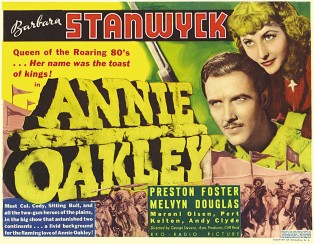 Among my favorite Old West partnerships is that of Annie Oakley and Frank Butler. The two met on Thanksgiving Day in 1875 in Oakley, Ohio and promptly squared off at a shooting competition. Annie was fifteen years old and stood just under five feet tall. Frank was twenty-three years old and was more than six feet tall. Annie won the shooting contest. Known to each other as Missie and Jimmy, the two married on June 22, 1876. Frank was impressed with Annie’s shooting skills and in 1882 began choreographing the trick shot and horseback riding routines she performed in the traveling circuses in which they were a part. The two had an impressive career together, appearing in venues all over the United States and Europe. They were married for more than fifty years when Annie died of pneumonia. Heartbroken, Frank stopped eating and died seventeen days after his wife. In 1935, the first western about Annie Oakley’s life starring Barbara Stanwyck opened in theatres across America. Annie Oakley, was an efficient, if historically inaccurate, biopic. Stanwyck plays the tomboy sharpshooter who romances fellow sharp shooter Preston Foster who portrays Frank Butler. The ninety minute film was directed by George Stevens. Stevens went on to make one of the definitive films in the genre – Shane. For more information about Annie Oakley and Frank Butler read Love Untamed: Romances of the Old West.
This Day…
This Day…
1922-In San Francisco, Samuel Dashiell Hammett resigns from Pinkerton’s National Detective Agency. Hammet has worked since 1915 as a professional detective, and his experiences will become the basis for his trendsetting detective novels, several of which are set in Western locales. Butte, Montana, is the Poisonville of Red Harvest, and The Dain Curse, The Maltese Falcon, and The Thin Man take place in San Francisco.
Lack of…
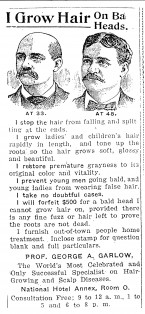 Miracle cures for hair loss were sold by snake-oil salesmen in the Old West and they are sold on the World Wide Web today. A “cure for baldness” has long been a profitable claim for nostrums. The Old West snake-oil salesman might sell his product as a cure for baldness when his audience was made up mostly of men, and a cure for “women’s complaints” when his audience was mostly women. In the next town, he might sell it as a cure for rheumatism. The common thread in all of his claims is they are unverified by any scientifically acceptable evidence. We might believe that we are more sophisticated and knowledgeable than the citizens of a small town in the Old West who gathered around the wagon of the snake-oil salesman to hear his pitch. While it is true that we are probably more knowledgeable because there is more information to know about, it is also true that the purveyors of nostrums incorporate today’s advanced knowledge into their claims. The Nineteenth Century snake-oil salesman might base his claims on “secret knowledge” passed along to him by an ancient medicine man. The purveyor of nostrums today is more likely to use words taken out of context from the sciences of genetics and biochemistry to link his claims to scientific research. Buyers beware!
This Day…
In Good Health
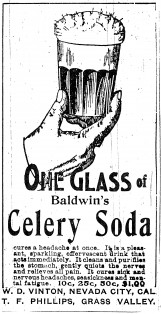 In the early 19th century most Americans healed themselves, as their ancestors had for centuries. Professional medical assistance was either too far away, too expensive, or both. Even wealthy urban families usually attempted some sort of home health care before the doctor was called. This care was usually administered with the aid of books, pamphlets, and proprietary medicines purchased at the general store. Proprietary medicine advertisements were the mainstay of newspapers in the Old West. Newspapers carried notices for medicated vapor baths, artificial teeth, genuine Galvanic Rings, the Anodyne Necklace and other amulets. Some patent medicine companies spent more than $100,000 a year advertising their products. Patent medicines were the hottest-selling items on store shelves. If the labels on the medicines were to be believed, they could handle just about any and every complaint. One concoction grandly promised to cure 30 different disorders, including “nervous debility caused by the indiscretions of youth.” Mostly they relied on heavy lacing alcohol to work their proclaimed wonders. It didn’t really cure what was ailing you but you didn’t mind so much.
This Day…
Clothing for the Family
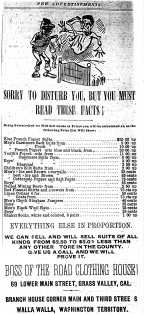 I keep telling myself that things have got to get better. Business calls will eventually be returned, books sales will improve, and McDonald’s cherry pies will never be put on hiatus to make room for some feeble attempt of a holiday pie with a filling no one can identify. But here it is. Another Monday and no improvements. This is the perfect time for another Old West advertisement. American fashions were influenced by European designers, but at the beginning of the century seventy-five percent of all clothing in the country were homemade. Observers said they could detect the potato-sack-like cut of a homemade garment a mile away, especially next to a tailor-made piece or, later in the century, a store bought or factory-made garment. Indeed, until the 1840s, when clothing became more readily available in stores, most Americans wore clothing sewn by themselves or their own mothers, sisters or daughters. The Boss of the Road Clothing House, located in the mining town of Grass Valley, California, opened its door in 1863 and featured the latest styles for the entire family. Among the most popular items sold to women there were calico dresses and a head covering called the “flat”. The flat was a woman’s low-crowned straw hat with a very wide brim. Many men purchased the roundabout; a short, close-fitting jacket, also known as a monkey-jacket.