
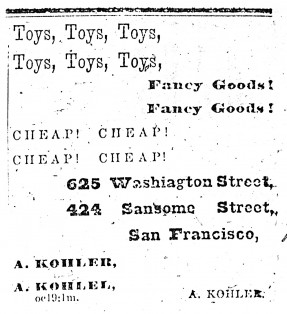
 Here we have a display for an ad for “Toys, Toys, Toys….” You ask, “What, What. What” toys are they talking about? Here are just a few toys you might find in a circa late eighteen hundred mercantile or store. Wax dolls, Punch and Judy dolls, toy soldiers, wooden blocks, and self-propelled tin-plated trains. Also, steam trains, which some parents believed were too dangerous for kids, were a hot item. Kids of the time also played with metal toys, like pistols and guns, and friction toys, which moved as the result of the release of momentum stored up in a flywheel. There were also elaborate toys with bells. One of the most sought after toys of the time were cast iron savings banks with mechanical wheels or other moveable parts. An example of one of these banks shows a hunter shooting a bear. The child took his coin and placed it into the gun barrel, releasing the spring catch and shooting the coin into a slot in the tree trunk. Then, just when you think that’s all the excitement a tike could take, a bear emerges from the top of the tree trunk.
This Day…
Puff, the Magic Draggin’
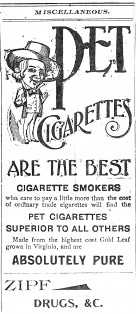 Though popular today, bashing the tobacco industry is not a new phenomenon. As far back as the late 1800s, the producers of cigarettes were not particularly well liked by certain segments of society. In particular, cigar makers feared the competition the popular, little smokes posed to their own lucrative, but more expensive, tobacco business. The threat was enough to make them gag. They were aided in their attempts to stamp out the cigarette by some of the more self-righteous members of the population. These well meaning, but not so well informed folks, argued that cigarette smoking was generally associated with immoral and criminal behavior, from youthful mischief makers to adult murderers. Teachers complained that the mild, addictive taste of these low priced smokes was too tempting for many weak willed boys to ignore. It was thought that smoking contributed to these boys’ arrested mental and physical development, and led to a life of wicked depravity. At the very least, overuse of the little weeds led to the wasting effects of the dreaded, “cigarette face”, which any trained observer could plainly spot. It’s unclear whether these arguments had much merit or extinguished the cigarette’s popularity, but in 1888, Congress pushed up taxes on cigarettes by 200% to raise money for the Spanish-American War. The price of a nickel pack of ten smokes did shot up 20 per cent, which, for a time anyway, scared cigarette consumers off even more than the fear of contracting “cigarette face.”
This Day…
Wrestling! Tonight!
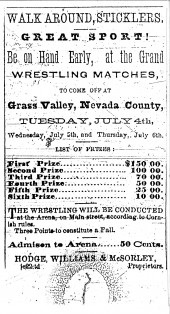 Spelling bees, Saturday night shoot-‘em-ups, quilting parties, and card games were just a few ways in which people amused themselves in the Old West. Wrestling matches were among the most favorite past-times. Early colonists from England are credited with making the sport popular. They brought with them a variety of wrestling styles and often persuaded Native Americans to participate in the matches. Wrestling tournaments were featured at picnics, threshing bees, and holiday celebrations. Professional wrestlers from carnivals would often times challenge local wrestling champions to a match and cash prizes were awarded to the amateur that could throw the expert. These events were so well attended special arenas were built to hold the crowds that flocked to see them. On nights when no one would challenge the wrestling champ, a large, brown bear was paraded out for him to compete against. If the man won he was awarded more than a hundred dollars. If the bear won he got a basket of apples.
This Day…
Edison’s Effective Lamp
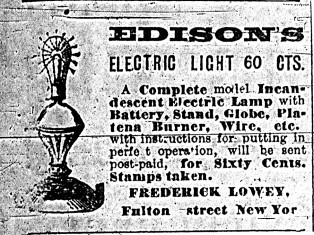 Early settlers had more than one way to light up their log cabins. Candles, kerosene, and lard-oil lamps were among the few. These types of lights were a fire hazard and in many cases were responsible for entire towns being burnt down. A safer way to provide light to homes was being sought in England. Sir Humphrey Davy was working on producing electric arcs using a platinum wire incandescent and passing a current through the air. By 1840 a number of incandescent lamps, including Davy’s, were being patented, but none were commercially successful until American inventor Thomas Alva Edison produced his carbon filament lamp in 1879. Edison’s electric light was a much sought after product. It worked by passing a weak electric current between a heated filament and a cold electrode. The first power station was constructed on Pearl Street in New York. In 1882 several miles of streets were dug up to install electric cables from the station to surrounding homes, which began receiving electric current on September 4. Electric lighting didn’t dominate the Old West until the end of the century.
This Day…
In Need of Provisions
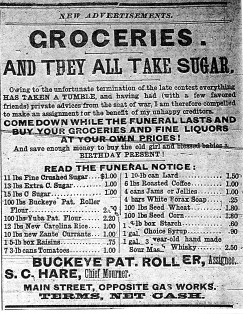 The western pioneer was independent only until the supplies in his covered wagon ran out. They looked to stores to supply them with goods necessary for life and desirable for comfort. The local market was the place to get powder and shot, tobacco, coffee, clothing, beans, liquor and news. Specialty shops provided pioneers with wallpaper, stationary, crayons, stereoscopic views, beauty cream and other refinements not usually associated with life on the plains. The general store was the place of first resort for everything from coal oil to calico to canned oysters, and much more. The place smelled of just about everything; the rich fruitiness of plug tobacco, the leather of boots and belts, fresh ground coffee, cheese, dried and pickled fish and the subtle musty-sweet tang of fresh fabric in bolts. Not an inch of space was wasted.
This Day…
1860-Arizona mining at Tubac, and in the Santa Rita, Cuerro Colorado, and Santa Cruz Mountains is halted when US Army troops pull out of the area to prepare for the Civil War. The Apache in the area take back control. Gold is in the Orofina Creek in Nez Pearce country. The miners, largely from the West, arrive from gold fields in British Columbia, prospects in Idaho, then move farther east to Montana.