
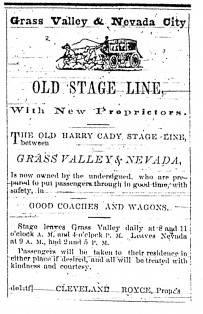
 I’ll be speaking at the Nevada County Historical Society meeting tomorrow evening at 6:30 p.m. at the Madelyn Helling Library in Nevada City. The talk will center on the most recent book released The Bedside Book of Bad Girls: Outlaw Women of the Midwest. Email me for more information – gvcenss@aol.com. Hope to see you there. And now for this commercial message…. The stagecoach figured prominently in the early west. Under ideal condition, a coach driven by a fresh team of horses could “cut dirt” at the breakneck pace of nine miles per hour. Yet driving condition throughout much of the century were rarely ideal. Vehicles got stuck in ruts of mud so often that the expression “up to the hub” became a national colloquialism to illustrate any intractable predicament. Bad roads and driver impatience frequently combined to turn a coach over. During any long stage trip, in fact, passengers expected and were mentally prepared for at least one turnover.
This Day…
1836-William A. Slacum, official agent of President Jackson, helps settlers in Oregon to organize the Willamette Cattle Company, which raises money and sends Ewing Young to California to buy several hundred head of cattle. The object is to give the American missions economic independence from the Hudson’s Bay Company.
More About Old West Ads
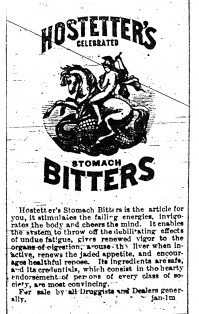 For those who might be feeling as poorly as a centipede with sciatic rheumatism the following Old West advertisement might just be the thing to make it better. In the early 19th century most Americans healed themselves as their ancestors had for centuries. Professional medical assistance was either too far away, to expensive, or both. Even wealthy urban families usually attempted some sort of home health care before the doctor was called. This care was usually administered with the aid of books, pamphlets, and proprietary medicines purchased at the general store. Proprietary medicine advertisements were the mainstay of newspapers in the Old West. Newspapers carried notices for medicated vapor baths, artificial teeth, genuine Galvanic Rings, the Anodyne Necklace and other amulets. Some patent medicine companies spent more than $100,000 a year advertising their products. Patent medicines were the hottest-selling items on store shelves. If the labels on the medicines were to be believed, they could handle just about any and ever complaint. One concoction grandly promised to cure thirty different disorders including “nervous debility caused by the indiscretions of youth.” Mostly they relied on a heavy lacing of alcohol to work their proclaimed wonders. Hostetter’s Stomach Bitters, for instance, soothed indigestion with a formula packing a fifty-proof wallop.
This Day…
Absolutely Pure
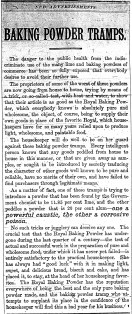
The product in the center of an advertising war in the mid-1800s
This Day…
Around the House
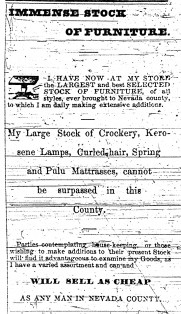 A one-room log cabin with dirt or puncheon floor, simple fireplace, sawbuck table and straw mattress in which an entire family might sleep – that was as far as luxury went on the frontier and in newly settled regions of the country. Long-settled communities enjoyed roomier abodes, of course, and as the wealth of the region and of the nation grew, houses became larger, more elaborate and better equipped. Specialized stores helped homeowners furnish their dwellings with the most fashionable sofas, chairs, and love-seats available. Early Victorian furniture was popular and the most common style carried by furniture stores. Victorian furniture was large and made of mahogany, rosewood or black walnut. Notable characteristics were saber legs; marble table tops; turned bedposts; mushroom-turned wooden knobs for handles; ornamentation in the form of carved medallions featuring flowers, fruits and foliage. There’s nothing simple about that look. I’m not surprised the advertisment boasted that the items were cheap.
This Day…
Outraged Cheyenne, Arapaho, and Sioux warriors launched a series of attacks all along the valley of the South Platte River in Colorado. The Indians strike at wagon trains, stage stations, and military outposts. The town of Julesburg, in northeast Colorado, is burned, and its white residents scalped in retaliation for the massacre at Sand Creek. Denver is threatened. Communications and supplies throughout the area are halted.
Old West Advertisement
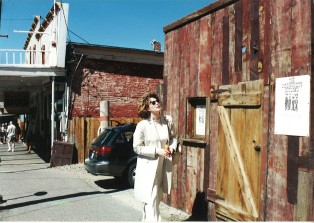
In Virginia City, Nevada researching Old West Ads