
1867-Four boisterous cowboys in Laramie, Wyoming decided to roust some immigrants from Illinois. The immigrants were not intimated though and a fearful brawl erupted. Deputy Marchal Big Steve Long commanded a halt to the proceedings which was ignored, of course. He then pulled both 44’s and fired into the pugilists. Five of them were killed, three from Illinois and two of the cowboys.
Wedding Gowns and Scientists
Before I write about another extraordinary woman from history I’d like to congratulate Barbara Bognanno-Badger for winning the wedding dress given away at the launch of the book Object: Matrimony. Barbara’s name was selected at random from more than two hundred ten entries. The gown is from Prairie Lace Designs and is valued as $5,000. Enjoy the gown, Barbara. And now, from bridal wear winners to physics. The first woman to be awarded a Nobel Prize was Marie Curie in 1903 for Physics. She became the only woman to receive two Nobel Prizes, when she was awarded the prize for Chemistry in 1911. Her work with radiation and the discovery of the elements radium and polonium opened the doors for many advances in science and medicine. Soon after Madame Curie won the 1911 prize, she was hospitalized for depression and kidney problems and suffered from ill health the remainder of her life. The dangers of radiation were not understood and she often worked unprotected with radioactive substances. She died in 1934 at age sixty-six of aplastic anemia, a bone marrow condition caused by radiation. In 1938 Marie’s daughter, Irene Joliot Curie, won a Nobel Prize for Chemistry for her work with neutrons, setting the stage for nuclear fission. She died of leukemia at age fifty-eight in 1956 as a result of being exposed to radiation while assisting her mother years before.
This Day…
1884-The toll bridge over the Arkansas River in Dodge City, Kansas – City Marshall Bill Tilghman emptied his revolver and started up with his Winchester in order to encourage some rowdy cowboys to return to their camp. They stood their ground and fired a few shots in return but nobody was hit. It was all in good fun.
The Empress of Blues
Bessie Smith began her professional singing career at the age of eighteen in 1912, earning eight dollars a week. For many years she toured on the minstrel and vaudeville show circuit until she made her first recording in 1923. “Down Hearted Blues,” which sold over 750,000 copies in the first year, thereby making her the most successful black performer of her era. Her stage performances then earned fifteen hundred dollars per session, a tremendous sum at the time, although she received no royalties from the recordings; Bessie Smith received only thirty dollars per record of the one hundred sixty she recorded. Although many would now consider that she was duped into signing such a recording contract, Bessie was a hard-drinking, swaggering woman who reportedly would get into a knockdown fight over the slightest insult. The woman known as Empress of the Blues lived hard and fast. She died at the age of forty-three in 1937, in Mississippi. The speeding car she drove in as a passenger slammed into the rear end of a truck. Her arm was nearly severed, and she died of trauma and blood loss. Her bootlegger boyfriend, Richard Morgan, the driver of the car, was unharmed. No Breathalyzer tests were available to determine the root cause of the accident. Newspaper reports suggested that Bessie Smith died because she was taken to a segregated white hospital that refused treatment. However, records confirm that she was transported directly to Clarksdale’s, a black hospital, where she died six hours later.
This Day…
The Celebrated Spoiled One
Pocahontas, a nickname meaning “little spoiled one,” was born Amonute, daughter of Chief Powhatan in 1595. She was an extrovert from a young age, inquisitive and naturally good-natured. At eleven years old she played a minor role in securing John Smith’s survival. Later she was the go-between for trade among the settlers and Indians bartering at Jamestown. The fictionalized version of her love affair with Smith may, in fact, bear some truth, but in a much more disturbing way for our modern sensibility. Today, a thirty-year-old having sex with a preteen in pedophilia and a crime. But, in that era, intercourse with non-Christian pagans of any age was not considered wrong. Pocahontas was known to have “long, private conversations” with Smith during her frequent visits to the Jamestown complex, yet the true dimensions of these encounters are a matter of conjecture. A few years later she was betrothed to the older Englishman John Rolfe, only after she agreed to be baptized in 1614. Two years later Rolfe took her to London, where she was received as a celebrity, billed as a real live Indian princess by high society, and held an audience with King James. In 1617 she believed the smoky air of London was the cause of her coughs and bouts of weakness and wished to return to the forests she had known. Along with Rolfe she boarded a ship to return to Virginia, but the vessel only made it to the end of the Thames River before it turned back. Pocahontas died in London at age twenty-two of disease called the king’s evil, a form of tuberculosis characterized by swelling of the lymph glands.
This Day…
Being First

Mary Ragsdale
Chris Enss Quoted in the Dodge City Globe “Dodge City set to figure prominently in new movies”
Chris Enss Quoted in the Dodge City Globe “Dodge City set to figure prominently in new movies”
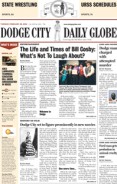
Chris Enss was interviewed by the Dodge City Globe about the soon to be developed movie “Thunder Over the Plains” based on “Thunder Over the Prairie” by Chris Enss and Howard Kazanjian.
Download Dodge City Globe PDF
Jesse James
Jesse James, notorious train and bank bandit of the late 19th century, and an important figure in the history of the midwest frontier, gets a drastic bleaching in this film made in 1939. Script by Nunnally Johnson is an excellent chore, nicely mixing human interest, dramatic suspense, romance and fine characterizations for great entertainmet. Tyrone Power capably carries the title spot, but is pressed by Henry Fonda as his brother. The story follows historical fact close enough with allownace for dramatic license, hitting sidelights of James in his brushes with the law. The initial train holdup is vividly presented, with all other robberies left to imagination. The picture starts with a foreword on the ruthless manner in which railroads acquired farms for right-of-way through the midwest.