
1892-New Mexico, still a territory, openes its university; Congerss will later grant over 300,000 acres to support the school.
They Called Him Bat
Legendary lawman William Barclay Masterson had a reputation for being a tough talker, an excellent shot, and a dandy dresser. He wore tailor-made suits and a derby hat and carried a gold-headed cane. He was a handsome, well-liked character with black hair and blue eyes who was extremely fast on the draw. Born in Illinois on November 22, 1855, Bat (as he was more commonly known) was the second of five brothers. His parents were homesteaders who moved their family to a prairie farm in Wichita, Kansas in 1871. At the age of nineteen, Bat persuaded two of his brothers to abandon farm life for a job hunting buffalo. The Masterson boys stuck together for a while, but the trip split up when his siblings decided to return home and Bat decided to continue on with the difficult work. For more than a year, Bat roamed from Topeka to the Texas Panhandle. He changed employment often: He was a section hand for the Santa Fe Railroad, a ranch hand, and an Indian scout for the army. After his first gunfight in January 1876, in which Bat killed a man who fired on him and the woman he was with, he headed for Dodge City. There he invested in the Lone Star Dance Hall on the main street of town, and the establishment proved to be profitable. Not long after Bat’s arrival in the rough-and-tumble town, he helped a prisoner escape from jail. He’d had too much to drink and involved himself in an arrest that had nothing to do with him. The town marshal gave Bat a beating that turned him around so much so Masterson decided he would never go against the law again. In fact, the incident opened his eyes to the possibility of a future as an officer of the law. Bat followed his brothers-one a marshal, the other a deputy-into the field of law enforcement. Bat campaigned hard for the position of Ford County sheriff deputy and was subsequently awarded the job. He was an effective lawman who tried to talk perpetrators into surrendering rather than resorting to gunplay. Using his fists and finesse, he persuaded many wrongdoers to “leave town peacefully” or “be carried out with a bullet hole in their chest.” Bat had an impressive and famous array of friends that included Wyatt Earp and Doc Holliday. Outlaws who knew of their association refused to tangle with Masterson for fear the Earp brothers and Holliday would come after them. Before Bat’s siblings were killed in the line of duty, the men participated in numerous posses that successfully tracked down and apprehended outlaws in the area. As such, the plains around Ford County during Masterson’s time in officer were relatively peaceful. A controversial act drove Bat out of law enforcement in April 1881. Bat was in Tombstone, Arizona when he got the news that one of his brother’s lives was being threatened by a ruthless businessman. He quickly made his way back to Dodge City and arrived just in time to face the bad guys on the street. Once the smoke cleared from the gun battle, Bat alone was left standing. He resigned from his position as an officer and left Kansas to see the West. He traveled through New Mexico, Utah, and Texas, earning his keep at each location by gambling. His natural gift for storytelling led to a job writing newspaper articles in Creede, Colorado, where his work was noticed by a correspondent for the New York Sun who helped him secure a position as a sportswriter for the New York Morning Telegraph in 1901. Bat returned to law enforcement in 1905 when President Theodore Roosevelt appointed the fifty-year-old man as a special United State marshal to the Oklahoma Territory. He did not hold the post long due to the prior commitment he had with the Morning Telegraph. Just before noon on October 25, 1921, Bat headed up 8th Avenue from his New York apartment to the newspaper office and wrote his column for the next day. He died of a heart attack fifteen minutes after he finished writing the article. He was found slumped over his desk with his pen in one hand and his column in the other. He was laid to rest at the Woodlawn Cemetery in New York. The tombstone over his grave carries his name, date of birth, and the words Loved By Everyone.
This Day…
Death of a Regulator
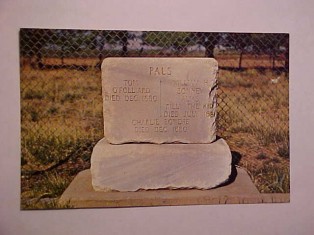
Billy the Kid's Tombstone
Making My Way Home
While sitting at the airport enduring the late flights and pajama wearing, no showering, multiple carry-on passengers, I decided to try and catch up on the daily journal section of my site. It’s been long but enjoyable two week adventure releasing of the book Sam Sixkiller: Cherokee Frontiers Lawman to the public. I began the journey in Colcord, Oklahoma where United State marshal Sam Sixkiller rode collecting bootleggers and murderers and I ended the trip in the hills around Edgewood, New Mexico where Billy the Kid spent time with his riders. In between I got to meet great western authors like Johnny Boggs and Sherry Monahan and hang out with actor Wes Studi. It will be good to get home and return to work, however. Getting updates on the Broadway production and the motion picture will be focus this week. But first, just to be home. As Charles Dickens once wrote, “Home is a name, a word, it is a strong one; stronger than magician ever spoke, or spirit ever answered, in the strongest conjuration.” That and I’m out of clean underwear.
Count It All Joy
Chuck Swindoll tells a story about a young man named Glen Chambers. Glen had a heart to serve God on the mission field. He got his training, went to Bible college, went to seminary, and he raised his support. He left everything behind and boarded a plane to fly as a missionary to South America. He had gone through the strain of financial problems and misunderstanding with family. He’d dealt with the pain of separation, and he was filled with hope and anticipation and excitement about serving Christ. As he was about to fly, he thought to himself, I really should have said more to my parents, so he tore off a corner of a magazine and wrote them a little note: “Mom and Dad, I’m so excited, going to serve Christ. Thanks for getting behind me in this. I love you, Glen.” Glen stuffed the note in an envelope and put it in the mail to his parents. Glen got on the plane, and in the middle of the night, a mountain in the jungles of Ecuador reached up, pulled that plane out of the sky, and Glen was killed in a plane crash. He never made it. All the training, all the fundraising-everything-and he never got there. After the funeral was over, his parents got the letter Glen wrote. They opened it. It turns out that on the back of the magazine corner he’d torn off to write that note was printed one word: “why.” Why? That’s the question that hits the hardest, isn’t it? It’s the question that hurts the most…lingers the longest…and it’s the question that every follower of Jesus Christ has asked. I’ve asked it so many times. Why, God? And it’s the question James helps us answer. James 1:2-4 Consider it pure joy, my brothers, whenever you face trials of many kinds because you know that the testing of your faith develops perseverance. Perseverance must finish its work so that you may be mature and complete, not lacking anything. In this world there will be pain and suffering. There’s just no getting around it. It a sure thing. Surer still is that God has overcome this world. God has a reason…a good reason. The nail that doesn’t remain under the hammer will never reach the goal. The diamond that doesn’t remain under the chisel will never become a precious jewel. The gold that doesn’t remain under the fire will never be refined.
This Day…
Juanita Put to Death
The Fourth of July celebration held in Downieville, California, in 1851 was a festive event that included a parade, a picnic, and patriotic speeches from numerous politicians. Proud members of the Democratic County Convention spoke to the cheering crows of more than five thousand people, primarily gold miners, about freedom and the idea that all are considered equal. The celebration was accentuated with gambling at all the local saloons and the consumption of alcohol, available in large barrels lining the streets. When residents weren’t listening to orators wax nostalgic, many happy and drunk souls gathered at Jack Craycroft’s Saloon to watch a dark-eyed beauty named Juanita deal cards. Juanita was from Sonora, Mexico, and engaged to the saloon’s bartender, but that did not stop amorous miners from attempting to get close to her. Fred Cannon, a well-liked Scotsman who lived in town, frequently propositioned Juanita. On the Fourth of July in 1851, he took her usual rejection particularly hard and threatened to have his way with her regardless. When Juanita finished work that evening, she went straight home. The streets were still busy with rowdy patriots who weren’t willing to stop celebrating. Fred Cannon was among the men on the thoroughfare who were drinking and firing their guns in the air. After more than a few beers, Fred decided to take the celebration to Juanita’s house. Juanita was preparing for bed when Fred pounded on the front of her home and suddenly burst in, knocking the door off the hinges. She yelled at the drunken man to get out. Before leaving, Fred cursed at her and threw some of her things on the floor. The following morning Juanita confronted Fred about his behavior and demanded he fix her door. He refused, insisting that the door was flimsy and was in danger of falling off the frame prior to his involvement. Juanita was enraged by his response, and the two argued bitterly. When Fred cursed at her this time, she pulled a knife on him and stabbed him in the chest. Fred’s friends surrounded the woman, calling her a harlot and a murderer. They demanded that she be hanged outright. Many of the townspeople insisted on trying her first, however. After a quick and biased hearing, Juanita was found guilty and sentenced to be hanged. The fearless woman held her head up as she was led to the spot where she would be put to death. She refused a blindfold, and when asked if she had any final words about the crime for which she was accused, she simply nodded her head. She boldly stated that she was not sorry and that she would “do it again if so provoked.” Juanita was the first woman to be hanged in the state of California. She was buried in the same grave as Fred Cannon. The pair was moved from the site six months later when gold was discovered where they laid. Their remains were relocated to the Downieville Cemetery. Time and the elements have erased the name of the infamous Juanita from the marker that stands over her grave.
This Day…
The Murder of Julia Bulette
Red, white and blue bunting hung from the windows and awnings lining the main street of Virginia City, Nevada on July 4, 1861. The entire mining community had turned out to celebrate the country’s independence and share in the holiday festivities. The firemen of Fire Engine Company Number 1 led a grand parade through town. Riding on top of the vehicle and adorned in a fireman’s hat and carrying a brass fire trumpet filled with roses was Julia Bulette. The crowd cheered for the woman who had been named Queen of the Independence Day parade, and Julia proudly waved to them as she passed by. In that moment residents looked past the fact that she was a known prostitute who operated a busy parlor house. For that moment they focused solely on the charitable works she had done for the community and, in particular, the monetary contributions she had made to the fire department. Julia Bulette had been born in London, England, in 1833. She and her family moved to New Orleans in 1848 and then on to California with the gold rush. Julia arrived in Virginia City in 1859 after having survived a failed marriage and working as a prostitute in Louisiana. In a western territory where the male inhabitants far outnumbered the female, doe-eyed Julia learned how to make that work to her advantage. She opened a house of ill repute and hired a handful of girls to work for her. Julia’s Palace, as it came to be known, was a high-class establishment complete with lace curtains, imported carpets, and velvet, high-back chairs. She served her guests the finest wines and French cooking and insisted that her gentlemen callers conduct themselves in a civilized fashion. She was noted for being a kind woman with a generous heart who never failed to help the sick and poor. In recognition of her support to the needy, the local firefighters made her an honorary member. It was a tribute she cherished and did her best to prove herself worthy. On January 21, 1867, Virginia City’s beloved Julia was found brutally murdered in the bedroom of her home. The jewelry and furs she owned had been stolen. The heinous crime shocked the town, and citizens vowed to track the killer down. The funeral provided for Julia was one of the largest ever held in the area. Businesses closed, and black wreaths were hung on the doors of the saloons. Members of Fire Engine Company Number 1 pooled their money and purchased a silver-handled casket for her burial. She was laid to rest at the Flowery Cemetery outside Virginia City. The large wooden marker over her grave read simply JULIA. Fifteen months after Julia’s death, law enforcement apprehended the man who robbed and killed her. Jean Millian had been one of her clients and had Julia’s belongings on him when he was apprehended. Millian was tried, declared guilty, and hanged for the murder on April 27, 1868. This story as well as many other previous tales are from the book Tales Behind the Tombstones.