
1873-In retaliation for Red Beard’s heavy handed behavior towards them on the 3rd, the soldiers returned in force to the dancehall with their own guns blazing. A sportsman named Charles Leshart and his female companion were both wounded, and Emma was shot again before the soldiers burned the building to the ground and filed away in orderly military fashion.
Children of the Trail
Crude rock markers and wooden crosses dot the various trails used by settlers heading west in the mid-1800s. A significant number of those markers indicate the final resting places of children. The trek across the frontier was filled with peril. Violence, disease and accidents claimed the lives of thousands of infants and toddlers. So uncertain were some pioneers of the longevity of their offspring born en route, they held off named their babies until they were two-years-old. The leading causes of death for children younger than age six traveling overland were cholera, meningitis, and smallpox. A number of children suffered fatal injuries when they fell under wagon wheels, fell into campfires, fell down steep canyons, or drowned in river crossings. In 1852, a family from Kentucky who were caught up in the gold rush barely made it out of Independence, Missouri, when their four-year-old died from meningitis. The leaders of the wagon train they were a part of stopped the caravan, and the men in the party cut down a medium-size oak tree to use as a casket for the girl. The girl’s body was laid in the shell, and the wooden slab was placed over it and nailed down. They dug a grave alongside the trail, lowered the crude casket, read a few words from the Bible, and prayed over the plot. After the grave was filled in, they flattened it by driving the wagons back and forth over the fresh earth. Pioneers believed this action kept wild animals from digging up the area. When the trip resumed the mother of the deceased child stood in the rear of the wagon, staring back at the spot where they had left her daughter. She continued staring at the spot hours after the grave was out of sight. An emigrant mother who lost her four-month-old child on the way to the fertile land of Oregon recorded a bit of the heartbreaking ordeal in her journal. In April 1852, Suzanna Townsend wrote, “we did feel very happy with her all the time she was with us and it was hard to part with her.” The journey across the rugged plains was so treacherous and risky some political leaders suggested only men should make the trip. In 1843, Horace Greeley wrote, “It is palpable homicide to tempt or send women and children over the thousand miles of precipice and volcanic sterility to Oregon.” Centuries-old cemeteries throughout the West are filled with small burial sites. More than one-third of the graves in the historic St. Patrick’s Cemetery in Grass Valley, California, represents children who have long since been gone. As in many gold-mining-camp cemeteries, marble cherubs are the most common overseers of the graves. Sculptured lambs representing innocence were also frequently used. The stories of the many lives that ended before they had a chance to make their mark on the frontier are lost forever. Only by their weathered tombstones are we able to know the tale of sacrifice to settle a new land.
Bad Day At Black Rock
Considerable excitement is whipped up in this suspense drama, and fans who go for tight action may not be that fascinated with the picture. Besides telling a yarn of tense suspense, the picture is concerned with a social message on civic complacency. Basis for the smoothly valued production is a story by Howard Breslin and adapted by Don McGuire. To the tiny town of Black Rock, one hot summer day in 1945, comes Spencer Tracy, war veteran with a crippled left arm. He wants to find a Japanese farmer and give him the medal won by his son in an action that left the latter dead and Tracy crippled. Tracy is greeted with an odd hostility and his own life is endangered when he puts together the reason for the cold, menacing treatment. The film is paced to draw suspense tight and keep expectancy mounting as the plot crosses the point where Tracy could have left without personal danger and plunges him into deadly menace when he becomes the hunted. There’s not a bad performance from any member of the case, each socking their characters for full value. To top it off, the movie was made in one of the best locations in the world, Lone Pine, California.
This Day…
Another Lawman Down
What an extreme pleasure it was to meet descendants of Cherokee lawman Sam Sixkiller this weekend in Oklahoma. Such lovely people one and all and they generously shared photographs of Captain Sixkiller’s children and grandchildren with me. I learned a great deal more about the lawman and the Nation he protected. Colcord, Oklahoma is one of the most friendly towns I ever visited and I couldn’t help but imagine Sixkiller patrolling the area. On my way home I was reminded of a lawman who made his mark on this area of California. His name was David Douglass and a short account of his life is included in the book Tales Behind the Tombstones. Douglass was elected to the post of Nevada County sheriff in 1894. Sheriff Douglass had been a guard for gold shipments traveling by train and had also served as a messenger for Wells Fargo. He was known by residents in Grass Valley and Nevada City, California, as a bold, fearless, and defiant officer, dedicated to making sure the law was upheld. On Sunday, July 26, 1896, Douglass set out after an outlaw named C. Meyers who had been terrorizing the country. The pursuit ended in the death of the bandit and the sheriff. Sheriff Douglass shot and killed the highwaymen, but just who shot Douglass remains a mystery. After learning where the thief was hiding out, Douglass, mounted his horse and took out after him. When the sheriff hadn’t returned by the next day, his friends and deputies combed the area looking for him. His body was discovered a few feet from the outlaw’s. Cedar and chaparral trees were thick around the secluded scene, and it was evident to the sheriff’s deputies that he had been lured to the spot. Sheriff Douglass’s body was found with his head pointing downhill, his face plunged in the brush and dirt. The Grass Valley Union newspaper reported that the “force of the fall brought a slight contusion to the forehead.” Those who discovered his body believed that the bullet that took his life had entered his back, thrusting him forward. The report quoted deputies as saying, “Undoubtedly Sheriff Douglass had shot Meyers dead and was going to inspect the damage when a bullet pierced his frame.” As subsequent facts developed it appeared there had been an accomplice of Meyers hiding somewhere in the area. The unknown shooter fired shots at Douglass. The first bullet went into his back on the left side, and the second hit him in the right hand. Nevada County residents were shocked by the news of the respected sheriff’s death. They arrived in droves at the scene of the tragedy hoping to find a clue as to who the murderer might have been. Dozens of well-armed men scoured the hills in search of the assassin. The killer was never found. A monument to the memory of the sheriff and the outlaw (buried at the site) was erected at the location of the tragic gunfight in early 1900. It is believed Douglass was pitted against two and then one escaped. The bodies were lying parallel to one another. The gravestone over Sheriff Douglass’s grave and that of the bandit he shot is located in the Tahoe National Forest in Nevada City, California on a dirt pathway on Old Airport Road.
The Lone Grave
It was the news of gold that let loose a flood of humanity upon the foothills of Northern California. Prior to 1849 most west-heading wagons were bound for Oregon. All at once settlers burst onto the scene searching for their fortune in gold. Some found what they hoped for, but others found nothting but tragedy. Such was the case for the Apperson family, pioneers who lost a young family member in a fiery accident in 1858. The wagon train the sojourners were a part of struggled to make its way over the treacherous Sierra Nevadas and down the other side into the valley below. The appersons and their fellow travelers were exhausted from the four-month overland trip, which had started in Independence, Missouri. After reaching the outskirts of the mining community of Nevada City, California, they made camp as usual and rested for a few days before moving the train on into town. The forest settling was idyllic, and the Appersons decided to stay there instead of going on with the others. They built a home for themselves and their four children. For a while they were truly happy. But on May 6, 1858, an unfortunate accident occurred that left them devastated. At their father’s request the Apperson children were dutifully burning household debris when the youngest boy, barely two years old, wandered too close to the flames, and his pant leg caught fire. His sister and brothers tried desperately to extinguish the flames but were unsussessful. The boy’s mother heard his frantic screams and hurried to her child. She smothered him with her dress and apron, and then quickly rushed him to a nearby waterng trough and immersed his body. The child’s legs and sides were severly burned, but he survived. For a time it seemed as though his injuries might not be life threatening. The boy lingered for a month and then died. He was buried at the southwest corner of their property. The Apperson family stayed only a few months after his death and then moved on. At the time of his passing, the grave was marked only by two small seedlings. Since then concerned neighbors and community leaders have taken an interest in the burial site, surrounding the small spot with a fence and a marker. Motorists driving along U.S. Highway 20 from Nevada City frequently stop to visit the lone grave beside the road. It lies to one side of the interstate between two large cedars. A stone plaque now stands over the place where the child lies. Donated by the Native Sons of the Golden West, the plaque reads Julius Albert Apperson, Born June 1855. Died May 6, 1858. A Pioneer Who Crossed The Plain To California Who Died And Was Buried Here. The Emigrant Trail followed along the ridge and through Nevada City. The marking of this lone grave perpetuates the memory of all the lone graves throughout the state. Not only does the plaque signify the grave as a historic landmark, it stands as a symbol of sacrifice.
This Day…
1864-Congress creates the Territory of Montana from Idaho Territory. Thousands of miners have swarmed into the area during the past year, creating population centers at Bannack, Virginia City, and Helena. The new territory adopts a seal depicting a miner’s pick and shovel and a farmer’s plow against a mountain background.
Outcast Cemetery
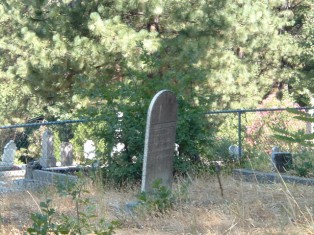
Laid to rest in a spot no one would find.
An Excerpt from “Sam Sixkiller”

“No one imagined that Muskogee was to lose a good citizen and the Territory one of the bravest of officers.”
The Indian Journal – December 29, 1886
In the hours leading up to Christmas Day 1886, Muskogee was crowded with trail hands, farmers, drifters and families. Mothers with their children in hand filtered in and out of the various stores that lined Main Street to shop. Upon exiting the businesses they would stop to admire the few displays in the windows. Most of the people visiting the mercantile, restaurants and hotels on December 23 and 24 were primarily interested in horse racing. They hurried back and forth from the two mile long stretch of track outside of town carrying food, alcohol and cash. Men laid money out recklessly on long-legged, sleepy-eyed geldings, some with United States Army brandings on their rump. Spectators stood on either side of the unmarked track anxiously waiting for the races to begin. Horses and riders lined up for the ‘dropped flag’ start. The shouts and cheers from the onlookers nearly drowned out the sound of the animals’ pounding hooves hurrying toward the finishing mark.
Dick Vann was among the enthusiastic group enjoying the festivities. Whenever the horse he bet on won he would celebrate with a round of thunderous applause and a long swig off a half-empty bottle of whiskey. Alf Cunningham had had his share of drinks during the event and he and Dick took turns slapping one another on the back each time their wager paid off and laughing uproariously at their good fortune.
By early afternoon on Christmas Eve both men were well on their way to getting drunk. They were belligerent with anyone jockeying for a better position to see the races than they had and were not immune from spitting in the face of people who celebrated a win when they had lost. Vann had finished off his bottle of whiskey and persuaded Cunningham to return to a place in town that would sell them more bootleg alcohol. Heavy grey clouds hung over the busy hamlet. A great V-shaped mass of ducks and Canadian geese flying south passed overhead of the two as they walked away from the race track. The whole sky was filled with the soft whir of wings. Cunningham removed a gun tucked inside his coat pocket, pointed it at the birds and pretended to shoot. Amused with himself, Cunningham laughed at his playful antics. Vann was too distracted by the sight of Tom Kennard, a Creek Lighthorseman to do more than grin.
Kennard stood in the doorway of the Commercial Hotel surveying the plethora of activity around him. Vann watched the officer carefully, then crossed to the other side of the street to avoid coming in contact with him. Unaware that anything was out of the ordinary at first, Cunningham followed after his brother-in-law. When he spotted Kennard he slowed down. Deciding against continuing on with Vann, he crossed the street to the lawman. Cunningham wore a contemptuous look as he approached Kennard. The bitterness he had for the law grew with magnificent intensity as he drew closer to the Lighthorseman. Kennard, a descendant of black slaves once owned by the Creek Indians, saw Cunningham walking towards him, but did not anticipate any trouble.
Without hesitating, Cunningham jerked his gun out and pointed it at the lawman’s face. He swore angrily at Kennard and threatened to kill him. Neither calm reasoning nor the promise of jail could persuade Cunningham to lower his weapon. A passerby, Mrs. Renfoe (wife of the town butcher), witnessed the exchange, grabbed the pistol and before Cunningham was able to wrench it free, Kennard drew his own gun. He brought the butt of the weapon down hard on the cursing assailant’s head and Cunningham collapsed at his feet. Kennard took the gun away from him and left him where he fell.
Cunningham came to a few hours later. In the near distance he could hear whistling, hand clapping and the sound of horses’ hooves galloping down the race track. The crowd that had congregated in town to celebrate the season had thinned considerably. No one around seemed the slightest bit concerned about whether Cunningham was face down in the dirt or not. People had cut a wide swatch around him to avoid any contact with the known trouble maker. After inspecting the lump on his skull, he got to his feet. He was rattled, but not enough to stay put. He dusted off his clothes then proceeded in the direction of the track.
As the stillness of a starry night crept up on Muskogee, Vann and Cunningham were seen together again wandering in and out of businesses in the process of closing. Cunningham relayed the tale of his encounter with Kennard to Vann and both men were infuriated with the officer and every other Lighthorsemen in the Nation. The memory of what happened to Jess Nicholson and Black Hoyt was still fresh in their minds. The men needed guns to do what they felt needed to be done. They tried to purchase a pistol from Turner & Byrnes’ Hardware, but were turned away by the owner of the store, C.F. Byrnes. Undeterred, they walked to the popular Mitchell House and went inside. Ray Farmer, the owner of the hotel, was too preoccupied with his job to notice the two enter and didn’t see Cunningham steal his shotgun. The two left the establishment determined to use the weapon they had acquired.
City Marshal Shelley Keyes was making his appointed rounds when Vann and Cunningham swaggered out of the Mitchell House in front of him. Cunningham raised the shotgun he was carrying to Keyes’s face. The lawman instinctively held up his hands. Vann eyed the pistol on Keyes’s hip and before the officer had a chance to object, he jerked it out of his holster. They left Keyes with his arms in the air and a bewildered look plastered across his face. He watched them disappear into the alleyways and dark corners of the buildings.
Drunk on the courage the guns gave them, Vann and Cunningham scanned the vicinity for Lighthorseman Kennard. One of Muskogee’s most well-known citizens, Armistead Cox noticed the two men walking down the street and caught a glimpse of the weapons they were toting as they passed by an eatery called King’s Restaurant. Cox wasn’t completely sure, but he thought he saw the butt of the shotgun tucked under Cunningham’s arm with the barrel pointed downward. The men continued on their way and there was no chance for a second look.
Captain Sixkiller was purchasing medicine at Dr. M.F. William’s drugstore when Vann and Cunningham arrived on the scene. The lawman wasn’t on duty, he had plans to take his family to a service at the Methodist church, but first he had to get rid of the headache he was suffering from. He had been sick for one reason or another since late November after returning home from a trip to Fort Smith. In early December, he and Fannie traveled to Vinita to visit family. The hope was that his health would be restored during that time, but they were forced to come home on December 15, 1886, because the captain wasn’t getting any better.
As Captain Sixkiller stepped out into the street he saw the shadowy image of the armed men. They were silhouetted against the light from the hotel and butcher shop across the street. The captain was unarmed and had no reason to believe Vann and Cunningham were carrying weapons. He wasn’t intimidated in the least. As he walked toward the pair one of them called out his name. Vann then shouted, “You’d never do that to me again.” Suddenly Cunningham fired the shotgun at the officer. Captain Sixkiller sprang forward before the full force of the shotgun shell made contact. He knocked the gun out of Cunningham’s hands and fell to the ground. A few pellets had riddled his clothing, but none had penetrated the skin. Before the lawman could defend himself, Vann drew his pistol and fired four times. Blood oozed from the lawman’s chest and head. All four bullets had met their target.
Captain Sixkiller staggered a bit then dropped to his hands and knees. Vann pulled the hammer back on the gun again and shot him one more time. The lawman groaned as the fatal wound fought against every internal organ to keep from working. The captain winched in pain as he exhaled. One of the murderers leaned over his body as he breathed his last breath; when it was over the shooters fled.
Rancher H.B. Spaulding and Armistead Cox were the first to arrive at the scene of the crime, followed by a gentleman named Nip Blackstone and the butcher, Jim Renfro. Cox checked to see if Captain Sixkiller was still alive. He knew by looking at his injured skull it wasn’t possible, but he had to be sure. It was a gruesome sight. The lawman had a hole in his face under his left cheekbone and it was covered with powder burns from being shot at close range. The clothing around his waist was saturated with blood; a pair of bullets was lodged into his abdomen.
City Marshal Keyes watched the men surround the deceased captain from across the street. He was overcome with guilt for letting the renegades get the best of him and take his gun. In an effort to conceal his identity from Vann and Cunningham and anyone else who might have witnessed the exchange, he turned his coat inside out and removed his hat. A reporter for the Cherokee Advocate who spotted Keyes noted “it seemed as though he might like to contract for a cast iron suit of clothes.”
Captain Sixkiller’s lifeless frame was transported to the undertaker’s office and his body was prepared for burial. His wife Fannie and his children learned of the shocking news from the men who handled the lawman’s remains. Fannie was inconsolable. Captain Sixkiller’s killing was a hard truth for the community to accept as well. The loss was immediately felt throughout the entire Indian Nation. Recognized as being the “head and heart of the Indian police,” the public demanded swift justice.
On Saturday morning December 26, writs were issued for the killers and given to four United States marshals, Frank Dalton, Tyson Greenbury, James Campbell and H.J. Hayes. The writs read “Dick Vann and Alf Cunningham feloniously, willfully and premeditatedly, and with malice and forethought, killed and murdered Samuel Sixkiller a Cherokee Indian.” For twenty-four hours the marshals searched vigorously for the murderers but could not locate them. An additional search took place on Monday, December 28, 1886. Captain Sixkiller’s brothers Martin and Luke joined the posse along with three other members of the Lighthorsemen. The men decided to look for the runaway killers in the thick bottoms of Gooseneck Bend, ten miles east of Muskogee. It was the area Vann had traveled to in 1884, when he was trying to escape justice for the attempted murder of John Hammer.
The December 29, 1886, edition of the Indian Journal newspaper reported that after Vann and Cunningham had killed the captain “they ran half leisurely down Main Street, turned the corner and passed the billiard hall as they headed out of town. Saturday night it was noted they attempted to lodge with an acquaintance named John Lowery who objected to them staying with him. Vann tried to change his mind by showing him the pistol he had and in the process the weapon discharged accidentally, the bullet going across the end of his thumb.”
While the police continued their search for killers, several letters of condolence were sent to Captain Sixkiller’s widow and his family. One of the letters Fannie received was from the chairman and secretary of the Missouri-Pacific Railway, Thomas Furlong and John J. Kinney. “Dear Madam: I was deeply pained to learn from this morning’s paper of the sad calamity that had befallen you in the untimely and cruel death of your late husband. My wife and family desire with me to tender you our sincere sympathy in your terrible affliction.” In addition to the letter, Furlong forwarded a resolution adopted by the railroad secret service. The resolution was adopted to express the rail line’s sentiment relative to Captain Sixkiller’s tragic death.
“Whereas, by the hands of murderous assassins our esteemed friend Captain Sam Sixkiller has been taken from our midst, and while submitting to the all-wise and inscrutable Providence, we desire to express our sentiments, respecting this to us an irreparable loss of a tried and true friend, and to the United States Government a brave, honest and competent officer. Therefore, we, the members of the Missouri-Pacific Railway Secret Service Department at St. Louis assembled, deeply deplore the cruel and untimely death of our esteemed friend, Captain Sam Sixkiller, who endeared himself to the members of this department by his uniform kindness and invaluable assistance rendered us in the discourage of our duties, and while our grief in itself is great at the loss of our esteemed friend, we realize that the loss of such an exemplary husband and father is immeasurable, and therefore we desire to convey to his family our heartfelt sympathy in this their greatest hour of affliction.”
More than two thousand mourners attended Captain Sixkiller’s funeral the Sunday after he was killed. The services were conducted at the Methodist Church and the eulogy delivered by Cherokee leaders from Tahlequah. The church could not contain the friends who gathered to pay their respects. According to the December 29, 1886, edition of the Indian Journal, “people from nearly every part of the eastern portion of the territory attended the last rites.”
Newspaper editors throughout the Nation praised Captain Sixkiller for his heroism and courage. An editor for the Indian Chieftain in Vinita wrote in an article that “a man with so little thought of danger should fall by violence seemed in no way strange.” The Indian Journal editor noted “the Captain has done probably more than any one person to free the railroad towns of this Territory of their dangerous and reckless elements, and to him the country owes a great degree the comparative security to life and property that it now enjoys.” In a report made to the Commissioner of Indian Affairs in Washington, Indian agent Robert L. Owen commended Captain Sixkiller noting that “he died a martyr to the cause of law and order and had the respect and confidence of all the decent people in the country particularly of men like Honorable Isaac C. Parker, U.S. Judge of this district….”
The procession that accompanied Captain Sixkiller’s remains to the cemetery was staggering and a testimony to how much people thought of him. The crowd on hand at the graveyard was one of the largest ever assembled in that section of the country.
The men responsible for the death of the revered Captain Sixkiller were two of the most wanted men in the Nation. A $1,500 reward was offered for their arrest. Friends of both Dick Vann and Alf Cunningham made it known that the men had every intention of turning themselves in to authorities and added that the pair were willing to stand trial, even though they believed Captain Sixkiller’s associates would distort the facts in their case and make sure they were prosecuted in the bitter end. Vann and Cunningham wanted to wait ten days before surrendering themselves to the law. The nearly two week span of time was to ensure tempers had cooled and that the public was ready to hear their side of the incident. Numerous officers were on the trail of Vann and Cunningham and were convinced the pair would be apprehended before the ten days had ended.
Vann and Cunningham were charged with the crime of murder by a Creek Indian court. When or if they were caught they were to be turned over to Creek authorities. According to the compact existing between the Creek and Cherokee Nation, the Creek Nation had jurisdiction over the case. If Vann and Cunningham were arrested in the Cherokee Nation they would have to be extradited to the Creek Nation to stand trial. Judge Parker wanted to help bring the fugitives to justice, but as all the parties involved in the murder were Cherokee, the federal court had no jurisdiction in the matter.
After carefully considering the specifics of the case, the Judge determined the only way the federal government could assist in arresting Alf Cunningham would be to go after him for theft. The gun he had taken from the owner of the Mitchell House qualified as stealing, a crime well within Judge Parker’s right to handle. He issued a writ giving his deputy marshals the authority to arrest Cunningham on a larceny charge. The murder charge took precedent over the crime of stealing. If the deputy marshals managed to apprehend Cunningham they would turn him over to the proper court.
While the hunt for the captain’s assassins was in progress, another man was named to the slain lawman’s post. William Fields, a U.S. marshal and the former city marshal of Tahlequah, was Captain Sixkiller’s successor. He was an accomplished officer who knew filling the vacancy left by his beloved predecessor would be a daunting task. Several months after the death of Captain Sixkiller newspapers were still praising his work. “There never was before and there never was afterwards an officer like Captain Sam Sixkiller,” the February 24, 1887, edition of the Muskogee Phoenix reported. “He was as handsome as an Apollo Belvedere; if there is a race born without fear, Sixkiller belonged to it. He had a figure like Mars divestible of immortality. It was worth a hundred miles travel to see Sixkiller seated in his saddle, straight as Tecumseh: perhaps no man ever had a more complete mastery over a horse than the gallant captain.”
Captain Sixkiller’s widow and children struggled with the loss of their loved one. His brothers had joined in the quest to track down his killers and his sisters, sons and daughters helped comfort their mother and care for the family home. A note on a picture of the captain hanging on the wall in the house reminded relatives how he was quickly taken from them: “Captain Sixkiller was gunned down in Muskogee by Alf Cunningham and Dick Vann.”
Sam Sixkiller Now Available
Sam Sixkiller was one of the most accomplished lawmen in 1880s Oklahoma Territory. And in many ways, he was a typical law-enforcement official, minding the peace and gunslinging in the still-wild West. What set Sam Sixkiller apart was his Cherokee heritage. Sixkiller’s sworn duty was to uphold the law, but he also took it upon himself to protect the traditional way of life of the Cherokee. Sixkiller’s temper, actions, and convictions earned him more than a few enemies, and in 1886 he was assassinated in an ambush. This new biography takes a sweeping, cinematic look at the short, tragic life of Sam Sixkiller and his days policing the streets of the Wild West.