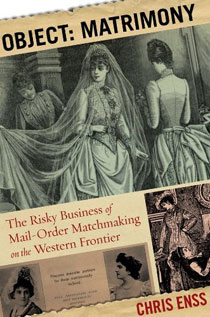
Object Matrimony Available in bookstores everywhere October 2, 2012

Desperate to strike it rich or eager for free land, men went into the frontier West alone and sacrificed many creature comforts. Only after they arrived at their destinations did some of them realize how much they missed female companionship.

One way for men living on the frontier to meet women was through subscriptions to heart-and-hand clubs. The men received newspapers with information about women with whom they could correspond—sometimes with photographs. Eventually a man might convince a woman to join him in the West, and in matrimony.

Complete with historic photographs and actual advertisements from both women seeking husbands and men seeking brides, Object Matrimony includes stories of courageous mail order brides and their exploits as well as stories of the marriage brokers, the mercenary matchmakers looking to profit off of the miners and settlers. Some of these stories end happily ever after; others reveal desperate situations that robbed the brides of their youth and sometimes their lives.

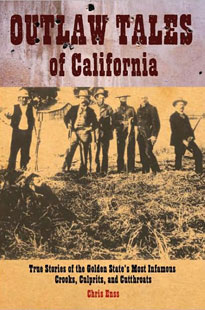
Outlaw Tales of California

Outlaw Tales of California Book Cover

From the world-famous to the relatively obscure, Outlaw Tales of California features true tales of fifteen bandits, outlaws, and no-good scoundrels. From Sacramento to Los Angeles, San Francisco to Nevada City, the frontier towns of California were populated by some of the toughest and most dangerous characters in the West. Tom Bell, the flat-nosed, felon doctor had his “Catch me if you can!” motto finally catch up to him when he was hanged after a wild eighteen-month career as an outlaw. Lawman-gone-bad Henry Plummer got twisted up in a lascivious love affair. And bad luck bandit Dick Fellows never could catch a break—except for in his leg and ankle. From Charles Earl “Black Bart” Boles to “Rattlesnake Dick” Barter, Juan Flores to Joaquin Murieta, read about the most notorious desperados in the history of the Golden State. Through these astonishing true stories, Outlaw Tales of California introduces you to a state you thought you knew—and a West that was wilder than you’ve ever imagined.


More Outlaw Tales of California Available in October of 2012

From the world-famous to the relatively obscure, Outlaw Tales of California features true tales of fifteen bandits, outlaws, and no-good scoundrels. From Sacramento to Los Angeles, San Francisco to Nevada City, the frontier towns of California were populated by some of the toughest and most dangerous characters in the West. Tom Bell, the flat-nosed, felon doctor had his “Catch me if you can!” motto finally catch up to him when he was hanged after a wild eighteen-month career as an outlaw. Lawman-gone-bad Henry Plummer got twisted up in a lascivious love affair. And bad luck bandit Dick Fellows never could catch a break—except for in his leg and ankle. From Charles Earl “Black Bart” Boles to “Rattlesnake Dick” Barter, Juan Flores to Joaquin Murieta, read about the most notorious desperados in the history of the Golden State. Through these astonishing true stories, Outlaw Tales of California introduces you to a state you thought you knew—and a West that was wilder than you’ve ever imagined.

This Day…

1844-American expansionism is formally expressed as the Democratic platform of presdential candidate James K Polk. The platform stresses ‘reannexation’ of Texas and ‘reoccupation’ of Oregon. The slogan ‘Fifty-four Forty or Fight’ asserts the US right to the land that will become the State of Washington. That land, north of Oregon, is at present occupied by the British by mutual agreement.

Confessions of a Killer

My Brother, Years Ago, Just Being Silly

This past week a man confessed to a murder police have been trying to solve for thirty-one years. Although the man’s actions were vile and contemptible there is something to be said for a spirit that knows it violently transgressed and can find no peace unless and until the truth be told. News accounts of the confession note that the killer admitted to family members shortly after the murder took place that he had “done a bad thing.” He never elaborated on that “bad thing” until recently. I believe the Holy Spirit kept his heinous actions at the forefront of his troubled, twisted mind. I believe the Holy Spirit prompted the man’s relatives to remember to make mention of the “bad thing” and bring it to the authorities attention. It’s not in man alone to want to admit their shocking sins. Only the Holy Spirit could cause us to want to plead guilty to what we’ve done wrong. I used to think the three that took my brother’s life would confess, but that time has past. The Holy Spirit stops talking to a person when that individual becomes deaf to His voice. The Bible describes it as hearing, but hearing not. There is no point in setting the alarm on a clock in a deaf person’s room. He won’t hear it. Likewise, a person can condition himself to not hear an alarm clock ring by repeatedly shutting it off and not getting up. The day finally comes when the alarm goes off and she doesn’t hear it. That must be what happened. My brother’s assassins visit my website every now and then. They’re proud of what they’ve done. I think they’re cowards and liken them to cowboy Ike Clanton waiting in the shadows to ambush Wyatt Earp, or Wiley Lynn, the corrupt federal agent who shot marshal Bill Tilghman down in cold blood. The spirit that speaks to them will only ever remind them to keep quiet about what they’ve done and forget the lives they tortured. I’m probably wrong, but it feels like the man who confessed to murdering a seven-year-old boy in 1981 has a better chance at redemption than they do today.

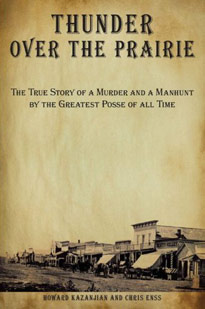
Thunder Over the Prairie Soon to be a Major Motion Picture

The year was 1878. Future legends of the Old West–lawmen Charlie Bassett, Bat Masterson, Wyatt Earp, and Bill Tilghman–patrolled the unruly streets of Dodge City, Kansas, then known as “the wickedest little city in America.”

When a cattle baron fled town after allegedly shooting the popular dancehall girl Dora Hand, these four men–all sharpshooters who knew the surrounding harsh, desertlike terrain–hunted him down, it was said, like “thunder over the prairie.” The posse’s legendary ride across the desolate landscape to seek justice influenced the men’s friendship, careers, and feelings about the justice system. This account of that event is a fast-paced, unforgettable glimpse into the Old West.

This Day…

1875-the ever fractious Panch Griego killed three cavalrymen in a dispute over cards in Lambert’s Saloon in Cimarron, New Mexico.
1893-after robbing a train near Cimarron, New Mexico on the 24th the Bill Doolin Gang was ambushed by a posse while crossing the river back into Oklahoma. U.S. Marshal Chris Madsen hit Doolin in the foot but the outlaws escaped.

The Last Stage Robbery

Photo by Sheryl Marie

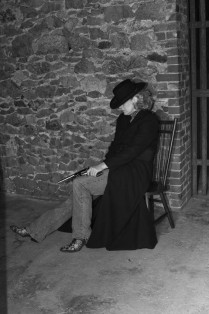
In addition to the chance to work in beautiful Helena, Montana this week, it proved to be a fruitful time with my editors as well. Lots of books in the works including a western fiction entitled Laura Reno’s Brothers. It’s the western version of how I lost my brother, and let me assure you dear readers, unlike real life, the bad woman and her daughters in this story get theirs in the end. I couldn’t let this day pass without recognizing a brazen frontier woman named Pearl Hart. More than one hundred and thirteen years ago this week, Pearl robbed the last stage to ever be robbed in the Old West. Armed with a .44 Colt pistol and dressed in a man’s gray flannel shirt, jeans, and boots, Pearl Hart rode off into the hills around Globe, Arizona, to rob an unsuspecting stagecoach. The petite twenty-eight year-old woman had a cherub like face, short dark hair, and hard, penetrating little eyes. The white sombrero perched on her had was cocked to one side and cast a shadow over her small nose and plumb cheeks. While her accomplice seized the weapon the stage driver was carrying, Pearl lined the passengers alongside the road and relieved them of the more than $450 they possessed. Before the lady bandit sent the shaken travelers on their way, she provided them with one dollar. “That’s for grub and lodging,” she told them. Once the stage was off again, Pearl and her partner in crime rode out in the opposite directions. The brazen daylight robbery that occurred on May 30, 1899, had historic significance. It was the last stage ever held up, and Pearl Hart was the last stage bandit, female or otherwise, to perpetrate such a crime. Pearl’s mother was desperately ill and needed money to help purchase medicine. Not that it makes it right to rob a stage, but that was the motivation behind it she claimed. There weren’t many stages running in Arizona in the late 1890s; trains were not the primary means of transportation. Pearl decided to rob the stage that ran from Florence to Globe. The holdup went smoothly but the escape plan was flawed. She got lost in the woods surrounding the crime scene and was eventually apprehended by a posse sent to arrest her. Pearl Hart was charged with highway robbery, and her trial took place in Florence. News of Pearl’s crime and the hearing were reported in newspapers throughout the country. For a while she was arguably the most famous woman in the world. The first jury found that the darling Pearl was a victim of circumstances and granted her an acquittal. The judge was furious with the verdict and ordered a second jury to be appointed. After warning them not to be swayed by the fact that she was a woman, the jury found her guilty. Pearl was then sentenced to five years in jail. The bandit Pearl Hart served eighteen months for her sentence and was released on December 19, 1902. She left Arizona for Missouri and settled in Kansas City with her younger sister. There is some dispute over the date the famous lady thief died. Some historians believe she passed away in 1925 in Kansas City. Others suggest she died in Arizona in 1955. Her body lies in an unmarked grave in a small cemetery located at the base of the Dripping Springs Mountains near Globe.

This Day…

1885-Led by Geronimo, Nana, and Mangas, more than 100 Apache Indians flee their reservation at San Carlos in Arizona territory and head for Mexico. A wave of panic siezed the area, as newspaper editorials and citizens call for dispatch of thousands of federal troops.

Ghosts of Bodie

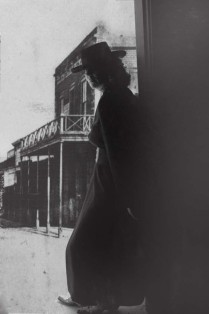
Standing in the shadows of a ghost town.

One of the most extraordinary places I’ve ever visited is a ghost town called Bodie. The gold camp is not far from the booming metropolis of Bridgeport, California. Bodie has more than one hundred buildings standing in a state of arrested decay. There you can see what life was really like in the mid-1800s. I’ve spent a lot of time at the cemetery there. I learn a great deal about history wandering around old cemeteries. At the Odd Fellows Cemetery in Bodie there is a demur marble angel that sits among the faded wooden crosses and weather-ravaged rock grave memorials. The three-foot cherub holds a flower wreath in her left hand and rests her hand on her right elbow. The lone angel watches over the burial site of a three-year-old little girl named Evelyn Meyers. Evelyn was the joyful, precocious daughter of Fannie and Albert Meyers. Born in Bodie on May 1, 1894, the child had a ready smile for everyone she saw and a particular fondness for an elderly miner who was a dear friend of the family. Fannie would take Evelyn with her when she went to do the weekly shopping. The little girl played outside with the other children in town and sat with the old miner friend and listened to the stories he would tell. Evelyn would follow the man everywhere he went, from the blacksmith shop to the church. The miner was taken with the little girl’s devotion. In the spring of 1897, Evelyn spotted the miner on Main Street and took out after him. Unaware that the child was following him, the man made his way to his claim just outside the town. Evelyn crept quietly behind. Whistling and preoccupied with the job of searching for gold, the miner raised a pickax up and back to begin chipping away at a rock wall. He still did not know Evelyn was behind him as he began to work. The top of the pickax caught the girl in the head, killing her instantly. The miner was devastated. The girl was laid to rest on April 6, 1897. Thousands of Bodie visitors have passed by the angel tombstone in the one-hundred-plus years it has been standing in the cemetery. Vandals have broken the top of the wings on the statue as well as the left foot. The inscription at the base of the marble is still clearly visible and reads Beloved Daughter. If you’re interested in reading more stories like this, please read Tales Behind the Tombstones: The Deaths and Burials of the Old West’s Most Nefarious Outlaws, Notorious Women, and Celebrated Lawmen. Written by yours truly, the book is available everywhere.