
1903 – “The Great Train Robbery” the 1st Western film, released starring Justus D. Barnes and G. M. Anderson
The Devil Horse and the Stuntman
Enter now to win a copy of
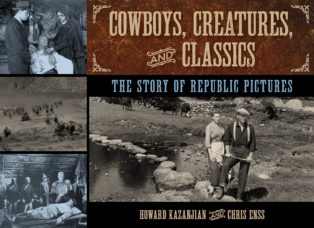
Cowboys, Creatures and Classics: The Story of Republic Pictures
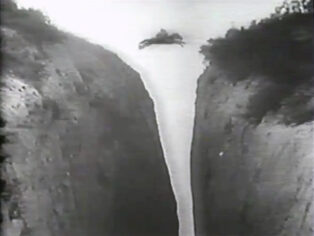
A pair of frantic, disheveled riders race side by side down a dusty, sun-scorched path. Suddenly they plunge into a wooded area. Branches slap at them, but neither dares slow his mount’s gait. They break through the other side, each still jockeying for lead position. The rider barely lagging behind now extends his arm out to grab the young man inches from him. The young man spurs his horse along faster and pulls away from the man trying to catch him. Ahead in the near distance, the crude path ends abruptly, giving way to a rocky cliff with a raging river far below. The two riders continue on fast, unaware of the danger. The young man is the first to leap off the precipice, his horse still under him. The rider behind him doesn’t hesitate but pushes his roan harder. The two fly off the cliff with great speed and plummet into the water.
The daring riders find their way to the surface. They’re dazed, but alive. The animals are alive as well, and they scramble to the water’s edge and hastily step out onto dry land.
After fighting the river’s strong current, both men managed to reach a sand bank and drag themselves out of the water. They are exhausted and drenched. The young man struggles to stand up and, once he finds his footing, hurries off after his horse. The cowboy that was chasing him hasn’t any strength left. He lies flat on his back staring up at the cliff where he dropped, contemplating how he could have survived such a fall.
That particular stunt was executed by legendary rodeo champion turned stuntman Yakima Canutt for the film The Devil Horse starring Harry Carey. Republic Pictures had a stable of daredevils who lived to perform death-defying feats that kept audiences on the edge of their seats. Yakima Canutt and the other stunt staff revolutionized the art and helped make Republic features and serial some of the most exciting and profitable works in the motion picture industry.
Contact
We would love to hear from you! Please fill out this form and we will get in touch with you shortly.
"*" indicates required fields
To learn more about Canutt and the other dedicated men and women who were willing to risk their lives for the movies produced by Republic read
Cowboys, Creatures and Classics: The Story of Republic Pictures
This Day…
Along Came Alice Sisty
Enter now to win a copy of
Along Came a Cowgirl: Daring and Iconic Women of the Rodeo and Wild West Shows
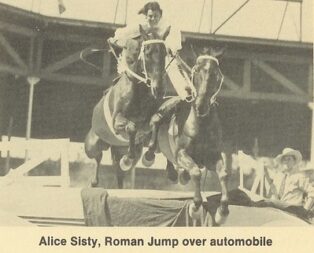
A hush fell over the large crowd at the rodeo arena in Salt Lake City, Utah, in July 1938 as daredevil rider Alice Sisty raced into the arena atop two English jumpers. She was standing on the backs of the animals with one foot on one horse and the other foot on the second mount, known as Roman riding. Alice led the horses into a gallop around the arena as the audience cheered and applauded. She expertly handled the jumpers named Whale and Brownstone. Alice had performed the Roman standard jump a number of times and was confident the trick would come off perfectly.
The trick involved the excited horses leaping over a parked automobile. It was an outstanding feat that, when executed well, brought rodeo fans out of their seats shouting for joy. Alice did not disappoint. Her signature jump was flawlessly carried out. She waved to the wildly cheering audience as she urged her horses into another pass at the stunt.
Born in Netcong, New Jersey, in January 1913, Alice first broke into national headlines when, at twenty years of age, she rode an Indian pony from Reno, Nevada, to the steps of New York City Hall. It was a three- thousand-mile journey, and, when she arrived in New York, mayors from coast-to-coast celebrated Alice’s accomplishment with letters of congratulations. The Cheyenne, Wyoming, Chamber of Commerce helped defray Alice’s expenses on the journey, and she helped advertise the Cheyenne Frontier Days by wearing a cowboy suit with the Cheyenne inscription on its back.
Alice had been riding horses since the age of six. Her grandfather owned a racetrack, and the love of horses was undoubtedly born in her. One of Alice’s first rodeo appearances was in Asbury Park. It was followed by well received appearances in such places as Des Moines, Iowa; Cheyenne, Wyoming; Omaha, Nebraska; and Billings, Montana. She performed at the Chicago World’s Fair and at Madison Square Garden.
Billed as a trick and fancy rider, Alice won numerous cowgirl championships. She was one of the highest paid, female rodeo performers in the 1930s. Friends and fans seldom, if ever, saw her without her makeup and hair done to perfection and adorned in beautiful cowgirl clothing. The dark-haired, blue-eyed Alice had decided to become a cowgirl when she was nineteen and signed to ride in Colonel Zack Millers’ 101 Ranch.
In addition to the prized English jumpers with which she used to perform the Roman standard jump trick; she owned a white Arabian horse named Chopa. Chopa was a highly intelligent animal who responded to every command of Alice’s voice. The pair were seen together in rodeo shows from coast to coast.
Alice passed away from an unnamed illness on September 11, 1953, in Crescent City, California, where she lived with her second husband, Hennie Sommer. Alice was forty years old when she died.
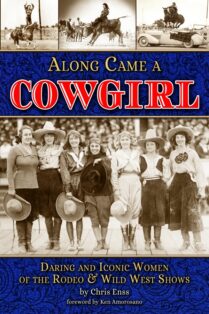
To learn more about fearless riders like Alice read
Along Came a Cowgirl: Daring and Iconic Cowgirls of the Rodeo and Wild West Shows
This Day…
1942 – “Casablanca” directed by Michael Curtiz and starring Humphrey Bogart and Ingrid Bergman premieres at Hollywood Theater, NYC (Academy Awards Best Picture 1943)
Along Came Cowgirl Tillie Baldwin
Enter now to win a copy of
Along Came a Cowgirl: Daring and Iconic Women of the Rodeo and Wild West Shows
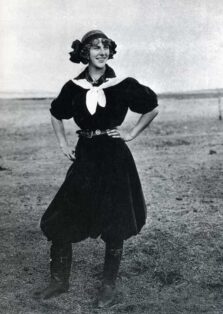
Tillie Baldwin
Hundreds of rodeo fans filled every available seat at the Pendleton Roundup in northwestern Oregon in late September 1912. They cheered loudly for Swedish bronc buster Tillie Baldwin sitting atop an outlaw horse named Spike. The gate was moments away from opening and the bronc was already bucking wildly. Tillie ground her hat down tight on her head, and then clenched onto the thick reins of her ride. The chute opened and Spike darted out into the arena. Tillie bobbed up and down in the saddle, holding on with all her might, as the horse worked violently to try and throw her off his back. At long last, a horn sounded, and the ride was officially over. Tillie had survived the long trek around the arena on top an animal who had been unsuccessful in tossing her to the ground. The crowd enthusiastically applauded the twenty-four-year-old, and the remarkable ride earned her first prize in the women’s bucking bronco contest. She was awarded a $350 saddle. In addition to winning the bucking bronco championship, Tillie also won the trick riding competition and its $150 purse.
Tillie Baldwin was born Anna Mathilda Winger in Arendal, Norway, in 1888. She was fourteen years old when she migrated to the United States with her family in 1902, and she did not speak English. Six years later, she had not only mastered the language but had become a hairdresser with a healthy clientele of New York ladies wanting a new look.
During a trip to Staten Island in early 1908, Tillie saw a troupe of cowboy and cowgirl actors making a movie. The teenage hairdresser immediately wanted to learn to ride a horse and join the talent. Tillie approached one of the actors and asked them to teach her to ride. She worked for weeks with her paid instructor and eventually became a competent horsewoman. Shortly thereafter, she asked the producer of the film if she could join the cast. He agreed.
From those silent pictures, the eager young equestrian signed a contract to perform live in Captain Jack Baldwin’s Western Show. There she perfected her riding skills and met her husband, cowboy Johnny Baldwin. While employed in Baldwin’s show, she changed her name from Mathilda to Tillie. In time, she signed with the renowned 101 Ranch Wild West Show. When she wasn’t performing, she was competing in various rodeos around the country.
Over the course of her thirteen-year rodeo career, Tillie Baldwin won roping and riding events in such prestigious programs as the Winnipeg and Calgary Stampedes and the California Rodeo in Salinas. Routinely billed as the “fearless rider who had never been thrown by a bucking bronco”, rodeo fans in 1921 named her as one of three best women riders in the country. Also on that list were Fannie Sperry and Bertha Blanchard.
Tillie retired from rodeo competition in 1925 and moved to South Lyme, Connecticut, where she operated a horse ranch and riding school. She died on October 23, 1958, at the age of seventy.
To learn more about talented riders like Tillie read
Along Came a Cowgirl: Daring and Iconic Women of the Rodeo and Wild West Shows
This Day…
1950 – Frank Loesser‘s musical “Guys & Dolls”, starring Robert Alda, Vivian Blaine, and Sam Levene, opens at 46th St Theater, NYC; runs for 1200 performances, winning 5 Tony Awards
Along Came Cowgirl Kitty Canutt
Enter now to win a copy of
Along Came a Cowgirl: Daring and Iconic Women of the Rodeo and Wild West Shows
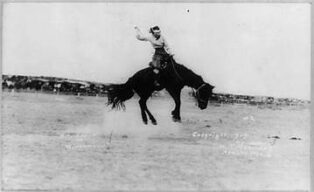
Bronc busting champion Kitty Wilkes won her first title at the Wild West Celebration Rodeo in Miles City, Montana, in 1916. The seventeen-year-old, New York native’s straightforwardness and untamed physical daring gave fans the impression she was born and bred into the rugged life of a Wyoming ranch. Few would have guessed she was new to the sport or that winning the top prize would inspire her to excel in other rodeos. From that exciting moment in Miles City she was determined to show the world that one need not be “born in the saddle” to be a crack rider.
Katherine Derre, whose stage name was Kitty Wilkes, was born on July 15, 1899. She had a natural talent for breaking horses and parlayed that skill into bronc riding in public showings. Not only did she have a way with wild horses, but she was also an exceptional trick and fancy rider. Owners of relay strings were eager to gain her services.
Between the rodeo in Montana in the summer of 1916 and the Pendleton Roundup in Pendleton, Oregon, in early fall of 1916, Kitty honed her bronc riding talent at ranches and rodeos throughout the West. She insisted on using the orneriest animals for training. Outlaw horses were blindfolded and saddled for her to ride. One encounter resulted in the horse bucking Kitty off and bruising her ribs. She wouldn’t allow the horse to beat her, however. She swung back into the saddle, refusing to leave it until the animal finally broke.
Kitty’s nickname was Diamond Girl because she had a diamond set in her front tooth. When needed, she would remove the diamond and pawn it for the entry fees to rodeo contests.
Her performance at the Pendleton Roundup in 1916 resulted in her being named the All-Around Champion Cowgirl. Among the many people she met during the roundup was Yakima Canutt. Canutt, who also competed at the rodeo, would go on to become one of Hollywood’s leading stuntmen. Kitty and Yakima fell in love and were married in Kalispell, Montana, in 1917.
Kitty was a fierce athlete who hated to lose. It was not uncommon for her to challenge women who outrode her, and she believed cheated, to a fistfight. In September 1918, she was disqualified from participating in a rodeo in Washington because she hit a rider in the mouth with a piece of wood.
Not content with being the top female bronc rider in the country, she aspired to be the top female relay racer as well. Rodeo fans loved to watch the petite woman fly past the grandstands on her horse, hurrying to meet the next mount waiting to be saddled and ridden to the next point. More than once Kitty would be finishing part of the race standing on the stirrups trying to get into the saddle. Her grit and resolve often paid off with a win.
The rodeo stars Kitty often competed against were Mabel Strickland, Bonnie McCarroll, and Prairie Rose Henderson.
Kitty Wilkes was eighty-eight years old when she died on June 3, 1988.
To learn more about fearless women like Kitty read
Along Came a Cowgirl: Daring and Iconic Women of the Rodeo and Wild West Shows
This Day…
1920 – Silent film “The Last of the Mohicans” released, adapted from James Fenimore Cooper‘s novel, starring Wallace Beery, Barbara Bedford
Along Came Cowgirl Berenice Dossey
Enter now to win a copy of
Along Came a Cowgirl: Daring and Iconic Women of the Rodeo and Wild West Shows
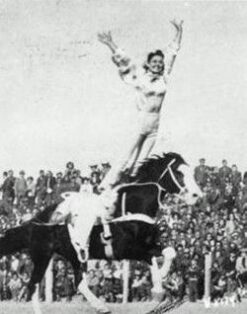
In early February 1941, more than twenty-five hundred people jammed into the stadium to watch the exciting events at the World’s Championship Rodeo in Phoenix, Arizona. They came to see wild cow riding, calf roping, steer roping, bronc riding, and trick rider Berenice Dossey. Not only was she a “spectacular performer” according to the Arizona Republic newspaper, but she was also known as one of the most beautiful women on the rodeo circuit. Among the myriad of tricks that she perfected on top of her horse Sundee were the hippodrome stand, double vault, and the Cossack drag, where she would hang under her ride’s belly at full gallop. It was her flawless execution of the Cossack drag that helped earn her the title of World Champion Trick rider in 1941 and 1945.
Berenice was born on April 26, 1913, in Ellensburg, Washington. Her parents Louis and Winnifred Smith Blair owned a ranch and its’ there she began riding horses at the age of three. By the time she was twelve she was standing up in the saddle when she rode and attempting a number of other stunts on the backs of the many thoroughbred horses belonging to her father and uncle. Like many skilled horsewomen in the 1930s, Berenice was a part of the Miller Brothers 101 Ranch Wild West shows. While she was with the famous show, she not only honed her trick riding skills, but became an accomplished horse racer and an expert of a type of choregraphed dressage riding called quadrille.
The trick rider’s peers considered her to be a “real trouper of the rodeo game.” On those occasions when she lost her balance and fell to the ground or was thrown off the back of her ride, she always continued with show, doing all the difficult stunts no matter what kind of pain she was experiencing.
Not only was Berenice an exceptional rider, but she was also a gifted seamstress. She made all the western apparel she wore in the various rodeos in which she participated.
Berenice worked as a professional trick rider for more than twenty years, performing in rodeos across the United States and Canada. She was married three times. Her second husband, Carl Dossey, was a World Champion bareback rider. The pair were living in Chandler, Arizona, when died tragically trying to stop of team of runaway horses at the Madison Square Garden Rodeo parade held on March 12, 1955.
The talented Berenice retired in 1956 after marrying Frank Bolen in Nogales, Arizona. The couple moved to California for a brief time before settling in Pocatello, Idaho. Berenice was active in several civic organizations and served as a 4-H leader and was on the board of directors for the Little Britches Miniature Rodeo. Her hobbies included dress pattern making and leather works. She made custom belts for her three adult children, grandchildren, and numerous friends.
Berenice Blair Taylor Dossey Bolen died of cancer on September 18, 1974, at the age of sixty-one. She was inducted into the Cowgirl Hall of Fame in 1991.
To learn more about fearless riders like Berenice read
Along Came a Cowgirl: Daring and Iconic Women of the Rodeo and Wild West Show