
1960 – Cy Coleman and Carolyn Leigh’s musical “Wildcat” with Lucille Ball premieres in New York City
Queen of Noir
Enter now to win a copy of
Cowboys, Creatures and Classics: The Story of Republic Pictures
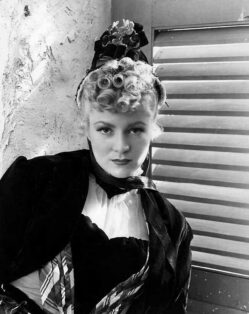
Claire Trevor made famous the role of Dallas the soiled dove in the film Stagecoach. With a voice once described as sounding like delicious trouble, she was one of the most sought-after supporting actresses during the 1930s and 40s.
She was born in New York City – movie buffs disagree whether it was 1909 or 1910 – to a Belfast, Ireland-born mother and a strict Paris born father who had a custom tailor shop on Fifth Avenue.
As a child, Trevor dreamed of being a ballerina. But along the way she became involved in church plays and fell in love with the stage. After studying art briefly at Columbia University, she attended the American Academy of Dramatic Arts in New York. She had to drop out after six months, though, because her father’s business failed during the Depression, and he told her that she would have to help out.
“That shocked the hell out of me,” she later recalled. “We weren’t rich, but I never thought of money as being a worry, so it scared me. I thought, ‘What do I know how to do? Acting is the only thing I know how to do, and to get a job in the middle of the Depression in New York was not easy.
After a successful run on Broadway at the age of twenty-one, Trevor made her film debut in the early Western, Life in the Raw, and between 1933 and 1938, starred in over twenty movies including Dante’s Inferno, Dead End and The Amazing Dr. Clitterhouse starring Humphrey Bogart. In 1939, she co-starred with an unknown Wayne in Ford’s classic, Stagecoach, and is one of few stars to have ever received top billing over The Duke.
Trevor appeared in other popular Westerns including Honky Tonk with The King of Hollywood, Clark Gable, and The Desperadoes starring Randolph Scott and Glenn Ford. She became known for her hard-boiled blondes in film noirs, winning her only Oscar for her performance in John Huston‘s Key Largo, but her unconventional Western roles popularized the bad girl of the Wild West making her a cornerstone of the genre.
The Oscar winning actress died on April 8, 2000, at the age of ninety.
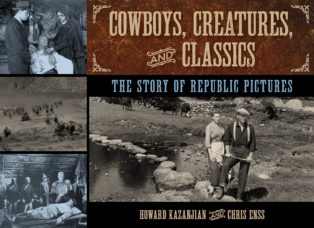
Cowboys, Creatures, and Classics 3
I'm looking forward to hearing from you! Please fill out this form and I will get in touch with you if you are the winner.
Join my email news list to enter the giveaway.
"*" indicates required fields
To learn more about film legends like Claire Trevor read
Cowboys, Creatures and Classics: The Story of Republic Pictures
This Day…
Starlet Jane Russell
Enter now to win a copy of
Cowboys, Creatures and Classics: The Story of Republic Pictures
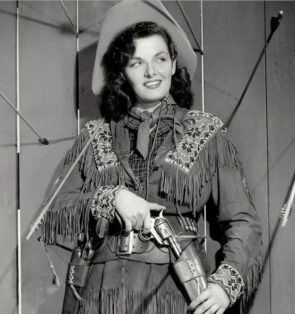
Jane Russell was a dark-haired siren whose sensational debut in the 1943 Western The Outlaw inspired producer Howard Hawks to challenge the power and strict morality of Hollywood’s production code. Her provocative performance in the film – and the studio publicity shots posing her in a low-cut blouse while reclining on a stack of hay bales – marked a turning point in moviedom sexuality. She became a bona fide star and favorite pinup girl of soldiers during World War II. Troops in Korea named two embattled hills in her honor.
Born Ernestine Jane Geraldine Russell on June 21, 1921, the stunning, talented actress would turn her sexy image to comic effect in films with Bob Hope, Marily Monroe and other major stars. Among her better films are The Paleface in which she plays the spirited Calamity Jane opposite Hope’s feckless dentist in a spoof of The Viriginian, and Gentlemen Prefer Blondes, a musical in which she is brunette gal pal Dorothy to Marilyn Monroe’s gold-digging Lorelei Lee. In the latter, the two stars perform a razzle-dazzle production number of the Jules-Styne-Leo Robin hit song “Diamonds Are A Girl’s Best Friend.”
Some of the other Westerns she starred were Son of Paleface, Montana Belle, and The Tall Man.
Russell was a Christian who made several appearances on the Trinity Broadcast Network discussing her faith in Jesus Christ. She passed away on February 28, 2011, at the age of eighty-nine.
Cowboys, Creatures, and Classics 3
I'm looking forward to hearing from you! Please fill out this form and I will get in touch with you if you are the winner.
Join my email news list to enter the giveaway.
"*" indicates required fields
To learn more about some of the amazing women in Westerns read
Cowboys, Creatures and Classics: The Story of Republic Pictures
This Day…
1941 – Imperial Japanese Navy with 353 planes attack the US fleet at Pearl Harbor Naval Base, Hawaii, killing 2,403 people
The Olympic Skater Turned Actress
Enter now to win a copy of
Cowboys, Creatures and Classics: The Story of Republic Pictures
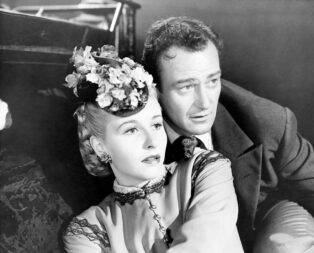
The most influential woman at Republic Pictures from the early 1940s to the studio’s demise in the early 1960s, was Vera Hruba. Born in Prague, Czechoslovakia, on July 12, 1919, the blonde beauty caught Republic Picture’s president Herbert Yates’ attention in 1939 when she toured the United States with an ice-skating show called Ice Vanities.
Vera was an exceptional ice skater, having placed 17th in the 1936 Olympics behind figure skater Sonja Henie. Yates was captivated with Vera’s talent and looks and believed she could be as successful as Ms. Henie who was one of the leading stars at 20th Century Fox. He cast Vera, and the entire company of the Ice Vanities, in a musical film entitled The Ice Capades. Critics called the picture “sheer enchantment on ice.” Vera was mentioned along with five other skaters as “spectacular”. Yates couldn’t have agreed more and in 1943 signed her to a long-term contract with the studio and added Ralston to her name. He added Ralston, a name borrowed from the cereal, because Hruba was difficult for moviegoers to pronounce.
The first movie Vera Hruba Ralston appeared as a star, minus the skates, was Republic Pictures’ 1941 horror film The Lady and the Monster. Her costars were Erich von Stroheim and Richard Arlen. Billed as “a picture from out of this world” the plot involves a millionaire whose brain is preserved after his death, and telepathically begins to take control of those around him. The film reviewer for the Havre Daily News referred to Ralston’s debut as a dramatic actress as “the find of the season.”
Most did not agree with the critics who found the foreign ingénue to be a promising star. Many complained that her performance was wooden and that her accent was too thick. Yates ignored every voice but his own and quickly reteamed von Stroheim and Arlen with his discovery in another feature entitled Storm Over Lisbon. In this spy thriller Ralston played an allied operative in Lisbon and Arlen an American newspaper man who she helps get out of Portugal with important information. Audiences found Ralston attractive, but struggled to understand what she was saying.
Yates hired acting instructors and speech coaches for Ralston. While her English and her acting soon improved she could not lose her strong Czech accent. Yates felt that ticket buyers would eventually see how compelling the stunning blonde’s talent truly was and learn to embrace her way of talking in much the same way they did Marlene Dietrich. In order to help Ralston, gain a broader acceptance he paired her with an actor that had mass appeal – John Wayne.
The western starring Wayne and Ralston was Dakota. Wayne and Ralston portray newlyweds who plan to use their nest egg to buy property at a location where a railroad town is rumored to be built. Before the pair has a chance to make a start for themselves, they are robbed of their money and Wayne sets out to find the crooks and retrieve what’s his.
Wayne was hesitant to work with Ralston. None of the pictures she had made for Republic had done well. Yates enticed Wayne into making Dakota with the promise of a percentage of the revenue from the next movie he was slated to do for the studio. The film was Wake of the Red Witch and Wayne made a substantial amount from the percentage Yates agreed to give him. It was enough to fund a production company of his own.
Widely released on Christmas Day in 1945, audiences were pleased with the fast-moving film. The movie critic at the Tallahassee Democrat called Dakota a “rip-snorting, fast-shooting, western drama packed with action.”
Returns were better than okay. Dakota was hugely profitable. In terms of box office sales, it would be the most profitable film Vera Hruba Ralston would ever make.
Vera passed away in February 2003 at the age of seventy-nine. To learn more about Vera read Cowboys, Creatures and Classics: The Story of Republic Pictures.
This Day…
1848 – US President James K. Polk triggers gold rush of 1849 by confirming a gold discovery in California
Miss Kitty and Gunsmoke
Enter now to win a copy of
Cowboys, Creatures and Classics: The Story of Republic Pictures

For more than nineteen years, Amanda Blake’s character on Gunsmoke, Miss Kitty, gave strength and succor to the parched patrons who visited Dodge City’s Longbranch Saloon. Kitty Russell was extremely softhearted, beneath what could be a very businesslike exterior, and would have willingly become romantically involved with Marshal Matt Dillon.
The few Westerns seen on television during the early 1950s starred old-style move heroes such as the Lone Ranger and Hopalong Cassidy, and had little to do with the real West. Two shows, Gunsmoke and The Life and Legend of Wyatt Earp, changed all that. Gunsmoke was set in Dodge City, Kansas, around 1880. It first began as a radio program starring William Conrad as Marshal Dillon and Georgia Ellis as Miss Kitty.
When Amanda Blake heard that the successful radio show was going to be made into a television pilot she knew she wanted to audition. Blake was born Beverly Louise Neill on February 20, 1929, in Buffalo, New York. She was educated in Buffalo, Gainesville, Georgia, and Claremont, Los Angeles County, where she moved with her parents in 1943.
Blake made her dramatic debut as a ten-year-old in a school pageant in Buffalo, and later studied acting at Buffalo’s Studio Club. She signed a contract with MGM while still in her teens, and her first film role was in the 1950 film Stars in My Crown.
“I knew I had to have the part of Kitty,” she told reporters in a 1971 interview. “So, I hounded the producer until I got it.” In order to do the long-running Gunsmoke series, Miss Blake commuted by private plane from her home near Phoenix. She left the show in 1974. “I was tired and it was time to go,” she recalled years later. “It was the end of the trail.”
Gunsmoke ran from September 10, 1955, to September 1, 1975. The show lasted only one year without Blake.
In 1968, Amanda Blake was selected as the first female inductee into the Hall of Fame of Great Western Actors and Actresses in Oklahoma City. She died of cancer in Sacramento, California, on August 16, 1989.
Cowboys, Creatures, and Classics 3
I'm looking forward to hearing from you! Please fill out this form and I will get in touch with you if you are the winner.
Join my email news list to enter the giveaway.
"*" indicates required fields
To learn more about the actress of television and film Westerns read
Cowboys, Creatures and Classics: The Story of Republic Pictures
This Day…
Republic Pictures’ Western Star Gail Davis
Enter now to enter to win a copy of
Cowboys, Creatures and Classics: The Story of Republic Pictures
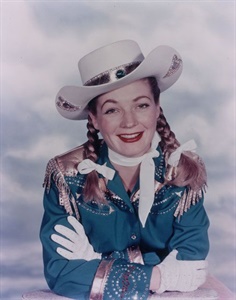
Bullseye! The Annie Oakley Show was on the air from 1954 to 1957 and Annie hit the entertainment bullseye every week with her hard riding, straight shooting, and suspense. Actress Gail Davis portrayed the Western legend. To some, Gail was only a minor flicker in the Hollywood star system. But to others, she was something special and more famous than that “other” Davis named Bette.
For more than three years she was TV’s pigtailed, fast-riding, sharp-shooting, good-looking Annie Oakley, who helped keep law and order in her hometown of Diablo through eighty-one black-and-white episodes. The series continues in re-runs for several years after that.
Davis was born in Little Rock, Arkansas and attended the University of Texas where she participated in college plays. From there she headed to Hollywood and landed her first small movie role in Romance of Rosy Ridge, a 1946 movie starring Van Johnson.
Next she had a part in If You Knew Susie with Eddie Cantor and Joan Davis at RKO. Not long after that, she began appearing as the female lead in some of the films of B-Western cowboy stars such as Allan “Rocky” Lane at Republic and Tim Holt at RKO.
She served herself well playing opposite Roy Rogers in 1949’s The Far Frontier. The movie also featured a couple of other figures who also would go on to make their marks in early TV Westerns: Clayton Moore (The Lone Ranger) and Andy Devine (“Jingles” on the Wild Bill Hickok Show).
Gene Autry spotted her, was impressed, and signed her to a contract with his Flying A Productions. Davis appeared as Autry’s leading lady in several of his theatrical movies.
When The Gene Autry Show was launched on television in the summer of 1950. Davis showed up in numerous episodes during the series’ first three years. Then Autry put Davis in her own show the “Annie Oakley” series which was produced by Flying A.
Also in the cast was Jimmy Hawkins as Annie’s brother Tagg and Brad Johnson as deputy sheriff Lofty Craig. After a taste of Annie’s deadeye shooting and Lofty’s hard-hitting fists, not many outlaws stayed around Diablo too long.
Appropriately, Annie’s horse in the series was named Target.
Flying A press agents claimed Davis grew up shooting and riding just like the real Annie Oakley. But in the early 1950s interview, Davis said she learned to ride and shoot after coming to Hollywood. Obviously, she picked up on it all quickly, because her shooting act became a part of Autry’s live touring show.
Gail Davis passed away in March 1997 of cancer. She was seventy-one when she died.
Cowboys, Creatures, and Classics 3
I'm looking forward to hearing from you! Please fill out this form and I will get in touch with you if you are the winner.
Join my email news list to enter the giveaway.
"*" indicates required fields
To learn more about the talented actress who portrayed Annie Oakley read
Cowboys, Creatures and Classics: The Story of Republic Pictures