
1932 – Amidst the Great Depression, Democrat candidate Franklin D. Roosevelt is elected President of the United States, defeating Republican incumbent Herbert Hoover
Along Came Cowgirl Mary Duncan
Enter now to win a copy of
Along Came a Cowgirl: Daring and Iconic Cowgirls of the Rodeo and Wild West Shows
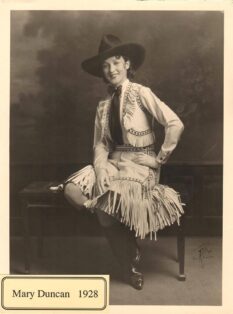
Rodeo fans at the Round-Up in Pendleton, Oregon, in 1928 were thrilled by the prospect of meeting the cowgirl actress chosen to reign over the prestigious event. Queen Mary Duncan had entertained motion picture audiences with her horseback riding skills in the popular silent films Four Devils and The River. Audience members hoped she would demonstrate some of the roping and riding techniques she performed on screen at the event, maybe even participate in a relay race or two. Champion trick rider Mabel Strickland, who had ruled as queen over the prior year’s program, had dazzled ticket buyers with an exhibition of her talent. Queen Mary’s contribution to the festivities would not be as daring.
Born on August 13, 1894, in Luttrellville, Virginia, Mary learned to ride at a young age and could have gone on to work in Wild West shows but decided to attend Cornell University instead. She left college after two years to go on the stage. She had phenomenal success in the Broadway plays Poppy and Shanghai Gesture. On the merits of those performances, she was signed by Fox Film Corporation to appear in a series of films portraying a feisty rancher’s daughter who helped fight off cattle thieves. The vivacious, auburn-haired beauty’s talent for the screen equaled her talent on stage.
Mary Duncan had been in Pendleton a month prior to the Round-Up. She arrived with director Edward Sedgwick and other cast and crew members to film a movie entitled Our Daily Bread. Sedgwick wanted to use the rodeo as a backdrop for the setting. It was the first time in motion picture history that the Round-Up would be both heard and seen on the screen. The director filmed the rodeo in 1924 when his then wife, Josie Sedgwick had been the queen of the event. Unlike Josie’s court, Mary’s did not feature cowboy attendants. The Round-Up board of directors appointed a traditional court: two princesses from Pendleton and two from the surrounding area. Queen Mary and her attendants appeared in the parade dressed in white leather costumes trimmed in black. Mary rode in a stagecoach and her attendants followed her on horseback.
When the Round-Up concluded, Mary, Edward Sedgwick, and the others associated with the production of Our Daily Bread remained in the area. Local newspaper reporters followed Mary’s every move, referring to her as “Queen” in the articles written about her and the film being made in the wheatfields and hills of Umatilla County. “The people out here are perfectly marvelous,” she told a reporter for the La Grande Observer. “I wish you would convey for me how glorious my time in Oregon has been.”
Pendleton residents who spent time with the actress during her visit praised her for her charm and kindness. Some claimed she was one of the “most talented Round-Up Queens who never rode a horse.” The community invited Mary back to the rodeo to serve again as the queen of the event years after she returned to Hollywood, but she declined the offer, insisting the honor should go to a working cowgirl.
Queen Mary Duncan died on May 9, 1993, at the age of ninety-eight.
To learn more about talented women like Mary Duncan read
Along Came a Cowgirl: Daring and Iconic Women of the Rodeo and Wild West Shows
This Day…
1906 – Charles Evans Hughes (R) elected NY Governor beating William Randolph Hearst
Along Came Cowgirl Lucyle Richards
Enter now to win a copy of
Along Came a Cowgirl: Daring and Iconic Women of the Rodeo and Wild West Shows
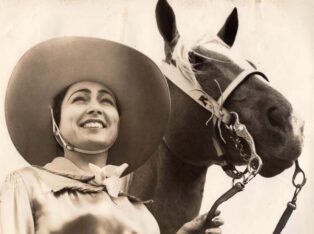
Lucyle Richards tightened the grip she had on the rope attached to the flank strap tied around the steer she was about to ride. The monstrous animal underneath the ninety-nine-pound woman recognized by rodeo fans across the country as the most beautiful of all the professional cowgirls, waited anxiously for the chute to open. The steer was huffing and angry and Lucyle anticipated a rough time. The audience at the rodeo in Kilgore, Texas, on August 13, 1939, were excited to see the accomplished performer and they called out her name and cheered. She stayed on the back of the steer for more than a minute before being thrown head over heels at a distance of twelve feet. Lucyle was a bit shaken but she quickly picked herself up and waved to the crowd. They erupted in thunderous applause and she bowed in appreciation.
Born Lucyle Garms in Pushmataha County, Oklahoma, in 1909, to a Choctaw Indian mother and Irish father, her rodeo career began at the age of thirteen. Not only did she ride bucking steers and horses, but she was an accomplished trick roper and rider. She won the World Championship Saddle Bronc riding competition in Chicago in 1930 and earned additional titles for the sport in Boston in 1934.
Married a number of times, her husbands included rodeo stars Oklahoma Curly Roberts and T. J. Richards. “I like to take chances,” she told a Fort Worth, Texas, newspaper reporter in the summer of 1938. “That’s why I do what I do, riding vicious horses for a living. I’ve been riding the rodeo since 1929 – from Texas to London and back. It’s been a good life, lots of fun, but it has not been without its struggles – five broken ribs, a fractured chest bone, and innumerable bruises. But I wouldn’t have changed a thing.”
During the 1940s, Lucyle’s time in the arena was overshadowed by the troubles in her personal life. In late April 1941, she was arrested for the murder of her fiancé, wealthy cattleman Frank Dew. The two had been romantically involved for more than a year when she suspected he had been seeing another woman. Lucyle showed up at Dew’s home to confront him over the matter and during their physical altercation, Lucyle pulled a gun from her purse. The pair wrestled over the weapon and Frank died shortly after being shot. Lucyle denied firing the shot that killed him and a jury found her not guilty at the end of a four-day trial.
At the conclusion of the court case, Lucyle left bronc busting to attend the Chennault Aviation Academy in Houston. After learning to fly she became an instructor. She was one of only four women instructors in the country in the special government training program. During World War II, Lucyle ferried bombers between the United States and England.
By 1951, the accomplished rodeo entertainer and aviatrix returned to the arena winning the Saddle Bronc Riding Championship in Oklahoma City and at Madison Square Garden in New York. Ten years later, she retired from riding and became a police officer in Yoakum, Texas.
In 1987, the woman described as a cross between Annie Oakley and Amelia Earhart, was inducted into the National Cowgirl Hall of Fame. Lucyle Richards passed away in 1995 at the age of eighty-six.
To learn more about fearless women like Lucyle read
Along Came a Cowgirl: Daring and Iconic Women of the Rodeo and Wild West Shows
This Day…
1917 – 1st class US mail now costs 3 cents per ounce
Along Came Cowgirl Olive Golden
Enter now to win a copy of Along Came A Cowgirl!
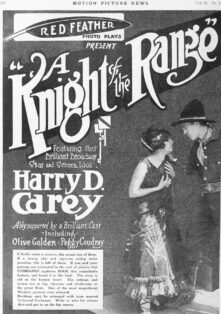
When the five-reel western drama A Knight of the Range premiered in early 1916, critics praised silent film cowboy and cowgirl actors Harry D. Carey and Olive Fuller Golden performances. Audiences were dazzled by the equestrian feats never-before seen in a motion picture. “Stunts that are inconceivable of execution are performed before the all-seeing eye of the camera,” a review of the film in a Hollywood magazine read. “Lovers of riding will miss the treat of their lifetime if they fail to see Western stars Carey and Golden work their magic on horseback. Golden is one of the prettiest and most popular of film favorites. Her long golden curls droop over her shoulders and her bewitching smile is as golden as an Arizona sunset; golden also is her disposition. She will be a star as long as motion pictures are being made.”
Olive Fuller Golden was a rodeo performer who got her start in film in 1914 in a picture called A Sorrowful Shore. Born on January 31, 1896, she came from a performing family headed by her father, famed vaudeville entertainer George Fuller Golden. She traveled to Hollywood from New York in 1913 where she became an original stock player for director D. W. Griffith – along with Mary Pickford, Lillian and Dorothy Gish, and Harry Carey. She starred opposite Harry Carey in her first film and the pair married two years after A Sorrowful Shore premiered.
In 1916, Olive signed a contract with Universal, where legend has it, she introduced her husband to John Ford and helped convince the studio executives to let Ford direct pictures. Until that time Ford had been a stuntman and assistant director. She acted in John Ford’s film The Soul Herder in 1917. She then retired from films and helped manage Harry’s career and raised a family. Shortly after her husband’s death in 1947, Olive decided to come out retirement. She appeared in a number of movies including Gunfight at the O. K. Corral, The Wings of Eagles, and Two Rode Together. The most memorable film in which Olive appeared was Ford’s The Searchers in which she played the mother of Vera Miles and her real-life son, Harry Carey, Jr.
Olive died in March 1988 at the age of ninety-two.
To learn more about these fearless cowgirl stars read
Along Came A Cowgirl: Daring and Iconic Women of Rodeos and Wild West Shows
This Day…
1921 – Eugene O’Neill’s play “Anna Christie” premieres in NYC
Publishers Weekly Review of The Doctor Was A Woman
The Doctor Was A Woman: Stories of the First Female Physicians on the Frontier
Coming February 2024
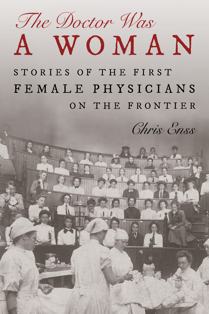
Historian Enss (The Widowed Ones) profiles in this colorful account 10 of the first female physicians on America’s Western frontier. She portrays them as highly determined individuals, whose resolve not only saw them through the medical schools that resisted admitting them, but also through the treatment of recalcitrant patients (“Doctors were few and far between in the unsettled land,” she writes, and yet “for a time it seemed most trappers, miners, and merchants would rather suffer than consult a woman doctor”).
Among the “lady physicians” and “hen medics,” there was Lilian Heath, a pioneer of plastic surgery who in 1886 mended the face of a man who’d shot himself in despair (she told him he looked better after her 30 surgeries than before); Emma French, the 16th wife of a Mormon who received the midwifery training common among her sister wives; and Bessie Efner, who was seduced to Wyoming by boosters of the Union Pacific Railroad Company, only to find that the men were unwilling to see her—her first patient was a horse she cured of colic.
Between the brief biographies are insightful notes on topics such as treating influenza, sterilizing patients, and extracting bullets. Readers who enjoyed Campbell Olivia’s Women in White Coats will want to check this out. (Feb.)
Praise for Tilghman Book
Early Comments about the Bill Tilghman book scheduled for release in fall 2024.
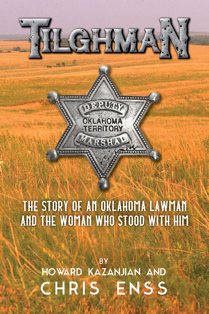
Zoe Tilghman, my grandmother, was a truly remarkable woman – a pioneer, horsewoman, musician, linguist, student, educator, writer, poet, wife, mother. When she married Bill Tilghman she also became an eyewitness to the important part he played in Oklahoma and the developing West. Chris Enss and Howard Kazanjian have done an excellent job of capturing her life.
Suzie Baerst
This unique “story within a story” reveals the challenges and triumphs of being married to one of America’s most prominent western lawmen. The colorful exploits of William “Bill” Tilghman, as told through the equally fascinating story of his wife Zoe, present the reader of this book with an exciting and insightful “edge of your seat” experience!
Wyatt McCrea – Actor/Producer
“Gritty, violent, magnificent and noble describes America and the early lawmen who made the frontier safe for expansion. The authors do a masterful job of unpacking the life of revered lawman Bill Tilghman through the words and prose of his second wife, Zoe Tilghman a scholar, mother, poet and remarkable woman in her own right. This husband and wife team were one of America’s early power couples.”
Eileen O’Neill – Former Head of Discovery Channel and TLC
Who was lawman Bill Tilghman? He did not have the dime novels that made Wild Bill and Buffalo Bill famous, nor Stuart Lake who spun the life of Wyatt Earp into fame. But he was one of the greatest lawmen of all. Tilghman now has history documentarians Chris Enss and Howard Kazanjian to show us details about the man from his own notebooks and from his talented wife Zoe’s own hand.
Wayne Tilman – Bestselling Author and Bill Tilghman’s Relative
This Day…
1866 – Jesse James‘ gang robs bank in Lexington, Missouri ($2000)