The Arrest of Popcorn Jenny


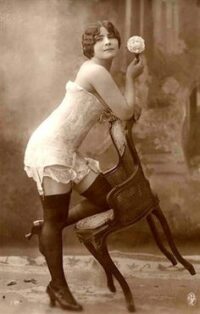
Among the most notable Deadwood soiled doves in 1876 and 1877 was Jenny Hines. Known by many as Popcorn Jenny, she was apprehended several times for operating a bawdy house. An incident that occurred on February 21, 1877, marked the beginning of the end of Jenny in Deadwood.  Police raided her business after a complaint was made by neighbors about the numerous men coming and going from the location at all hours of the day and night.

When the police arrived on the scene, Jenny reluctantly allowed them to enter. Initially they found no one in the home apart from the sporting gal herself. She assured the officers that nothing unseemly ever transpired in her home and that the idea she was exchanging sex for money was offensive. A further inspection of the premises resulted in a unique discovery made in her kitchen. The room was void of the traditional items one would expect to find. There was no table and chairs, etc. Instead, on the floor was a mattress and on the mattress a man by the name of Joe Hodges. He was under a blanket, curled up in a fetal position hoping no one could see him. He didn’t stir until the police poked him with a cane. Both Joe and Jenny were arrested and taken to jail.

Joe Hodges was brought before the judge not long after the magistrate had dealt with Popcorn Jenny and encouraged her to leave town. Joe was forced to undergo a series of embarrassing questions about why he was doing business with a known prostitute. The only explanation he offered was that he was a “widower and, in obedience to the scriptural injunction, he was seeking a congenial companion.”  He claimed when he saw Jenny, he was so charmed by her, he allowed her to lead him astray. He didn’t understand why the city would bother with two lonely people helping one another.

The judge admonished Joe and fined him $10. Jenny was never heard from again in Deadwood.

To learn more about the soiled doves who worked in the various brothels in Deadwood and the number of times they were arrested read An Open Secret: The Story of Deadwood’s Most Notorious Bordellos.

Join me at the Brothel Deadwood Museum on Sunday, September 24 from 11 A.M. to 6 P.M. for a tour of the brothel and stories of the many raids on the houses of ill repute in the Black Hills. Visit DeadwoodHistory.com for more information.
 

Deadwood’s Al Swearingen Among Most Notorious Old West Sex Traffickers


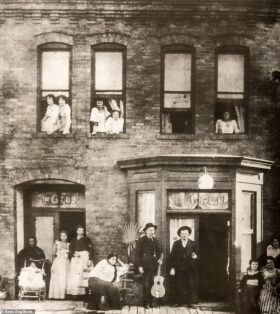
The Gem Variety Theater was overflowing with curious clientele, all there to see eight-year-old performer Mary A. McDonald, better known as Baby McDonald. It was the summer of 1877, and the popular, diminutive star was sharing the stage with her father James, the originator of skate and pedestal dancing. Miners, business owners, their families, ladies, and children filled every available seat and when the talent alighted from the wings to begin their act, the audience erupted in applause.

Al Swearingen, the owner of the theater, a short, husky, fiendish looking man with greasy, black hair and a black, slicked down mustache, watched the excitement unfold from behind a nearby bar. His taurine eyes glittered at the sight of the number of people in his establishment. A sold-out crowd meant a substantial profit for the evening. Baby McDonald was a great draw and the amusement-loving people of the Black Hills responded liberally to the petite attraction.

Given the variety of ticket buyers enjoying the show, a passerby might believe there was nothing objectional about the Gem. Like Swearingen, in which the only agreeable thing about him was the tailor-made, three-piece suits he wore, the least offensive activity at the theater was the innocent song and dance routine presented by the little girl on stage.

The second floor of the building was reserved for Swearingen’s stable of prostitutes. Men from every occupation visited the women who worked there. Some of those women were willing participants and others were lured into the trade, having traveled to the Black Hills on the pretense of being an actress at the Gem Variety Theater. Swearingen frequently visited major East Coast locations looking for female entertainers. Aspiring actresses, singers, and dancers enthusiastically responded to the call and when they arrived in Deadwood, they learned there were no jobs performing on stage. Void of prospects and lacking the funds to return home, the desperate women succumbed to working for Swearingen in his brothel.

Born in Mahaska County, Iowa, on July 8. 1845, entrepreneur Ellis Alfred Swearingen arrived in Deadwood in May 1876 with his wife Nettie and an unnamed young man. The trio relocated to the town from Custer City with the news that gold had been discovered. Swearingen operated a house of ill repute in Custer City with fourteen prostitutes in his employ. Two of those professionals were his wife and the man who accompanied him to Deadwood Gulch.

To learn more about Swearingen and the history of Deadwood’s brothels read An Open Secret: The Story of Deadwood’s Most Notorious Bordellos. Join me at the Brothel Deadwood Museum on Sunday, September 24 from 11 A.M. to 6 P.M. for a tour of the brothel and stories of the many raids on the houses of ill repute in the Black Hills.

Deadwood’s Women of Easy Virtue


The National Prohibition Act was passed by Congress on January 16, 1919, and officially went into effect on January 17, 1920. By early 1921, government statisticians reported that prohibition had had a positive impact on the country. It showed that labor was more constant and that absenteeism at jobs had decreased. The same government report showed that prostitution had diminished as a result of the National Prohibition Act. That might have been the case in some cities across the country, but in Deadwood, South Dakota, prostitution continued to be big business.

Listed among bordello owners who competed for business in Deadwood in the 1920s and 1930s was a woman of German descent named Pauline Longland. Born Pauline Wirz on May 22, 1891, in La Salle, Illinois, she came to South Dakota in 1910 and married Burr Longland in 1914. Her bordellos were located at 616 and 618 Main Street. When she was arrested for running a disorderly house in August 1920 and paid a sixty dollar fine for the crime, the court warned her against further offenses. Pauline’s line of work was so lucrative she wasn’t inclined to leave the profession for any reason.

On May 16, 1921, authorities raided her business, along with the businesses of several other bordello owners. She was taken into custody and charged with “keeping a house of ill fame.” Between 1922 and 1930, she was arrested four more times for the same violation and three times for possessing and selling alcohol. In 1930, Pauline was sentenced to ninety days in jail on various liquor offenses and ninety days for maintaining a public nuisance.

Pauline passed away on February 22, 1931, after suffering several months with a serious illness. “Her services, conducted by Rev. Alban Reed of St. Ambrose Catholic Church, were attended by a concourse of friends and relatives, and the casket was buried beneath a profusion of flowers in loving remembrance of the many friends of the deceased,” the February 26, 1931, edition of the Weekly Pioneer Times read.

To learn more about the busts at the Deadwood brothels read An Open Secret: The Story of Deadwood’s Most Notorious Bordellos. Join me at the Brothel Deadwood Museum on Sunday, September 24, 2023, for a lively talk on the busts and the various madams who were arrested as a result. Visit DeadwoodHistory.com or www.chrisenss.com to more information.


An Open Secret & Busts at the Brothel


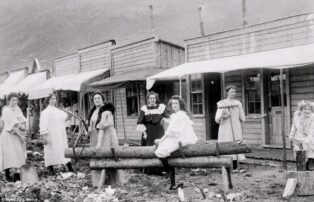
The discovery of gold in the southern Black Hills in 1874 set off one of the great gold rushes in America. In 1876, miners moved into the northern Black Hills. That’s where they came across a gulch full of dead trees and a creek full of gold and Deadwood was born. Practically overnight, the tiny gold camp boomed into a town that played by its own rules and attracted outlaws, gamblers, and gunslingers along with the gold seekers.

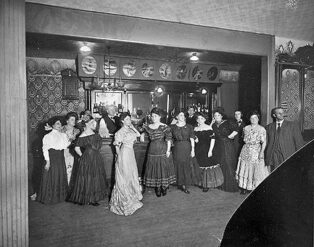
Deadwood was comprised mostly of single men. In the beginning the ratio of men to women was as high as 8 to 1. The lack of affordable housing, the hostile environment, the high cost of travel, and the expense of living in Deadwood prevented many men from bringing their wives, girlfriends, and families to the growing town. Hordes of prostitutes and madams came to Deadwood to capitalize on the lack of women. By the mid-1880s, there were more than a hundred brothels in the mining community.

One of the most notorious cat houses in Deadwood was owned and operated by Al Swearengen. Swearengen was an entertainment entrepreneur who opened a house of ill-repute shortly after he arrived in town in the spring of 1876. Initially known as The Gem, the brothel was host to several well-known soiled doves of the Old West from Eleanora Dumont to Kitty LeRoy.

Among the many madams who ran other cat houses in and around Deadwood were Poker Alice Tubbs, Mert O’Hara, and Gertrude Bell. The names of some of the most popular brothels in Deadwood Gulch were the Shy-Ann Room, Fern’s Place, The Cozy Room, the Beige Door, and the Shasta Room. After more than a hundred years of continual operation, the brothels in Deadwood were forced to close in 1980.

The brothels in Deadwood were raided numerous times during their 103-year existence. The Shasta Room located at 610 ½ Main Street was raided by authorities nine times between 1936 and 1964. Some of the madams were charged with the illegal sale of liquor and some with disturbing the peace. On January 11, 1939, a customer named Lodell Jay was taken into custody and charged with assault and battery after beating Madam Reid and creating a disturbance at the brothel.

To learn more about busts at the brothels read An Open Secret: The Story of Deadwood’s Most Notorious Bordellos. Visit www.chrisenss.com for more information. An Open Secret is available everywhere books are sold, on Amazon.com, Barnes&Noble.com, and at the Brothel Deadwood in Deadwood.


Queen of the West

Enter now to win a copy of

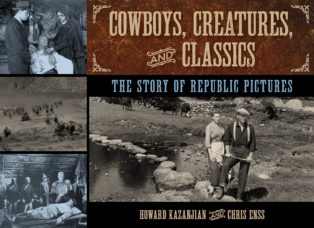
Cowboys, Creatures, and Classics: The Story of Republic Pictures


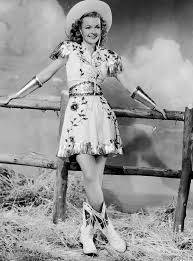
Dale Evans was one of Republic Pictures’ most popular western stars.  The unlikely celluloid cowgirl, western star starred in tandem with singing cowboy Roy Rogers in most of her thirty-eight films and two television series.  The undisputed Queen of the West was born Frances Octavia Smith on October 31, 1912, Uvalde, Texas.  In her words, her upbringing was “idyllic.”  As the only daughter of Walter and Betty Sue Smith, she was showered with attention and her musical talents were encouraged with piano and dance lessons.

While still in high school, she married Thomas Fox and had a son, Thomas Jr.  The marriage, however, was short-lived.  After securing a divorce, she attended a business school in Memphis and worked as a secretary before making her singing debut at a local radio station.  In 1931 she changed her name to Dale Evans.

By the mid-1930s, Dale was highly sought-after big-band singer performing with orchestras throughout the Midwest.  Her stage persona and singing voice earned her a screen test for the 1942 movie Holiday Inn.  She didn’t get the part, but she ended up singing with the nationally broadcast radio program the Chase and Sanborn Hour and soon after signed a contract with Republic Studios.  She hoped her work in motion pictures would lead to a run on Broadway doing musicals.

In August 1943, two weeks after signing a one-year contract with Republic Studios, Dale began rehearsals for the film Swing Your Partner.  Although her role in the picture was small, studio executives considered it a promising start.  Over the next year Dale filmed nine other movies for Republic, and in between she continued to record music.

Dale Evans dreamed of starring as the lead in the film version of Oklahoma, but Republic president Herbert Yates had other plans for the actress.  He wanted her to play opposite the studio’s star cowboy in the movie The Cowboy and the Senorita.

Dale’s only experience in westerns had been a small role as a saloon singer in a John Wayne picture, and she was not a skilled rider.  She committed herself to doing her very best, however, in the role of the “Senorita,” Ysobel Martinez.

The picture was released in 1944 and was a huge success.  Theatre managers and audiences alike encouraged studio executives at Republic to quickly re-team Dale and Roy in another western.

In between her film jobs, Dale toured military bases in the United States with the USO.  She sang to troops on bivouac, from Louisiana to Texas.  She was proud to think she was bringing a little sunshine into the hearts of the soldiers.

Dale also brought sunshine into the hearts of moviegoers, and ticket sales were evidence of that.  Republic had happened onto the perfect western team.  Dale was a sassy, sophisticated leading lady and the perfect foil for Roy, the patient, singing cowboy.

The Cowboy and the Senorita was a big hit for Republic.  The April 1944 edition of Movie Line Magazine heaped praise on the film and its’ stars.  “Intrigue and song fill the Old West when America’s favorite singing cowboy rides to the rescue of two unfortunate ladies about to be swindled out of their inheritance,” the magazine article read.


To learn more about Dale Evans read

Cowboys, Creatures, and Classics: The Story of Republic Pictures