Republic Pictures and Jean Nate

Enter now to win a copy of

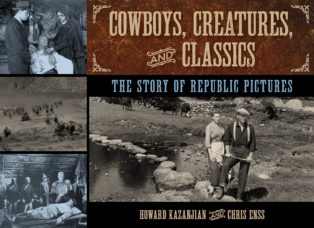
Cowboys, Creatures, and Classics: The Story of Republic Pictures


Not too long ago, I was in Pasadena with Howard Kazanjian promoting the book we coauthored entitled Straight Lady: The Life and Times of Margaret Dumont, “The Fifth Marx Brother.” It was a lovely event. With the exception of one woman who was wearing a designer jumpsuit with rhinestones, twenty bracelets on each wrist, and way too much Jean Nate, everyone was kind and complimentary. The lady in the jumpsuit declined to purchase a copy of the book and wasn’t shy about letting us know why. “I read a few chapters of your work in Barnes and Noble,” she began. “Maggie Dumont and Groucho Marx had a long-standing affair and you never mentioned it your book. It’s disgraceful that you call yourselves nonfiction writers. It’s useless to pretend that you’ll ever be widely read.”

Before I was able to share with her that in fact, Dumont and Marx were never romantically involved, she turned and stormed out of the building. The smell of Jean Nate still hovered in the air hours after she’d gone. I thought of a dozen things I could have said in response to the rudeness. Things like, “If you’re going to say something that dumb, you could at least fake a stroke” or “There’s a bus leaving in a few minutes. Please be under it.” Instead, I said nothing. And then she posted her remarks on Amazon and I wished I had followed her out of the store and shouted, “So, that’s what a mummy looks like without the bandages!”

The truth is that authors with infinitely more talent than I ever hope to have had endured harsh words from readers. One reviewer called William Golding’s book Lord of the Flies, “…completely unpleasant.” A critic of Truman Capote’s book In Cold Blood noted, “One can say of this book-with sufficient truth to make it worth saying: ‘This isn’t writing. It’s research.’” Another noted of Thomas Berger’s book Little Big Man, “…a farce that is continually over-reaching itself. Or, as the Cheyenne might put it, Little Big Man Little Overblown.”

Noel Coward once said, “I love criticism just as long as it’s unqualified praise.” I think I agree. This month I’m giving away a copy of Cowboys, Creatures, Classics: The Story of Republic Pictures.

Bring on the unqualified praise!
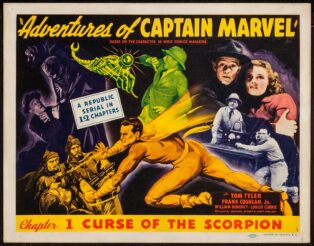
 

The Adventures of Captain Marvel

Enter now to win a copy of

Cowboys, Creatures, and Classics: The Story of Republic Pictures


A popular character Republic Pictures was allowed to introduce in one of its chapter plays was Captain Marvel. Also known as Shazam, the superhero was created in 1939 by artist C. C. Beck and writer Bill Parker for Fawcett Comics. Captain Marvel was the most popular comic book superhero of the 1940s. He was also the first to be adapted into film. The film was entitled Adventures of Captain Marvel.

In an interdepartmental memo passed from various executives at Republic to Herbert Yates, the project was touted as having “massive potential to be a box office hit.” The twelve-part series premiered in March 1941. The plot of the chapter play was described in the following way:

To a remote section of Siam, jealously guarded by unconquered native tribes, comes the unwelcome Malcolm Scientific Expedition seeking knowledge of the ancient Scorpion Dynasty. Billy Batson, assistant to a radio expert, is the only one of the parties who does not enter a forbidden chamber. As a result, he is awarded the power to transform himself into a superman, Captain Marvel, upon uttering the word “Shazam.”

After a dozen spine-tingling chapters, Billy is bound and gagged so he cannot utter the word. He tricks the Scorpion into releasing the gag in order, as he pretends, to explain to him the secret of his invulnerability. Once released, he cries, “Shazam” and becomes Captain Marvel. He is able to free himself and his friends and expose the Scorpion once and for all.

Adventures of Captain Marvel was a huge success for Republic Pictures. Critics called the production “roaring good entertainment.” Many film aficionados consider the serial to be the best ever made.

The collaboration between Republic Pictures and Fawcett Comics continued after the release of the Captain Marvel serial. In 1942, the two entities brought the character Spy Smasher to the screen. Spy Smasher is a costumed vigilante and freelance agent who battles a Nazi villain known as the Mask. The Mask heads a gang of saboteurs determined to spread destruction across America. According to author and film historian Alan G. Barbour, the Mask was the first in a long line of stereotypes that pictured hard-faced Nazis as propagandist tyrants.

Spy Smasher was a twelve-part serial that was shot in thirty-eight days. Production began on December 22, 1941, just a few days after the Japanese bombing of Pearl Harbor. The Spy Smasher wore a cape, leaped from bridges onto fast-moving cars, outgunned Nazi devils, and escaped from all types of death traps, from burning tunnels to compartments slowly filling with water. Spy Smasher used a number of gadgets, among them being various laser beams and his fire-resistant cape, to foil the Nazis’ plans.


To learn more about Captain Marvel and the Spy Smasher read

Cowboys, Creatures, and Classics: The Story of Republic Pictures

The Doctor Was A Woman Research

During the many months I spent researching and writing about pioneer women physicians, I couldn’t help but notice a theme that ran through the majority of the stories I found. As far back as 1890 in the Gold Country, women patients were seeking doctors’ recommendations on how to stop the aging process. Women of a certain age were hoping to find a crème or a lotion to remove the dark circles under their eyes and reduce wrinkles on their face and neck.
The invention of the “bust improver” in 1887, with pads of assorted sizes that could be inserted into a slit in the fabric, solved any enhancement issues. The corset helped women who wanted a waist-measurement that did not exceed the number of years of her age was a problem solver as well. How to get rid of dark circles and wrinkles was still a mystery.
Some doctors suggested women slather their face with donkey milk or duck fat to eliminate crow’s feet and turkey’s neck. Women complained the prescription did nothing to eradicate the wrinkles. It did, however, attract cats. A trade off most ladies disliked immensely.
Advertisements for Pears Soap featuring the beautiful actress Lilly Langtry, promised women who used the product a “nice youthful complexion, young looking hands, a reduction in wrinkles, and happiness galore.” In the print ads, Lilly boasted about the wonderful results she had washing with Pears Soap daily and encouraged women with stubborn wrinkles to wash their face two and three times a day. Langtry was a successful, wealthy, twenty-eight-year-old and many women were annoyed that someone who obviously didn’t struggle with wrinkles at her age would be giving advice on how to halt the process or gain happiness.
I feel the same way every time I see a commercial about wrinkle cream starring a teenager. Or hear a twenty something model lecture me about avoiding meat and eating only lawn clippings and Greek yogurt. What makes advertisers think the opinion of these supermodels has more weight or importance simply because they happened to hit the pick six in the genetic lottery?
It seems our entire existence is spent yearning for what we don’t have, and we’re convinced that whatever it is we’re missing is the one thing keeping us from perfect bliss. Which the makeup manufacturers would have you believe resembles a Revlon commercial where everyone is in a thong bikini cavorting on the beach while applying rejuvenating cream on their nonexistent drying pores. I don’t think it’s possible to have baby dolphin smooth skin unless you’re a dolphin. And I personally look like a sumo wrestler in a thong.
And as for happiness… What makes people happy anyway? I’ve concluded that most people are only really happy not when something good happens to them, but when something bad doesn’t happen to them.
Happiness is not settling for less, but just not being miserable with what is. I have always lived by the creed that it’s not the approval or accolades or possessions that make you smile, but simply making the left turn even though you were the third car in the intersection.
Now, where’s that duck fat?

From the Lusty Pages of a Great Sea Adventure!

Enter now to win a copy of

Cowboys, Creatures, and Classics: The Story of Republic Pictures


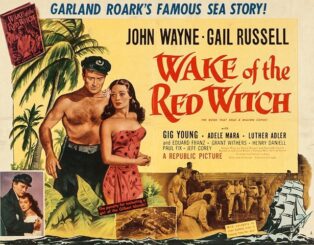
Greed for gold starkly stands forth as the theme of Wake of the Red Witch. Set in the 1860s in the South Pacific, Captain Ralls, skipper of the Red Witch, has a series of adventures involving sunken gold bullion, pearls, natives, an unscrupulous ship owner, and a giant octopus. The film cost $1.2 million to make: one hundred thousand dollars was paid for the screen rights for the book by Garland Roark from which the film was adapted. It was the most money the studio had ever paid for a story.

Republic built a full-scale replica of a three-mast sailing vessel on one of its largest soundstages. The schooner, over two hundred feet long, was an exact duplication of the one used in the ocean sequences that were filmed on location in Catalina Island.

Audiences flocked to the movie many referred to as “Wuthering Heights on the water.” Moviegoers praised the picture’s non-stop action and listed the underwater sequences and John Wayne’s battle with the giant octopus among the best moments of the film. Wake of the Red Witch performed well at the box office, finishing forty-third on Variety’s list of the top money makers in 1949.


To learn more about Wake of the Red Witch read

Cowboys, Creatures, and Classics: The Story of Republic Pictures.

Republic Pictures’ Drama of Undying Love

Enter now to win a copy of

Cowboys, Creatures, and Classics: The Story of Republic Pictures


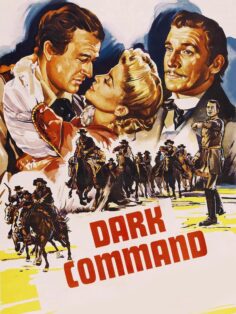
One of Republic Pictures’ big budget films, which raised the respectability of the company known for their cliffhanger serials, was Dark Command. Released on April 15, 1940, the film starred Walter Pidgeon, John Wayne, Claire Trevor, Roy Rogers, Marjorie Main, and George “Gabby” Hayes. Set in a time period immediately following the Civil War, the story involves renegade William Cantrell (presumably intended to be a Confederate William Quantrill), the leader of a pillaging band of guerrillas, who continues to launch raids on innocent civilians, looting, burning, and terrorizing in the name of the Confederacy, and the lawman who must stop the mad rebel at all costs. Pidgeon played Cantrell and Wayne played the marshal dedicated to his arrest.

Critics were complimentary of the movie, calling it “stirring” and “poignant.” The May 11, 1940, edition of the Indianapolis Star noted that the “characterization is more interesting than you usually find it, even in the deluxe westerns, with the roles of Cantrell, taken by Walter Pidgeon and his Ma, played by Marjorie Main, particularly striking.”

Roy Rogers’ performance, as well as Gabby Hayes’, was recognized for being strong and unforgettable. Wayne and Claire Trevor were also praised for their work. “Wayne proves again that he is good at the straight acting required in this sort of film,” the Indianapolis Star review continued. “Miss Claire Trevor is attractive and daring as the town’s banker’s daughter. Raoul Walsh has directed the film, particularly the scenes of far-flung action, forcefully.”

Republic Pictures itself received most of the accolades for the film. Hollywood’s biggest little studio had demonstrated in Dark Command that the majors had no corner on the big-budget western market.


To learn more about Dark Command and the other Westerns produced by Republic Pictures read Cowboys, Creatures, and Classics: The Story of Republic Pictures