
1886 – Wimbledon Women’s Tennis: Blanche Bingley defeats 2-time defending champion Maud Watson 6–3, 6-3
Don’t Smoke Em’ If You Got Em’
Enter now to win a copy of
Frontier Teachers: Stories of Heroic Women of the Old West
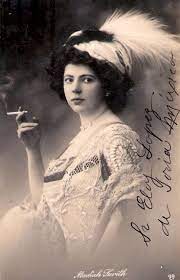
Walk into any saloon in the mid-1800s and chances were good a thick cloud of cigarette smoke stood between patrons and the bar. Smoking was prevalent in the Old West. It’s hard to imagine a cowboy on the trail without a cigarette in his hand or a wad of chewing tobacco in his mouth.
The effects of tobacco have been a topic of discussion among physicians since 1888 when Doctor Robert Koch, the leading authority on infectious diseases at the time, argued that the spitting of chewing tobacco was leading to a spread of tuberculosis.
A quartet of doctors from Dartmouth and Harvard weighed in on the subject of cigarette smoking in 1889. According to the October 4, 1889, edition of the Monroe Daily Independent physicians studying the proliferation of smoking in locations such as San Francisco, California and Denver, Colorado determined that “tobacco should be used moderately, if used at all.” The four doctors involved in the study concluded that laborers and artisans could smoke all they want without injury, but that “brain-workers” exposed themselves to the risk of nervous collapse if they indulged in more than one cigarette a day. The reasoning was that the life of a “brain-worker” tended to be sedentary and therefore their internal organs were not as strong as those who earned a living working with their hands. Laborers were sturdy individuals whose heart could withstand the strain.
The physicians all agreed that the habit of smoking tobacco was a very pernicious one if indulged in by boys. “A complication of nervous disorders is produced by excessive tobacco smoking and boys ought not to smoke,” the doctors concluded in their findings. “Many boys started smoking when they were eleven or twelve years old. They began by picking up their father’s half-smoked cigar or by stealing his tobacco. When these boys come to be seventeen or eighteen years of age they are thin, pale-faced, short and their vitality is seriously impaired.”
In 1905, Doctor Sara B. Chase spoke to the issue of women smokers. “Tobacco in any shape has no good qualities at all in it for women. I found that women not only smoke, but chew tobacco. Many of the women that smoke today are teachers. The most injurious form of smoking is cigarettes. It is the most injurious because tobacco is put right into the mouth and the nicotine poison in the tobacco is absorbed that way through the paper.”
The physician’s study concluded with the following warning, “A man would be a great deal better off if he would let tobacco alone. I know he would have more money because it is an expensive habit. Exactly how much nicotine is needed to poison a man is not known. A man who is a heavy smoker would probably require much more nicotine to poison him than a man who doesn’t smoke at all or one of nervous temperament.”
The results of numerous other studies would be posted in newspapers throughout the Old West from 1888 to 1912, but it didn’t stop a cowboy from rolling his own cigarette in corn shucks and smoking.
To learn more about some of the teachers that smoked and why, read
Frontier Teachers: Stories of Heroic Women of the Old West
This Day…
Sister Blandina, The Outlaw’s Teacher
Enter now to win a copy of
Frontier Teachers: Stories of Heroic Women of the Old West
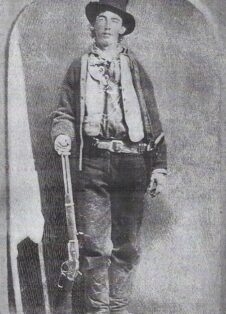
Sister Blandina stood over the pale, bullet-ridden body of a young gunman and mopped the sweat off his brow with a white cloth. He smiled benignly up at her, then turned his attention to the outlaws surrounding his bed. The renegades stared back at him quietly, all wearing grave expressions that reflected the severity of his physical condition.
Sister Blandina’s eyes shifted from the injured youth to the teenage boy standing next to him, tapping his holstered gun with his hat. “Sister Blandina,” the weak patient began, “Billy, our captain . . . .” Teenage outlaw Billy the Kid nodded politely to the nun. “We are glad to see you, sister, and I want to say, it would give me pleasure to be able to do you any favor.” For more than a month Sister Blandina had been caring for the wounded member of Billy the Kid’s gang known only as Happy Jack.
After being shot in the thigh he had been dumped in an abandoned adobe hut near Trinidad, Colorado, and left for dead. A boy from the school where Sister Blandina taught had found him and brought her to the location to help. In addition to fresh bandages and water, she had furnished the hurt desperado with food and linens. She had tended to his spiritual as well as physical needs, and for that she was rewarded with an audience with Happy Jack’s partner in crime. “He has steel-blue eyes and a peach complexion,” she recalled later in her journal. “. . . One would take him to be seventeen— innocent looking, save for the corners of his eyes, which tell a set purpose, good or bad.”
The purpose Sister Blandina had learned for one of Billy’s upcoming rides was definitely bad. According to Jack, the gang was going to kill the four physicians living in the area who had refused to call on the gunshot gang member. She was thinking of those men when she exchanged cordialities with Billy. “Yes, there is a favor you can grant me,” she said responding to his offer. “He reached his hand toward me,” she recounted later. “The favor is granted,” the Kid promised.
To learn about the favor Sister Blandina asked of Billy the Kid read
Frontier Teachers: Stories of Heroic Women of the Old West
This Day…
Olive Mann, The Mission Teacher
Enter now to win a copy of
Frontier Teachers: Stories of Heroic Women of the Old West
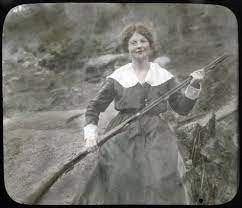
Twenty-two-year-old Olive Isbell cradled a loaded rifle in her arms and scanned the hilly landscape surrounding the adobe school where she taught at the Santa Clara Mission in California. From far off she could hear a gun spit in swift five-syllable defiance, and she readied herself for a potential attack on the building. Twenty preoccupied students toiled away at the books and lessons in front of them. The exchange of gunfire was so routine it barely disturbed their studies. The mission was under fire from the Mexican Army, which was trying to reclaim land it believed belonged to Mexico.
Settlers scattered throughout the area had converged on the site for protection. More than 195 people with their wagon trains and pack animals spread out over various sections of the mission were busy loading weapons and preparing themselves for a fight. A number of those people had contracted typhoid fever. They were weak and at times unable to work, and they desperately needed medical attention.
Olive had gathered the healthy children together at a stable on the far side of the compound. It was her way of keeping the youngsters occupied and safe during the uprising. The one-room, makeshift schoolhouse was 15 feet square, thick with flies and fleas, with dirt floors and the stench of manure. A few crude tables and benches made from scraps of wood were used as desks and chairs for the pupils, who ranged in age from six to fourteen years old. A fire pit in the center of the room kept the class warm, and the smoke from the hearth escaped through a large hole in the roof.
Olive vowed to educate the pioneer class to the best of her ability and protect them from any harm. The gun that swung from the belt of her gingham dress when it wasn’t in her arms assured her students they were safe.
To learn all the dangers Olive had to protect the children from read
Frontier Teachers: Stories of Heroic Women of the Old West
This Day…
1890 – Wyoming becomes 44th state of US (1st with female suffrage)
Sarah Herring Sorin, Teacher in Tombstone
Enter now to win a copy of
Frontier Teachers: Stories of Heroic Women of the Old West
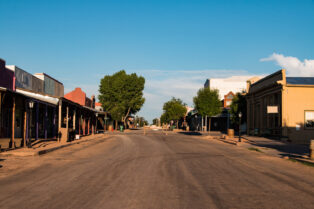
Tombstone is a historic western city in Cochise County, Arizona, United States
Among the many short news articles included in the October 5, 1886, edition of the Daily Tombstone was the announcement of a new teacher to the well-known Arizona town. Miss Sarah Herring, her four siblings, and mother, Mary, arrived in Tombstone in 1882 to join her father, mine owner and lawyer Colonel William Herring. Born on January 15, 1861, in New York, Sarah acquired her father’s desire to teach. The colonel was employed as a public schoolteacher for many years prior to moving his family West. She believed teaching children reading, writing, and arithmetic was crucial to providing stability and opportunity to their lives, and by extension bringing respectability to wild frontier communities. A year prior to Sarah riding into Tombstone, the boomtown witnessed its most notorious event, the gunfight near the O.K. Corral. She was convinced Tombstone’s rough and rugged reputation would improve by educating the youngsters who lived there.
Sarah was among several aspiring teachers summoned by the Board of School Examiners in December 1885 to take a test to determine their qualifications. She was one of four teachers that day who obtained a territorial certificate necessary to work at the school. Sarah began her career at the Tombstone school teaching first grade. The February 21, 1886, edition of the Tombstone Daily Epitaph included a brief note about her accomplishment. “Miss Herring is an excellent teacher,” the article read, “who has been tried in this city, and in her selection the Board of Trustees have acted wisely, and their appointment will be approved by every parent in this city.”
The Tombstone school board provided Sarah with the books she was to use in her classroom. Among the limited materials supplied were Appletons’ School Readers, the Elementary Spelling Book by Noah Webster, and Ray’s New Primary Arithmetic.
If not for the sudden tragedy that struck Sarah and her family in October 1891, she might have been content to remain an educator for the rest of her life. To learn what caused Sarah to leave the teaching profession, pursue another endeavor, and make history read Frontier Teachers: Stories of Heroic Women of the Old West.
This Day…
1932 – Author Damon Runyon (51) weds Patrice Amati del Grande
Mary Graves Clarke, the Sorrowful Teacher
Enter now to win a copy of
Frontier Teachers: Stories of Heroic Women of the Old West
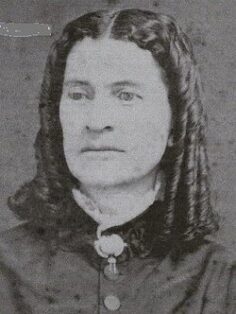
Mary Graves Clarke, a dark-haired woman with a pale face and deep age lines marking her high cheekbones and small mouth, sat behind a wooden desk staring out a window that was slightly tinged around the edges with frost. The view of the distant snow-covered mountains that loomed over Huntington Lake in Tulare County held her attention for a long while.
The eleven students in the one-room schoolhouse where Mary taught pored over the books in their laps, quietly waiting for their teacher to address them. The pupils ranged in age from six to fifteen years. The majority of the class were girls, a few of whom couldn’t help themselves from whispering while casting worried glances at their distracted teacher. Finally, one of the children asked, “Mrs. Clarke, are you all right?” Mary slowly turned to the pupils and nodded. “I’m fine,” she assured them. “I was just remembering.”
According to the journal kept by one of Mary’s students, her “expression was one of sadness.” In spite of her melancholy spirit, she led the students through a series of lessons then dismissed them for recess. She followed them outside and for a moment was content simply to watch them play. A cool breeze drew her attention back to the mountains and drove her thoughts back to a time when she was a teenager, hopeful and happy.
If she had stayed in Indiana where she was born on November 1, 1826, she might have married the boy next door, taught students to read and write at a schoolhouse in her hometown, and lived out her days watching her children and grandchildren grow up on the family farm. Her life, however, took a different course when her family joined the Donner Party in 1846 and headed west.

To learn about Mary Graves and what she did to help save the survivors of the Donner Party read Frontier Teachers: Stories of Heroic Women of the Old West