
1865 – US Secret Service begins operating under the Treasury Department
Gertrude Simmons, The Yankton Sioux Teacher
Enter now to win a copy of
Frontier Teachers: Stories of Heroic Women of the Old West
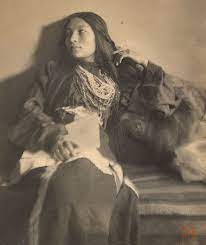
Twenty-one-year-old Gertrude Simmons sat in a stiff-backed chair in her small room at the Carlisle Indian School in Carlisle, Pennsylvania, and stared out at the students hurrying to class. The young men and women attending the institution were from Native American communities across the country. None of them were wearing the traditional clothing of their people; all were dressed in suit jackets, pressed trousers, or high collar dresses with ruffled bottoms and matching tights. The Indian children of various ages from six to sixteen had been transported to the facility as an “experiment in educating and assimilating Native American young people.”
Brigadier General Richard Henry Pratt, founder and superintendent of the boarding school was convinced his method of “civilizing” the Indian was the best. “A great general has said that the only good Indian is a dead one, and that high sanction of his destruction has been an enormous factor in promoting Indian massacres,” General Pratt told those in attendance at the Nineteenth Annual Session of the National Conference of Charities and Correction held in Denver, Colorado, in June 1892. “In a sense, I agree with the sentiment, but only in this: that all the Indian there is in the race should be dead. Kill the Indian in him, and save the man.”
When Gertrude had been lured to General Pratt’s institutions at eight years old, she had no idea she would be forced to abandon the language she grew up speaking, have her long hair cut off, and made to dress like non-Indian children. More than a decade after being enrolled at the White’s Manual Labor Institute in Wabash, Indiana, Gertrude applied to teach school to Native American boys and girls. She had mixed feelings about her duties. She wanted her pupils to learn how to read and write English but not at the expense of sacrificing their own culture.
Born in 1876, in Yankton, South Dakota, Gertrude was a Sioux Indian and was given the name Zitkala-Sa. Her father was a white trader named Felker Simmons and her mother a Nakota Sioux called Tate I Yohin Win or Reaches for the Wind. Her father passed away when she was still a toddler, and her mother became her sole support.
Contact
We would love to hear from you! Please fill out this form and we will get in touch with you shortly.
"*" indicates required fields
To learn more about Gertrude Simmons and her career in teaching read
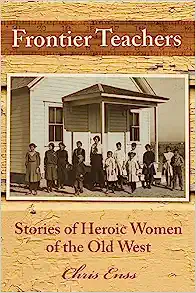
Frontier Teachers: Stories of Heroic Women of the Old West
This Day…
1901 – Butch Cassidy and the Sundance Kid rob train of $40,000 at Wagner, Montana.
Eliza Stewart Boyd, the History Making Teacher
Enter now to win a copy of
Frontier Teacher: Stories of Heroic Women of the Old West
A half-dozen rosy-cheeked children, bundled in heavy coats and wearing woolen hats and gloves, tromped over the frozen ground toward the new schoolhouse in Laramie, Wyoming, on February 15, 1869. Their teacher, thirty-six-year-old Eliza Stewart, happily greeted the pupils as they hurried into the building. Their cold lips stretched into a smile as she ushered them toward a potbellied stove dutifully warming the room. Seven other students would arrive before Eliza asked everyone to take their seats and the day’s lessons began. She was excited to teach the boys and girls the fundamentals that would better their lives. Her teaching style was friendly and inviting, and the class was eager to be educated.
Eliza had been practicing her trade for more than a decade before becoming the first public schoolteacher in Albany County, Wyoming. A tragedy in her life at the age of thirteen dictated her future calling. Her mother had died shortly after giving birth to her eighth child. Eliza, who was the oldest, took on the responsibility of caring for her brothers and sisters. Part of that care involved teaching her siblings how to read and write. She realized then she had a talent for teaching and decided to pursue her passion when she got older.
Eliza was born on September 8, 1833, in Crawford County, Pennsylvania. She excelled in school, and, after she graduated, she attended the Washington Female Seminary in Washington, Pennsylvania. Eliza ended her four years there in 1861 as class valedictorian. The speech she gave to her fellow students at the graduation ceremony was written in the form of a poem and aptly expressed the principles that guided her life.
“We, too, go forth at duty’s call, knowing there’s much to do; the harvest truly plenteous is, while laborers are few. For anyone who in this world would well perform her part must strive not only to do good but must be good at heart.”
With a degree in hand, Eliza returned to Crawford County to teach students in her hometown. After seven years, she decided she wanted to move west to help educate the influx of children settling in the new frontier with their ambitious parents. Eliza arrived in Laramie, Wyoming, on December 16, 1868. When news that a teacher had come to the wild town, leaders sought her out to offer her a position at the school which was soon to be built. She gladly accepted and less than three months later started work. Her students barely had time to fully appreciate her flair for teaching when she was selected to take part in a history making event.
To learn more about the history making event Eliza was asked to take part read
Frontier Teachers: Stories of Heroic Women of the Old West
This Day…
Madam Benny Fowler’s Open Secret
Enter now to win a copy of
An Open Secret:
The Story of Deadwood’s Most Notorious Bordellos along with a Kindle!

In late 1907, Madam Benny Fowler was in her room at the Mansion Hotel and Bar preparing for an evening out. She and one of her friends had plans to go to dinner and attend a party afterward. Benny had traveled to Deadwood from Belle Fourche where she operated a brothel at the location. The reason for the trip was twofold. Benny wanted to check on her Deadwood bordello and she wanted to get away from a man who had been bothering her.
Prentice Bernard, alias Vinegar Rowan, a cowpuncher and sheepherder from Montana, had spent time with Benny in Belle Fourche and become infatuated with her. He challenged customers who visited her, threatening to beat the men if they didn’t stay away. She hoped when he passed through Belle Fourche again and learned she wasn’t there he would ride on and forget her. That wasn’t the case, however. When Vinegar learned where Benny had gone, he followed her. He was in trouble with the law in Deadwood a few times because he wouldn’t leave her alone. He was crazy with jealousy over the men she met and, on December 7, 1907, pulled a knife on a bartender whom he overheard talking about Benny and assaulted a cook named Dick Moran for the same thing.
Frustrated with Vinegar’s actions and his relentless pursuit, Benny hurried back to Belle Fourche. Again, she hoped her clear rejection would persuade him to drop his fixation and move on with his life. After a day with no sign of Vinegar, Benny thought the coast was clear and returned to Deadwood to continue her visit with friends there. She had no way of knowing that Vinegar had never left Deadwood. He was so distressed over the way Benny had treated him he decided to get drunk and stay drunk. The manager of the Mansion Hotel and Bar where Vinegar was doing most of his drinking demanded the rancher give him his gun while he was there. Vinegar did so but asked several times for the weapon to be returned. His request was denied because he was considered too drunk to handle a weapon.
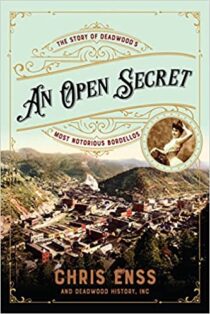
To learn more about soiled doves like Benny Fowler read
An Open Secret: The Story of Deadwood’s Most Notorious Bordellos
This Day…
1924 – “Ziegfeld Follies of 1924”, featuring Billie Burke and W.C. Fields, opens at the New Amsterdam Theatre, NYC
Jessie Haymen’s Open Secret
Enter now to win a copy of
An Open Secret:
The Story of Deadwood’s Most Notorious Bordellos along with a Kindle
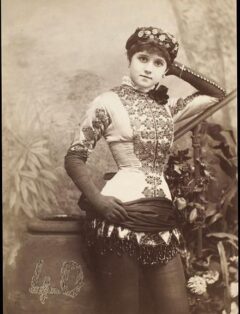
Jessie Hayman turned the flame down in the gas lamp sitting on a giant fireplace mantle in the parlor of her well-known brothel. Apart from the lit, red lantern hanging off the porch, the room was blanketed in darkness. It was approaching four in the morning and all of the home’s boarders were settled in their rooms with their overnight guests. Madam Hayman’s palatial bordello was one of the most popular businesses in San Francisco in 1906. Thirty attractive women of various ages and nationalities worked for Jessie. The income earned from the stable of employees was more than $4,000 a night. Consequently, Jessie was one of the wealthiest madams in the city.
As Jessie went about the routine of closing up shop, a heavy knock on the front door startled her. It was too late for callers but not out of the realm of possibility. As she made her way to the foyer she removed a pistol from a pocket of her dress. She cocked the gun just as she opened the door and raised it even with the face of an overweight man standing opposite her. The stunned man threw his hands up and took a step back. “If you’re a gentleman caller who got a late start, please forgive me,” Jessie stated firmly. “But if you’ve come to rob the place you’ve got to get past me first.”
After apologizing for the intrusion and assuring Jessie that he was merely interested in the company of one of her ladies, she let the frazzled man inside. Before Jessie had an opportunity to ask about his preferences he hurried off up the stairs. He seemed to know exactly where he was going. “Guess he’s been here before,” she said aloud to herself. “Wouldn’t do to shoot a regular,” she added playfully.

To learn more about women like Jessie Haymen read
An Open Secret: The Story of Deadwood’s Most Notorious Bordellos
This Day…
The Open Secret of Rose Ellis, Last of the Old West Madams
Enter now to win a copy of An Open Secret along with a Kindle!
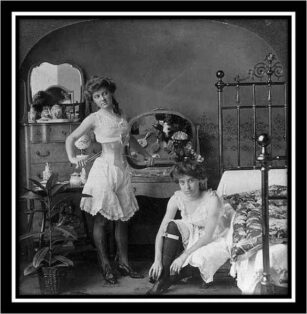
The light from a full October moon filtered through the open window beside Rose Ellis’s bed. The eighty-four-year-old woman stared thoughtfully into the night sky then closed her eyes in a half-hearted attempt to block out the peaceful image. Tears rolled off her tormented face onto the pillow underneath her head. The evening was calm and still, but her emotions were not. The sheets and blankets that once neatly covered her bed were crumpled and some were lying on the floor. Rose was restless, troubled. “Don‘t worry,” she whispered to herself, “I know what must be done.”
The Belmont Rest Home in San Francisco where Rose had just moved was a sparsely decorated, sterile environment—a stark contrast to the parlor houses she had furnished and managed in her younger years. Rose’s eighty-two-year-old sister, Buena, was lying in a bed a few feet away from her. Buena had lived with Rose her entire life. She wasn’t any more accustomed to her homogenized surroundings than Rose, but she had managed to fall asleep. Rose was grateful for that. Buena was developmentally disabled and seemed least harassed by the challenges of life when she slept.
As Rose watched her sister’s slow, steady breathing she thought back to the promise she had made her father to take care of Buena. On November 11, 1918, news that the Ellis girls’ father had died sent Buena into shock. Doctors performed a lobotomy on the distressed woman, which left her brain damaged. Rose pledged to care for her only living relative for the rest of her life.
Old age, lack of funds and limited options forced Rose to commit herself and Buena to the rest home. Although it was not an ideal situation, Rose was resigned to the living conditions. When doctors informed her that she had little time to live she decided to reevaluate the arrangement. The alternative she arrived at was extreme but necessary. It weighed heavily on her heart.
Lifting herself out of her bed, Rose shuffled over to a large bureau and slowly opened the top drawer. She removed a .38 caliber, nickel-plated revolver hidden under a stack of camisoles. She opened the gun and loaded two bullets into the chamber. Taking a deep breath she made her way to Buena’s bed, knelt down and kissed her on the cheek. Using all the strength in both her aged hands she pulled the hammer back and held the weapon to her sister’s ear. A shot rang out and Buena was gone.
Tears streamed down Rose’s face as she cocked the gun again and pressed it to her own temple. “See you soon, my darling sister,” she whispered to Buena’s lifeless form. The final shot was fired. Rose fell in a heap on the floor, the smoking gun still clutched in her hand.

To learn more about soiled doves like Rose Ellis read An Open Secret