
1832 – Benjamin Bonneville leads the first wagon train across the Rocky Mountains by Wyoming’s South Pass
The Student Teacher
Enter now to win a copy of
Frontier Teachers: Stories of Heroic Women of the Old West
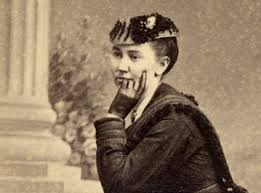
Throughout history teachers have been at the forefront of all civilizations, educating and inspiring the next generation and keeping societies moving forward. Frontier Teachers captures that pioneering, resilient, and enduring spirit of teachers that lives on today.
Tears streamed down twelve-year-old Bethenia Owens’s face as she watched her teacher pack his belongings into a faded, leather saddlebag and slip his coat on over his shoulder. She was heartbroken that the gracious man who introduced her to the alphabet and arithmetic would be leaving to teach school at a far-off location. Bethenia’s brothers and sister gathered around him, hugging his legs and hanging onto his hands. Mr. Beaufort had boarded with the Owens family during the three-month summer school term in 1852, and everyone had grown quite attached to him, especially Bethenia.
Mr. Beaufort smiled sweetly at Bethenia as she wiped her face dry with the back of her dirty hand. Streaks of grim lined her thin features and continued on into her hairline. Her long, brown locks protruded haphazardly out of the pigtails behind each ear. The dainty ribbons that once held her hair in place were untied and dangling down the back of her soiled, well-worn gingham dress.
Bethenia would remember this day for the rest of her life and her first teacher Mr. Beaufort. It was his kindness and dedication to education that inspired her to want to be a teacher.
To learn more about Bethenia Owens Adair, the schools teachers like her established, and about the other brave educators in an untamed new country read
Frontier Teachers: Stories of Heroic Women of the Old West.
This Day…
Rules for Teachers 1872
Enter now to win a copy of
Frontier Teachers: Stories of Heroic Women of the Old West
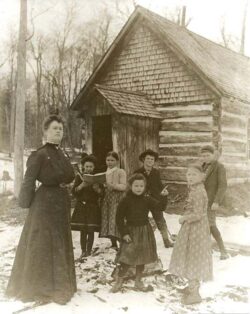
Teachers each day will fill lamps, clean chimneys.
Each teacher will bring a bucket of water and a scuttle of coal for the day’s session.
Make your pens carefully. You may whittle nibs to the individual taste of the pupils.
Men teachers may take one evening each week for courting purposes, or two evenings a week if they go to church regularly.
After ten hours in school, the teachers may spend the remaining time reading the Bible or other good books.
Women teachers who marry or engage in unseemly conduct will be dismissed.
Every teacher should lay aside from each pay a goodly sum of their earnings for their benefit during their declining years so that they will not become a burden on society.
Any teacher who smokes, uses liquor in any form, frequents pool or public halls, or gets shaved in a barber shop will give good reason to suspect their worth, intention, integrity, and honesty.
The teacher who performs their labor faithfully and without fault for five years will be given an increase of twenty-five cents per week in their pay, providing the Board of Education approves.
To learn more about the rules teachers had to follow in the Wild West read
Frontier Teachers: Stories of Heroic Women in the Old West
This Day…
1886 – Wimbledon Women’s Tennis: Blanche Bingley defeats 2-time defending champion Maud Watson 6–3, 6-3
Don’t Smoke Em’ If You Got Em’
Enter now to win a copy of
Frontier Teachers: Stories of Heroic Women of the Old West
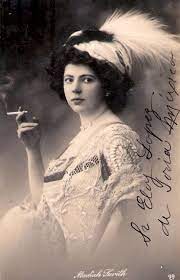
Walk into any saloon in the mid-1800s and chances were good a thick cloud of cigarette smoke stood between patrons and the bar. Smoking was prevalent in the Old West. It’s hard to imagine a cowboy on the trail without a cigarette in his hand or a wad of chewing tobacco in his mouth.
The effects of tobacco have been a topic of discussion among physicians since 1888 when Doctor Robert Koch, the leading authority on infectious diseases at the time, argued that the spitting of chewing tobacco was leading to a spread of tuberculosis.
A quartet of doctors from Dartmouth and Harvard weighed in on the subject of cigarette smoking in 1889. According to the October 4, 1889, edition of the Monroe Daily Independent physicians studying the proliferation of smoking in locations such as San Francisco, California and Denver, Colorado determined that “tobacco should be used moderately, if used at all.” The four doctors involved in the study concluded that laborers and artisans could smoke all they want without injury, but that “brain-workers” exposed themselves to the risk of nervous collapse if they indulged in more than one cigarette a day. The reasoning was that the life of a “brain-worker” tended to be sedentary and therefore their internal organs were not as strong as those who earned a living working with their hands. Laborers were sturdy individuals whose heart could withstand the strain.
The physicians all agreed that the habit of smoking tobacco was a very pernicious one if indulged in by boys. “A complication of nervous disorders is produced by excessive tobacco smoking and boys ought not to smoke,” the doctors concluded in their findings. “Many boys started smoking when they were eleven or twelve years old. They began by picking up their father’s half-smoked cigar or by stealing his tobacco. When these boys come to be seventeen or eighteen years of age they are thin, pale-faced, short and their vitality is seriously impaired.”
In 1905, Doctor Sara B. Chase spoke to the issue of women smokers. “Tobacco in any shape has no good qualities at all in it for women. I found that women not only smoke, but chew tobacco. Many of the women that smoke today are teachers. The most injurious form of smoking is cigarettes. It is the most injurious because tobacco is put right into the mouth and the nicotine poison in the tobacco is absorbed that way through the paper.”
The physician’s study concluded with the following warning, “A man would be a great deal better off if he would let tobacco alone. I know he would have more money because it is an expensive habit. Exactly how much nicotine is needed to poison a man is not known. A man who is a heavy smoker would probably require much more nicotine to poison him than a man who doesn’t smoke at all or one of nervous temperament.”
The results of numerous other studies would be posted in newspapers throughout the Old West from 1888 to 1912, but it didn’t stop a cowboy from rolling his own cigarette in corn shucks and smoking.
To learn more about some of the teachers that smoked and why, read
Frontier Teachers: Stories of Heroic Women of the Old West
This Day…
Sister Blandina, The Outlaw’s Teacher
Enter now to win a copy of
Frontier Teachers: Stories of Heroic Women of the Old West
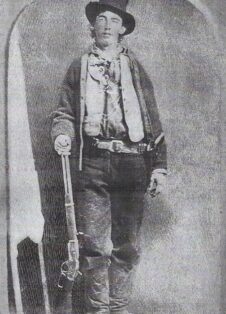
Sister Blandina stood over the pale, bullet-ridden body of a young gunman and mopped the sweat off his brow with a white cloth. He smiled benignly up at her, then turned his attention to the outlaws surrounding his bed. The renegades stared back at him quietly, all wearing grave expressions that reflected the severity of his physical condition.
Sister Blandina’s eyes shifted from the injured youth to the teenage boy standing next to him, tapping his holstered gun with his hat. “Sister Blandina,” the weak patient began, “Billy, our captain . . . .” Teenage outlaw Billy the Kid nodded politely to the nun. “We are glad to see you, sister, and I want to say, it would give me pleasure to be able to do you any favor.” For more than a month Sister Blandina had been caring for the wounded member of Billy the Kid’s gang known only as Happy Jack.
After being shot in the thigh he had been dumped in an abandoned adobe hut near Trinidad, Colorado, and left for dead. A boy from the school where Sister Blandina taught had found him and brought her to the location to help. In addition to fresh bandages and water, she had furnished the hurt desperado with food and linens. She had tended to his spiritual as well as physical needs, and for that she was rewarded with an audience with Happy Jack’s partner in crime. “He has steel-blue eyes and a peach complexion,” she recalled later in her journal. “. . . One would take him to be seventeen— innocent looking, save for the corners of his eyes, which tell a set purpose, good or bad.”
The purpose Sister Blandina had learned for one of Billy’s upcoming rides was definitely bad. According to Jack, the gang was going to kill the four physicians living in the area who had refused to call on the gunshot gang member. She was thinking of those men when she exchanged cordialities with Billy. “Yes, there is a favor you can grant me,” she said responding to his offer. “He reached his hand toward me,” she recounted later. “The favor is granted,” the Kid promised.
To learn about the favor Sister Blandina asked of Billy the Kid read
Frontier Teachers: Stories of Heroic Women of the Old West
This Day…
Olive Mann, The Mission Teacher
Enter now to win a copy of
Frontier Teachers: Stories of Heroic Women of the Old West
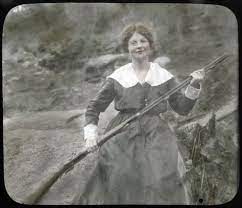
Twenty-two-year-old Olive Isbell cradled a loaded rifle in her arms and scanned the hilly landscape surrounding the adobe school where she taught at the Santa Clara Mission in California. From far off she could hear a gun spit in swift five-syllable defiance, and she readied herself for a potential attack on the building. Twenty preoccupied students toiled away at the books and lessons in front of them. The exchange of gunfire was so routine it barely disturbed their studies. The mission was under fire from the Mexican Army, which was trying to reclaim land it believed belonged to Mexico.
Settlers scattered throughout the area had converged on the site for protection. More than 195 people with their wagon trains and pack animals spread out over various sections of the mission were busy loading weapons and preparing themselves for a fight. A number of those people had contracted typhoid fever. They were weak and at times unable to work, and they desperately needed medical attention.
Olive had gathered the healthy children together at a stable on the far side of the compound. It was her way of keeping the youngsters occupied and safe during the uprising. The one-room, makeshift schoolhouse was 15 feet square, thick with flies and fleas, with dirt floors and the stench of manure. A few crude tables and benches made from scraps of wood were used as desks and chairs for the pupils, who ranged in age from six to fourteen years old. A fire pit in the center of the room kept the class warm, and the smoke from the hearth escaped through a large hole in the roof.
Olive vowed to educate the pioneer class to the best of her ability and protect them from any harm. The gun that swung from the belt of her gingham dress when it wasn’t in her arms assured her students they were safe.
To learn all the dangers Olive had to protect the children from read
Frontier Teachers: Stories of Heroic Women of the Old West