Anna Webber, Frontier Teacher

It’s a Pick-A-Book Giveaway.

This month enter to win any book from the catalog of books I’ve pinned.

Winners will be announced April 30.
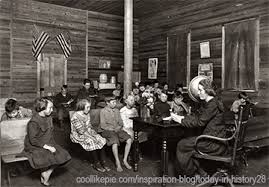


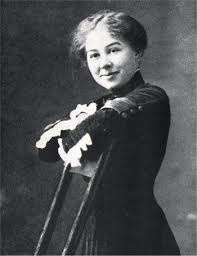
Twenty-one-year-old Anna Webber rubbed her eyes and leaned against the rough wall of the sod schoolhouse where she taught. The view from the window of the small building framed the tall grass and wheat fields around Blue Hill, Kansas, perfectly. A slight breeze in the middle distance brushed across the tops of cottonwood trees lining the banks of the Solomon River, richly adding to the peaceful scene.

Anna squinted into the sunlight filtering into the tiny classroom and stretched her arms over her head. The one-room schoolhouse was empty of students, and the young teacher was sitting on the floor grading papers. The room was only big enough for a half a dozen pupils but served more than sixteen children on most days.

Inside the roughly constructed building, made from strips cut from the prairie earth found in abundance around the small settlement, the furnishings consisted of a chair for the teacher and several boards balanced on rocks for the students to sit on. There was no blackboard and no writing desks. The primitive conditions made Anna’s job more difficult than she had anticipated and robbed her of the joy she initially felt when she entered the profession.

The town in Mitchell County, Kansas, where Anna held her first teaching assignment in 1881, was a growing community of farmers and railroad workers. Five years before her arrival, the area had been ravaged by hordes of grasshoppers. The insects destroyed crops and drove settlers away for a time. The ever-advancing railroad brought many back to the fertile ground to raise corn, wheat, and rye.  Anna’s family was among the people who returned to the region to start life anew.


To learn more about Anna Webber and other women who educated the people on the frontier read

Frontier Teachers:  Stories of Heroic Women of the Old West

This Day…

1882 – The Earp posse got itself dusted up at Mescal Springs by some bandits who robbed a store in Charleston.  Wyatt claimed to have killed Curly Bill there but it was another of his many lies.  Curly Bill had previously left the territory.  Wyatt and Doc then prudently fled to Colorado in order to avoid arrest by Behan’s posse on the Stillwater warrant.

This Day…

1889  – The Oklahoma Land run begins with an estimated 50,000 people lined up at noon hoping to stake a claim for a homestead ( the claim could be up to 160 acres in size ), it included most of the following Oklahoma Counties, Canadian, Cleveland, Kingfisher, Logan, Oklahoma, and Payne ( in total about 2 million acres ). This land had previously been occupied by Indians but the Indian Appropriations Bill approved the transfer of two million acres for settlement.

Rosa May: The Outcast’s Friend

It’s a Pick-A-Book Giveaway.

This month enter to win any book from the catalog of books I’ve pinned.

Winners will be announced April 30.


Rosa May sat beside the bed of a dying miner and wiped the sweat off his feverish brow.  She looked around his rustic, one-room cabin, past the sparse furnishings, and fixed her eyes on a tattered photograph of an elderly man and woman.  “Those are my folks,” the man weakly told her.  “They’re in Marshall County, Illinois.  Where are your folks?”

The question stunned Rosa.  No one ever asked about such things.  No one ever asked her much at all.  Conversation wasn’t what men were looking for when they did business with her.  Rosa glanced out the window at a couple of respectable, well-dressed women.  They watched her through the clouded glass, pointed, and whispered.  She knew what they were saying without hearing it.

Rosa was just one of a handful of “sporting women” living in Bodie, California, in 1900 and she knew what people thought of her.  It used to bother her years ago, but not now.  It was an occupational hazard she’d learned to live with.

“Don’t you have people anywhere?” the miner asked.  Rosa dabbed the man’s head with a cloth and smiled.  “I don’t know anymore,” she answered.  “If I did have, they’d be back in Pennsylvania.”

Rosa’s parents were Irish – hard, strict people.  Rosa had dreamed of the day she would be out of their puritanical household.  She had left home in 1871, at the age of sixteen and soon found there weren’t many opportunities for a poor, petite, uneducated girl with brown eyes and dark, curly hair.  She ended up in New York, hungry, homeless, and eager to take any job offered.  The job offered was prostitution and five years later she came west with other women of her trade, hoping to make a fortune off the gold and silver miners.

Prostitution was the single largest occupation for women in the West.  Rosa hoped to secure a position at a posh brothel with crystal chandeliers, velvet curtains, and flowing champagne.  The madams who ran such places were good to their girls.  They paid them a regular salary, taught them about makeup, manners, and how to dress, and they only had to entertain a few men a night.  If a high-class brothel wasn’t available, Rosa could take a job in a second-class house and work for a percentage of the profits, turning as many tricks as she could each night.  If all failed, she could be a street walker or rent a “crib” at a boardinghouse.  Cribs, tiny, windowless chambers, had oilcloths draped across the foot of the bed for customers in too big of a hurry to take off their boots.


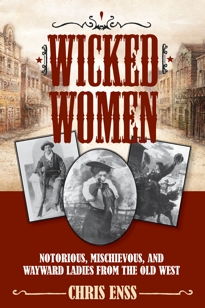
To learn the rest of Rosa May’s story and to read more about the bad girls of the Old West read

Wicked Women:  Notorious, Mischievous, and Wayward Ladies from the Old West.


Sacagawea: Heroine of the Lewis and Clark Journey

It’s a Pick-A-Book Giveaway.

This month enter to win any book from the catalog of books I’ve pinned.

Winners will be announced April 30.


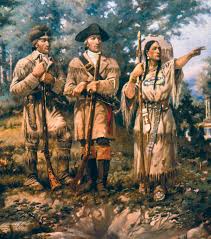
Sacagawea was the young Shoshone Indian woman who served as Lewis and Clark’s translator on their 1803 expedition to explore the uncharted western regions of America.  She made the entire journey to the Pacific, and the return trip, with a newborn baby on her back; many believe without her aid, the journey, commissioned by President Thomas Jefferson, would have ended in failure.  Some accounts say she died in 1812 at age twenty-five of putrid fever, while others believe she died in 1884 on an Indian Reservation in Wyoming.  The child she carried in a papoose was Jean-Baptiste Charbonneau, nicknamed Pompy, meaning first-born, who eventually attended St. Louis Academy with tuition paid by Clark.  Pompy later met Prince Wilhelm of Germany while on a natural history expedition and traveled back to Europe with him, where Pompy learned to speak four different languages.  But by the time he was twenty-four Pompy was back in North America, living as a mountain man.  When the Gold Rush of 1849 started, he got caught up in the fever and died from too much time wading through cold rivers panning for gold.  His cause of death was bronchitis at age sixty-one, and his portrait is the only one of a child on any U. S. coin.


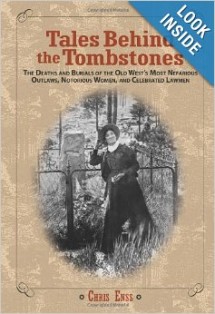
To learn more about Sacagawea and other amazing women who settled the west read Tales Behind the Tombstones.  Available everywhere books are sold.

Visit www.chrisenss.com to enter to win. 


Actress Jeanne Eagels

It’s a Pick-A-Book Giveaway.

This month enter to win any book from the catalog of books I’ve pinned.

Winners will be announced April 30.


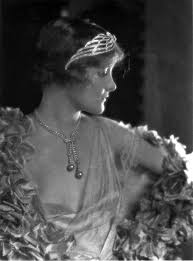
In 1929 Jeanne Eagel was nominated for a best actress Oscar for The Letter after she died earlier in the year at age thirty-nine from alcohol and heroin complications.  Eagels had started as a Ziegfeld Follies girl, but her talent and beauty soon moved her from the chorus line to center stage.  Tabloids of the time followed her progress and her secret marriage to a Yale football star, and they especially liked her temper, her no-shows, and her quitting plays whenever she felt like it.  At one point she was banned from appearing on stage by Actors Equity, which had forced her to move to Hollywood to make the “talkie” The Letter, one of the first films that showed the true dramatic possibilities of audio in cinema.  In the fall of 1929, she checked into a private drying-out hospital in New York City a week before the stock market crashed; unfortunately, she left via the morgue.


To learn more about pioneer actresses like Jeanne Eagels read

Entertaining Women:  Actresses, Dancers, and Singers in the Old West.

Available in bookstores everywhere and through Amazon.com