
Republic’s Drums of Fu Manchu
Enter now to win a copy of
Cowboys, Creatures and Classics: The Story of Republic Pictures
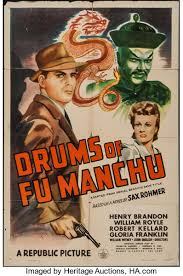
Between 1936 and 1956, Republic released a string of unique horror serials that promised audiences they would quake with fear when they came face to face with the studio’s terrifying lineup of ghouls, freaks of nature, and the walking dead.
Drums of Fu Manchu premiered in the spring of 1940. The creepy chapter play featured a race of bald-headed, fanged slaves known as “Dacoits” who had been lobotomized into doing the bidding of the immortal and insidious Doctor Fu Manchu. Fu Manchu hopes to conquer Asia and subsequently the world but needs specific artifacts from the tomb of Genghis Khan to achieve his goal. In Los Angeles, California, he convenes a meeting of the S-Far, an international conspiracy group that helps him draw up his plans. When archeologist Dr. James Parker is killed so Fu Manchu can obtain rare scrolls in his possession, his son Allan joins forces with Sir Denis Nayland Smith of the British Foreign Office to avenge his father’s death.
The sixteen frightful-looking “Dacoits” who contributed many of the thrills to Drums of Fu Manchu were a product of the makeup artist Bob Mark’s wizardry. The normal-looking people became grotesque monsters in Mark’s hands.
Rubber caps entirely covered their hair, giving them the impression of baldness. These caps, which could be worn only once, were especially manufactured at the cost of five dollars each. They were fitted tightly over the “Dacoit’s” heads, and heavy, theatrical grease paint was applied over them. The scars, which represented the incisions where Dr. Fu Manchu had removed the frontal lobes of their brain, were made of a special rubber composition and were held in place by rubber cement. The makeup of Fu Manchu himself, an elaboration of the “Dacoit’s” makeup, took exactly 2.5 hours each day to apply.
The fifteen-part Fu Manchu serial was directed by William Witney. He considered Fu Manchu to be his finest work. Sam Rohmer created the character of the insidious Fu Manchu in 1913 for a series of adventure novels. Rohmer’s books were best sellers, and he used a portion of the profit made from the sales to develop a product he believed needed refining—mothballs.
There was a time in 1935 that Republic Pictures’ development department believed there was nothing left on dry land to scare the wits out of moviegoers, so they decided to seek out stories from the depths of the darkest oceans. Undersea Kingdom was a 1936 serial thriller that starred Ray “Crash” Corrigan.
Before becoming a costar in a number of Republic westerns, Corrigan was a bit player and stuntman who frequently donned a gorilla costume to act as a crazed ape whenever the studio called for one. Corrigan even had his own gorilla costume.
Corrigan’s character in Undersea Kingdom is a lieutenant right out of Annapolis whose assignment is to stop an evil tyrant ruler from taking over the world. Corrigan’s character is recruited for the job when a series of mysterious man-made earthquakes threaten to destroy civilization. He leads an expedition to the ocean floor in a rocket-propelled submarine and discovers the Undersea Kingdom of Atlantis. Soon the explorers find themselves caught between two warring factions led by the peace-loving High Priest of Atlantis and the evil warlord Unga-Khan, whose diabolical plans include conquering the surface of the world.
Corrigan’s super-human athletic abilities combined with the genius of the rocket-sub inventor make them targets in an action-packed battle for survival against ray-guns, tanks, and robots.
To learn more about the many films Republic Pictures produced read
Cowboys, Creatures and Classics: The Story of Republic Pictures
This Day…
Republic Goes To War
Enter now to win a copy of
Cowboys, Creatures and Classics: The Story of Republic Pictures
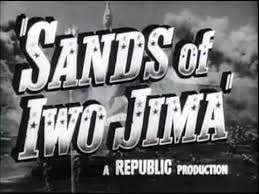
On December 7, 1941, radios buzzed with news that several hundred Japanese planes attacked a US naval base at Pearl Harbor in Hawaii, killing more than twenty-four hundred Americans as well as damaging or destroying eight Navy battleships and more than one hundred planes. Though it would be some time before people learned the full scope of the damage, within days a once distant war in Europe and the Pacific became a central part of life in the United States, affecting politics, business, media, and entertainment.
Hollywood went to war along with the rest of the country. Prominent actors enlisted in the armed forces; actresses joined the Red Cross and volunteered their services to the USO. Notable motion pictures executives took part in the effort, too. Darryl Zanuck from 20th Century Fox got into the Army Signal Corp., and Jack Warner of Warner Brothers was assigned to the Army Air Corp. Studio heads unable to join the military fought the battle from behind their desks producing films about the scene overseas and the gallant men and women protecting our freedom. By the summer of 1942, more than 125 pictures had been completed, or were in the process of being shot, that reflected war and its various angles or dealt with men in the fighting forces. Those pictures depicted the sterner side of the national and international war scene in not only dramas, features, and short subjects but also in comedies, cartoons, and even musicals.
Hollywood was instrumental in shaping the resolve of the American public during the gloomy days of World War II. President Franklin Roosevelt used American’s love affair with the movies to keep the public firmly behind the war effort. He was instrumental in creating the Office of War Information. The Office of War Information created campaigns to enhance public understanding of the war at home and abroad; to coordinate government information activities; and to act as a liaison with the press, radio, and motion picture industry. The Office of War Information was heavily involved in regulating Hollywood studios as they churned out war films at breakneck speed. Films like Warner Brother’s Confession of a Nazi Spy and 20th Century Fox’s The Purple Hearthelped galvanize the American public against two brutal enemies.
Republic Pictures also contributed to the awakening of the country’s citizenship as to whom the fight was against and why. Republic’s Flying Tigers, also known as Yank Over Singapore, was released on October 8, 1942. The movie was a tribute to the American Volunteer Group of pilots who battled the Japanese against overwhelming odds long before Pearl Harbor. According to the November 15, 1942, edition of the Hutchinson News, “Thrills abound in the picture which is a continuous series of stirring air duels between the outnumbered Americans and the Japanese.”
John Wayne has the principal role as leader of the American Volunteer Group. Anna Lee is a nurse in a hospital nearby. Paul Kelly, John Carroll, and Edmund MacDonald are pilots. The Hutchinson News noted that “some of the fight and injury scenes are strong medicine.”
To learn more about the many films Republic Pictures produced read
Cowboys, Creatures and Classics: The Story of Republic Pictures
This Day…
Republic’s The Crimson Ghost
Enter now to win a copy of
Cowboys, Creatures and Classics: The Story of Republic Pictures
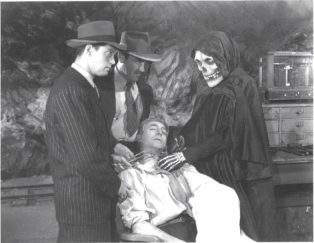
Scene from the Crimson Ghost – 1946
Moviegoers throughout the 1930s and 1940s enjoyed film adventures from heroes on exotic animals to those in space crafts. Such was the case with The Purple Monster Strikes, the original Republic Martian invader serial. The Purple Monster was actually not a monster at all, nor was he purple. The villainous character was in reality a Caucasian, Martian space soldier. He was part of the advance guard preparing a vast invasion of earth, dressed in a blue, tight-fitting outfit, trimmed with scaly gold metallic material, and wearing a matching gilded hood. Among the Purple Monster’s alien abilities was the power to become a transparent phantom and enter the body of another, controlling his actions, thereby donning the ultimate disguise.
The Purple Monster Strikes was the first post-war serial of 1945. Republic was prohibited from using the term “rocket ship” when referring to the spacecraft the Purple Monster used in the film. Universal Studios had a copyright on the word which was used quite extensively in their serial Flash Gordon.
Billed as 1941’s “sensational serial surprise,” Republic introduced a chapter play that combined monsters designed to take over space with earthly fiends. Entitled The Mysterious Doctor Satan, the villain is a mad scientist who wants to rule the world and planets from other galaxies with an army of mechanical monsters. Audiences were treated to fifteen shivering, shuddering, surprising episodes of Dr. Satan manipulating the hideous robots he creates to rob and terrorize the nation into submission. Dr. Satan’s sworn enemy is a beefy man in a copper mask appropriately known as Copperhead. Copperhead assumes the identity from his deceased father who was a fugitive from crooked justice in the Old West. The misunderstood hero is determined to protect society from the depredations of Dr. Satan, and, at the same time, wipe out the stigma attached to the name Copperhead.
According to Jack Mathis’ book Valley of the Cliffhangers, The Mysterious Doctor Satan was intended to be a series that would feature Superman as the fighter against evil. At the last moment, DC Comics, the owners of the Superman character, refused to let Republic use the radio and comic series star. Instead of abandoning the project, the writers replaced Superman with Copperhead, a character of their own creation.
A popular character Republic Pictures was allowed to introduce in one of its chapter plays was Captain Marvel. Also known as Shazam, the superhero was created in 1939 by artist C. C. Beck and writer Bill Parker for Fawcett Comics. Captain Marvel was the most popular comic book superhero of the 1940s. He was also the first to be adapted into film. The film was entitled Adventures of Captain Marvel.
In an interdepartmental memo passed from various executives at Republic to Herbert Yates, the project was touted as having “massive potential to be a box office hit.” The twelve-part series premiered in March 1941.
To learn more about the many films Republic Pictures produced read
Cowboys, Creatures and Classics: The Story of Republic Pictures
This Day…
Republic’s Captain Marvel
Enter now to win a copy of
Cowboys, Creatures and Classics: The Story of Republic Pictures
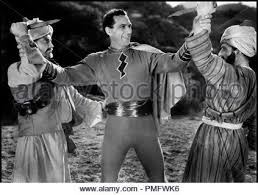
A popular character Republic Pictures was allowed to introduce in one of its chapter plays was Captain Marvel. Also known as Shazam, the superhero was created in 1939 by artist C. C. Beck and writer Bill Parker for Fawcett Comics. Captain Marvel was the most popular comic book superhero of the 1940s. He was also the first to be adapted into film. The film was entitled Adventures of Captain Marvel.
In an interdepartmental memo passed from various executives at Republic to Herbert Yates, the project was touted as having “massive potential to be a box office hit.” The twelve-part series premiered in March 1941. The plot of the chapter play was described in the following way:
To a remote section of Siam, jealously guarded by unconquered native tribes, comes the unwelcome Malcolm Scientific Expedition seeking knowledge of the ancient Scorpion Dynasty. Billy Batson, assistant to a radio expert, is the only one of the parties who does not enter a forbidden chamber. As a result, he is awarded the power to transform himself into a superman, Captain Marvel, upon uttering the word “Shazam.”
After a dozen spine-tingling chapters, Billy is bound and gagged so he cannot utter the word. He tricks the Scorpion into releasing the gag in order, as he pretends, to explain to him the secret of his invulnerability. Once released, he cries, “Shazam” and becomes Captain Marvel. He is able to free himself and his friends and expose the Scorpion once and for all.
Adventures of Captain Marvel was a huge success for Republic Pictures. Critics called the production “roaring good entertainment.” Many film aficionados consider the serial to be the best ever made.
The collaboration between Republic Pictures and Fawcett Comics continued after the release of the Captain Marvel serial. In 1942, the two entities brought the character Spy Smasher to the screen. Spy Smasher is a costumed vigilante and freelance agent who battles a Nazi villain known as the Mask. The Mask heads a gang of saboteurs determined to spread destruction across America. According to author and film historian Alan G. Barbour, the Mask was the first in a long line of stereotypes that pictured hard-faced Nazis as propagandist tyrants.
Spy Smasher was a twelve-part serial that was shot in thirty-eight days. Production began on December 22, 1941, just a few days after the Japanese bombing of Pearl Harbor. The Spy Smasher wore a cape, leaped from bridges onto fast-moving cars, outgunned Nazi devils, and escaped from all types of death traps, from burning tunnels to compartments slowly filling with water. Spy Smasher used a number of gadgets, among them being various laser beams and his fire-resistant cape, to foil the Nazis’ plans.
Daredevils of the Red Circle was a twelve-part serial that included a cape-wearing villain. The suspenseful, spine-tingling, mystery film told the tale of diabolical mastermind Harry Crowel, a.k.a. Prisoner 39013. Crowel escapes from prison and, aided by a seemingly endless supply of henchmen, sets out to destroy all holdings of industrialist Horace Granville, the man who put him in prison. One target is an amusement park, home of three Daredevils of the Red Circle who perform death-defying stunts. When head Daredevil Gene’s kid brother is killed in Crowel’s attack, the three heroes swear to capture Prisoner 39013. Unbeknownst to them, he is holding the real Granville captive and, with a near perfect disguise, has taken his place. A mysterious cloaked figure known as the Red Circle aides the daredevils in their crusade.
To learn more about the many films Republic Pictures produced read
Cowboys, Creatures and Classics: The Story of Republic Pictures
This Day…
Republic’s Catman of Paris
Enter now to win a copy of
Cowboys, Creatures and Classics: The Story of Republic Pictures
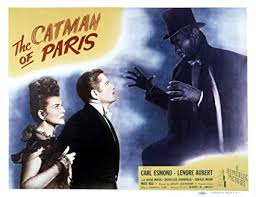
In April 1946, thrill seekers were looking forward to the release of The Catman of Paris. The gruesome mystery melodrama involved a man suffering from a loss of memory who was accused of being a feline killer operating in Paris.
The tagline read: “Walks like a man. Attacks like a cat. Who is the Catman of Paris.” The plot involved author Charles Regnier returning to 1896 Paris after exotic travels, having written a best seller that the Ministry of Justice would like to ban. That very night, an official is killed on the dark streets . . . clawed to death! The prefect of police suspects a type of cat, but Inspector Severen thinks there is nothing supernatural about the crime and thinks Regnier is responsible for the murder. Regnier denies he had anything to do with the crime but begins to doubt himself when he has a hallucinatory blackout during a second killing.
Vienna-born stage actor Carl Esmond played the troubled author Regnier. Lenore Aubert, the female lead in the movie, was also from Vienna. The press packet Republic Pictures circulated to theaters and media across the country contained plenty of information about the film as well as background information about the picture’s stars. Aubert’s story of how she made it from Vienna to Hollywood could have been a movie on its own.
According to the November 8, 1946, edition of the Mount Carmel Item, the actress had just finished making her third movie when the Nazis occupied her homeland. She and her mother fled to France where they hoped to begin a new life. There she continued studying and acting for a year until the downfall of Paris.
“The experience Miss Aubert underwent in getting from France, through Portugal, to Spain would alone defeat most people,” the Mount Carmel Item article read. “However, Miss Aubert realized her one hope for happiness could be found in America. After six months of ceaseless efforts, she was able to get a priority on a Portuguese boat.”
Critics were complimentary of Aubert’s performance and the film itself, calling both “satisfying” and “entertaining.”
Chills, thrills, suspense, and murder awaited moviegoers who dared to see Valley of the Zombies starring Republic’s contract players Robert Livingston and Lorna Gray. Debuting in May 1946, the film was about a prominent brain surgeon who is killed; law enforcement suspects the culprit was his associate Dr. Terry Evans. Doctor Evans and his sweetheart nurse embark on a quest to prove his innocence. In trying to clear himself, the doctor and his girlfriend visit hospitals, morgues, embalming establishments, and an eerie estate where a few more murders have been committed for good measure. While searching the estate, the doctor and nurse happen onto a gruesome figure that is a zombie. The zombie’s condition can only be reversed with large quantities of blood. The caretaker of the undead individuals traverse the woods and mental hospitals at night looking for unwilling blood donors.
Directed by Philip Ford, nephew of award-winning western director John Ford, Valley of the Zombies was void of any valleys and, apart from one undead creature, any zombies. It was a picture that was produced quickly to cash in on the zombie craze.