
The Second Hollywood

Enter now to win a copy of

Cowboys, Creatures and Classics: The Story of Republic Pictures
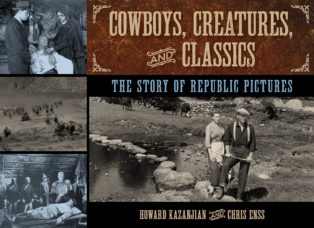
About two hundred miles north of Hollywood is the small town of Lone Pine. Almost at the dawn of motion picture making, the Eastern Sierra hamlet became a popular outpost for location filming. It offered scenery ranging from Sierra peaks to sand dunes. The mountain scenery there could double for the Himalayas, and the desert landscape could double for Salt Lake Valley. Lone Pine has proven to be as versatile as some of the most gifted actors performing on screen.

Movie cowboys from Hopalong Cassidy to John Wayne and Gene Autry to Rex Allen chased innumerable bad guys in the hills around Lone Pine. The cry of “Hi-Yo, Silver, Away!” still echoes through the canyon where the masked marvel and his sidekick Tonto rode. The songs sung by Roy Rogers can still be heard in the hills on quiet nights, and the report from shotguns fired by hundreds of celluloid outlaws ricochet off the ancient rocks.

Films requiring a foreign country’s rocky, desert landscape have been shot at Lone Pine. Even films depicting lunar landscapes have been shot on location there. Lone Pine has served as a supporting player of sorts for more than fifty studios for more than ninety years.

The first movie production came to Lone Pine in 1914. It was a William S. Hart western, but the name of the project has been lost to time. Historical records note that the town’s elders recalled only that it involved “a lot of riding and shooting” and that practically every able-bodied male in the community was pressed into service as either a member of law-abiding vigilantes or as one of the bad men being chased by Hart.

The 1920 silent film The Roundup, starring Rosco “Fatty” Arbuckle and Wallace Berry, was the first commercial production shot at Lone Pine. Locals loaned horses, wagons, and talent to make the movie. Lone Pine evolved from being a mining community when it was founded in 1865 to being one of the most favored spots to shoot motion pictures. Owens Valley in which the community is situated is regarded as one of nature’s masterpieces. Surrounded by massive ranges, it is not only one of the most richly endowed scenic areas in the world but also one of the most compelling.

Most of the actual filming at Lone Pine was either done on the desert bed of the valley, which is rimmed on all sides by towering mountains, or in the hills. From Lone Pine itself can be seen seven peaks more than fourteen thousand feet high, with Mt. Whitney reaching 14,496 feet into the sky. Nearby Death Valley, on the other hand, is 287 feet below sea level. There is snow all year on the mountain tops, and Palisade Glacier, the most southerly glacier in the United States, is less than sixty miles away.

Republic Pictures’ president Herbert Yates was enamored with Lone Pine and suggested the setting to film John Wayne’s first feature for the studio, Westward Ho. Wayne plays a character named John Wyatt who, at a young age, saw his parents killed and his brother kidnapped. Wayne’s character is leading a wagon train west when he meets up with his brother now working for the people who murdered their mother and father. The movie received high marks, and one of the reasons cited is that it was filmed on location and not on the studio’s backlot.

An article in the September 6, 1935, edition of The Times Recorder noted:
A saga of the Old West filled with wagon trains, herds of cattle, marauding bandits, and singing vigilantes, Westward Ho has all the ingredients needed for a successful outdoor, action picture. The story deals with a group of “Singing Riders” led by a young Westerner who protects the slow moving covered wagons against the onslaught of vicious desperados. Romance has its full share of the plot of Westward Ho. John Wayne, as the leader of the “Singing Riders,” fights successfully against terrific odds, but succumbs to the charms of lovely Sheila Manners.The photography of Archie Stout and the direction of R. N. Bradbury are outstanding. So too is the landscape where the magnificent film was made. Long after the movie has ended theatergoers will want to seek this idyllic spot out and linger in its beauty.


To learn more about the many films Republic Pictures produced read

Cowboys, Creatures and Classics: The Story of Republic Pictures


Along Came Yakima Canutt

Enter now to win a copy of

Cowboys, Creatures and Classics: The Story of Republic Pictures


A pair of frantic, disheveled riders race side by side down a dusty, sun-scorched path. Suddenly they plunge into a wooded area. Branches slap at them, but neither dares slow his mount’s gait. They break through the other side, each still jockeying for lead position. The rider barely lagging behind now extends his arm out to grab the young man inches from him. The young man spurs his horse along faster and pulls away from the man trying to catch him. Ahead in the near distance, the crude path ends abruptly, giving way to a rocky cliff with a raging river far below. The two riders continue on fast, unaware of the danger. The young man is the first to leap off the precipice, his horse still under him. The rider behind him doesn’t hesitate but pushes his roan harder. The two fly off the cliff with great speed and plummet into the water.

The daring riders find their way to the surface. They’re dazed, but alive. The animals are alive as well, and they scramble to the water’s edge and hastily step out onto dry land.

After fighting the river’s strong current, both men manage to reach a sandy bank and drag themselves out of the water. They are exhausted and drenched. The young man struggles to stand up and, once he finds his footing, hurries off after his horse. The cowboy that was chasing him hasn’t any strength left. He lies flat on his back on the bank staring up at the cliff where he dropped, contemplating how he could have survived such a fall.

That particular stunt was executed by legendary rodeo champion turned stuntman Yakima Canutt for the film The Devil Horse starring Harry Carey. Canutt was one of the most well-known members of the group of dedicated men and women who were willing to risk their lives for little pay and no screen credit—the stunt person. When a script called for rough and tumble action such as a fistfight, car crash, or jumping off a seventy-two-foot cliff into a ravine without a net or soft landing pad, a stunt person was required.

Republic Pictures had a stable of daredevils who lived to perform death-defying feats that kept audiences on the edge of their seats. Yakima Canutt and the other stunt staff revolutionized the art and helped make Republic features and serials some of the most exciting and profitable works in the motion picture industry.

Canutt appeared in more than two hundred films during his on-screen career, but he didn’t start out wanting to be in the movies. He broke horses and for a while was content with the work. Canutt was born in Colfax, Washington, in 1895. He attended school until he was twelve, and then he went to work full-time on a ranch. He won his first world championship cowboy award in 1917. Canutt became one of the best-known saddle and bareback bronc riders on the rodeo circuit. He was often among the top money winners in what was then the roughest of all competitive sports.

In between rodeos, he managed to break horses for the French government’s use in World War I. He then dropped the rodeo circuit temporarily to enter the Navy and served aboard a minesweeper. In 1919, he regained his world championship crown, the second of the five total he earned.

Canutt headed for the movies in 1923. He did forty-eight silent westerns before talkies took over. He didn’t have a voice for talkies, so he made the leap to stunt work. He excelled in the field. He and John Wayne developed a way to stage on-screen fights to make them look more realistic. Prior to the development of the choreographed screen brawl, the good guy and the villain threw unrealistic punches at one another and wrestled and flailed around. A Canutt screen fight involved positioning of the camera at angles to the participants, rather than straight on, and the camera would often face one of the participants. That camera angle gave the perception of bone-crushing punches landing on the jaw.

Not only did Canutt perform amazing stunts for the numerous pictures he was in, but he also choreographed stunt sequences for many movies in which he wasn’t a part of the on-screen talent. Some of the movies Canutt choreographed stunt sequences for included Flying Tigers, Spy Smasher, and Jungle Girl.

Canutt became a second-unit director in addition to stuntman and stunt coordinator. In that capacity he directed breathtaking action sequences of some of Hollywood’s most spectacular films; Spartacus and Ben Hur were two of those films. He also directed a number of low-budget westerns.

To learn more about the many films Republic Pictures produced read

Cowboys, Creatures and Classics: The Story of Republic Pictures
 

Republic Goes to War

Enter now to win a copy of

Cowboys, Creatures and Classics: The Story of Republic Pictures

On December 7, 1941, radios buzzed with news that several hundred Japanese planes attacked a US naval base at Pearl Harbor in Hawaii, killing more than twenty-four hundred Americans as well as damaging or destroying eight Navy battleships and more than one hundred planes. Though it would be some time before people learned the full scope of the damage, within days a once distant war in Europe and the Pacific became a central part of life in the United States, affecting politics, business, media, and entertainment.

Hollywood went to war along with the rest of the country. Prominent actors enlisted in the armed forces; actresses joined the Red Cross and volunteered their services to the USO. Notable motion pictures executives took part in the effort, too. Darryl Zanuck from 20th Century Fox got into the Army Signal Corp., and Jack Warner of Warner Brothers was assigned to the Army Air Corp. Studio heads unable to join the military fought the battle from behind their desks producing films about the scene overseas and the gallant men and women protecting our freedom. By the summer of 1942, more than 125 pictures had been completed, or were in the process of being shot, that reflected war and its various angles or dealt with men in the fighting forces. Those pictures depicted the sterner side of the national and international war scene in not only dramas, features, and short subjects but also in comedies, cartoons, and even musicals.

Hollywood was instrumental in shaping the resolve of the American public during the gloomy days of World War II. President Franklin Roosevelt used American’s love affair with the movies to keep the public firmly behind the war effort. He was instrumental in creating the Office of War Information. The Office of War Information created campaigns to enhance public understanding of the war at home and abroad; to coordinate government information activities; and to act as a liaison with the press, radio, and motion picture industry. The Office of War Information was heavily involved in regulating Hollywood studios as they churned out war films at breakneck speed. Films like Warner Brother’s Confession of a Nazi Spy and 20th Century Fox’s The Purple Heart helped galvanize the American public against two brutal enemies.

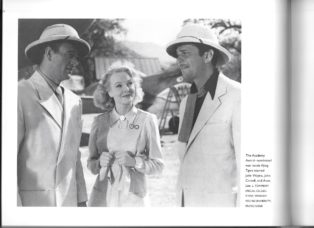
Republic Pictures also contributed to the awakening of the country’s citizenship as to whom the fight was against and why. Republic’s Flying Tigers, also known as Yank Over Singapore, was released on October 8, 1942. The movie was a tribute to the American Volunteer Group of pilots who battled the Japanese against overwhelming odds long before Pearl Harbor. According to the November 15, 1942, edition of the Hutchinson News, “Thrills abound in the picture which is a continuous series of stirring air duels between the outnumbered Americans and the Japanese.”

John Wayne has the principal role as leader of the American Volunteer Group. Anna Lee is a nurse in a hospital nearby. Paul Kelly, John Carroll, and Edmund MacDonald are pilots. The Hutchinson News noted that “some of the fight and injury scenes are strong medicine.”


To learn more about the many films Republic Pictures produced read

Cowboys, Creatures and Classics: The Story of Republic Pictures
 

The Amazing Lydecker Brothers

Enter now to win a copy of

Cowboys, Creatures and Classics: The Story of Republic Pictures


In the beginning, long before computer-generated imagery, there were the Lydecker brothers. Using detailed miniatures, scale model vehicles, creative lighting, and camera techniques, the special effects duo revolutionized the moviemaking business and made Republic Pictures a force to reckon with in the film industry. The Lydeckers followed in their father’s footsteps. Howard C. Lydecker worked specifically for actor Douglas Fairbanks and was an early practitioner in special effects, including the filming of miniatures and trick photography. Theodore was born in Englewood, New Jersey, in 1908. Howard, also known as “Babe,” was born in Havana, Cuba, in 1911.

Theodore and Howard were enamored with the film business and went to work developing their behind the camera artistry in the mid-1930s. Prior to being hired at Republic Studios, the pair worked for a succession of studios including Columbia, Fox, and Mascot. When Herbert Yates acquired Mascot in 1935, the Lydecker brothers were part of the package. The siblings worked under John Coyle learning all they could about force perspective and visual effects. When Coyle left Republic in 1938, Howard and Theodore assumed leadership of the special effects department.

According to a 1942 memo from studio head Herbert Yates, the brothers were responsible for nine optical effects areas: montages; inserts; some main titles; added shots; construction of all props for process shots; the gun room; matte and glass shots; special effects including fire, water, rain, snow, smoke, and underwater setups; and miniatures. It was in the creation of miniatures that the Lydeckers excelled.

Howard and Theodore worked together on conceptualizing the small scale sets. Theodore would then draft the plans for the building and oversee the construction. Howard’s job was to film the miniature models of towns, spaceships, buildings, trains, automobiles, stagecoaches, and whatever else a script might call for. In a short time, the Lydeckers earned the reputation as the kings of special effects. The approach they took when preparing for a sequence was simple: build large, photograph the subject matter from every possible angle, and always use natural light.

In addition to using detailed models and filming sequences with the miniatures against real location backdrops, Howard Lydecker shot the scenes in slow motion. He realized that during such shoots, film ran through the camera at a higher speed than normal (determined by the scale of the models) and when projected at normal speed, the slow-motion effect gave the end product the right appearance of mass and size. Utilizing all the techniques the Lydecker brothers developed and subsequently perfected, the visual effects on the movies Republic Pictures produced were superior to that of any other studio.

The majority of the time, the special effects geniuses had a small budget to work with and that forced them to be creative. In the case of the first Republic serial Darkest Africa, the Lydeckers were tasked with creating an army of batmen that would fly in and terrorize the heroes in the story. Other studios would have been content to build small models and dangle them on the end of a thread and shoot against jiggly rear-screen footage. Howard and Theodore built more than two dozen clay and rubber figurines, each 3.25 inches long with wing spans of six inches. They suspended the figurines on a rigger and rotated them above miniature sets representing the backdrop in the script. For close-ups of the life-sized batmen flying through the air, they sculptured a hollow shell body from papier-mâché. Sheaves were then placed in the reinforced heel and shoulder areas to allow the figurines to slide gracefully along a pair of stretched wires.


To learn more about the many films Republic Pictures produced read

Cowboys, Creatures and Classics: The Story of Republic Pictures