
Dastardly Dick Glass
Enter now to win a copy of
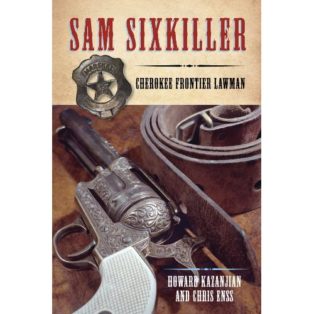
Sam Sixkiller: Cherokee Frontier Lawman
It was a warm September evening in 1886 when the citizens of Muskogee gathered in the center of town to enjoy a concert given by the Muskogee Amateur Italienne Musical Society. Horses and wagons lined the streets. The performers tuned their instruments and greeted crowd members anxious to express their support. Excited children chased one another around, and families jockeyed for the best positions in front of a crude bandstand. Women huddled together discussing their day and comforting fussy infants who were unsettled by the flurry of activity.
Before the event officially began, the sound of rapid gunfire echoed off the buildings that framed the main thoroughfare. The gunshots grew louder, and suddenly a pair of horsemen appeared riding pell-mell toward the congregation. People scattered. Running for cover, families disappeared into businesses and homes. The cries of astonishment and fear from the unassuming townspeople had no effect on the two riders. Black Hoyt, a half-blood Cherokee with whom Captain Sixkiller had previous dealings, and a white man named Jess Nicholson gouged their boot spurs into the sides of their mounts and charged down the street, shooting their weapons at anything that moved.
The out-of-control men were drunk and enjoying the chaos their wild behavior caused among the startled townspeople. Captain Sixkiller and the police officers that worked with him, including Charles LeFlore, rushed onto the scene brandishing their own guns. The captain shouted at Black and Nicholson to stop, but the men were not inclined to do so. After a few moments of waiting for the two rowdies to do as they were told, the Muskogee police force managed to corner the riders. LeFlore ordered them to throw their pistols down, and Captain Sixkiller informed them they were under arrest. Neither of the men complied.
A tense hush filled the air as Hoyt and Nicholson considered their options. The captain studied the belligerent looks on their darkly flushed features. “Give us your guns now,” he demanded, “before someone gets hurt.” Hoyt shifted in his saddle and rubbed off the sweat standing on his chin with his right shoulder. His arm was missing from the elbow down, and his shirtsleeve was pinned over the remaining portion of the limb. Hoyt had lost his arm in June 1886 after he was shot by an unknown assailant while at Fort Gibson, Oklahoma Territory. The bullet fractured the lower third of the appendage, and amputation was his only chance of recovery. Black and his father, Milo, objected at first, but after conferring with a second doctor, realized there was no other option. The younger Hoyt recovered quickly from the chloroform and, as soon as he could, left the post doctor’s office to avoid any further attempts on his life. With Milo’s help he learned how to ride and shoot holding the reins of his horse and pistol in the same hand.
Black smiled a nervous smile and shifted his glance back and forth from Charles LeFlore to Captain Sixkiller. The captain wore a serious, determined expression. Hoyt screwed up all his drunken courage and nodded. “Go to hell!” he barked at the lawmen.It wasn’t the first time Stubbs had been accused of stealing the pistol from Rushing. Although Stubbs denied taking the gun, the men continued to come around and harass him for the item. They refused to accept the storeowner’s claim that he knew nothing of it. Rushing finally told him he intended to get seventeen dollars for the weapon before he left or there would be “hell to pay.”
To learn more about the courageous lawman Sam Sixkiller read
Sam Sixkiller: Cherokee Frontier Lawman
This Day…
1878 Black Bart strikes again .
Keeping the Peace
Enter now to win a copy of
Sam Sixkiller: Cherokee Frontier Lawman
Captain Sam Sixkiller crossed the timber-lined banks of the Arkansas River atop a big, brown roan. The well-traveled trail that lay out in front of him looked like an ecru ribbon thrown down across the prairie grass. Riding a few paces behind the lawman was Deputy Bill Drew. Neither man spoke as they traveled. A herd of cattle in the near distance plodded along slowly toward a small stream. A couple of calves held back, bawling for their mothers, who had left them a safe distance behind. Upon reaching the stream the cows buried their noses in the water. They paid no attention to the approaching riders as they enjoyed a refreshing drink.
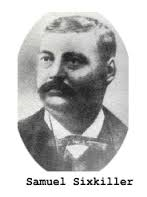
Captain Sixkiller pulled back on the reins of his horse, slowing the animal’s pace. He stared thoughtfully, considering the proximity of the cattle to the crude camp behind the field of prairie grass reaching to the horizon. Deputy Drew watched the captain, waiting for the officer to proceed. Both men knew the danger inherent in the job they’d set out to do that day in early January 1886. They were tracking a murderer named Alfred “Alf” Rushing, also known as Ed Brown.
Nine years prior to Captain Sixkiller leaving Muskogee on a cold winter’s day to apprehend Rushing, the elusive rowdy had shot and killed the marshal of Wortham, Texas. The Houston and Texas Central Railway ran through this busy cotton farm community, attracting nefarious characters like Rushing, a cattle rustler and bootlegger who hoped to make a fortune selling liquor and robbing business owners in the farming town. On December 8, 1879, Rushing and two accomplices had ridden into Wortham and made their way to J. J. Stubb’s general store. All three were armed with shotguns and hell-bent on retrieving a pistol they claimed Stubbs had stolen from them.
It wasn’t the first time Stubbs had been accused of stealing the pistol from Rushing. Although Stubbs denied taking the gun, the men continued to come around and harass him for the item. They refused to accept the storeowner’s claim that he knew nothing of it. Rushing finally told him he intended to get seventeen dollars for the weapon before he left or there would be “hell to pay.”
To learn more about the courageous lawman Sam Sixkiller read
Sam Sixkiller: Cherokee Frontier Lawman
This Day…
Badman Dick Glass
Enter now to win a copy of
Sam Sixkiller: Cherokee Frontier Lawman
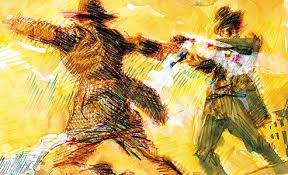
Sheriff John Culp and Constable Rush Meadows of Chick County, Texas, raced their foam-flecked horses into a dense stand of trees leading to the Arbuckle Mountains, several miles north of Muskogee. The seasoned riders guided their mounts around centuries-old pines and oaks, twisted with age, and massive boulders keeping company with the crowded forest.
The lawmen were in pursuit of the outlaw Dick Glass. Glass rode hard, maneuvering his horse in and out of downed timbers. An insane rage possessed him—he could not allow himself to be caught. He dug his heels into his ride and steered the animal toward an embankment. A wind that seemed to blow from the outer spaces of eternity swept his hat off. He didn’t even glance after it.
The one thousand dollar reward for Glass’s capture, offered by the US Western District Federal Court, spurred the officers on. Glass was a Creek Freedman—half Indian, half black—and a one-time farmer in the Creek Nation. When the Civil War ended in 1865, all the slaves belonging to Indians became free and equal. Generations of Creek Freedmen had been raised on the land they worked, and they wanted part of it for their own once the battle between the states had concluded. Not only was their request denied, but also they were dispossessed because they weren’t Indian. Men like Dick Glass were bitter over the unjust treatment and many turned to a life of crime and retaliation.
In late March 1885 Glass and the gang of miscreants that usually rode with him were run out of the Creek Nation for rustling cattle, stealing horses, and murdering. He reluctantly obliged, taking with him other Creek Freedmen who had partnered with him in his lawless activities.
Glass roamed through the Seminole, Pottawatomie, and Chickasaw Nations to the Texas line before settling a spot seven miles from Muskogee known as the Point. Glass and his gang made their way back to the Point after every criminal act. It was their rendezvous location, and lawmen who came looking and found him there never lived long enough to report it. There were no cabins, lean-tos, or barns on the property. Glass and the other desperados slept outdoors, exposed to the elements.
To learn more about the courageous lawman Sam Sixkiller read
Sam Sixkiller: Cherokee Frontier Lawman
This Day…
Defending a Nation
Enter to win a copy of
Sam Sixkiller: Frontier Cherokee Lawman
Everyone who enters WINS.
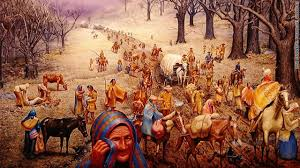
A springboard wagon topped a ridge surrounded by a grove of ancient juniper trees seven miles outside Muskogee. The wagon was weighted down with several heavy crates and made little sound. The contents inside the crates sloshed as the vehicle slogged through the rain-soaked turf. The soft ground muffled the hardworking wheels and the horses’ hooves. Solomon Coppell, an unshaven man dressed in a dirty, fawn-colored suit with a long-tailed coat, drove the wagon over a crude trail cut deep in mud and dirt. His roving button eyes scanned the scene in front of him, looking for anything out of the ordinary.
Just beyond Solomon’s line of sight, tucked behind a thicket of brush, Captain Sam Sixkiller sat on his horse watching the driver. Sweat rolled down the lawman’s face that late spring day in 1883 as the sun rode up into a leaden sky, empty and cloudless, and blanketed the captain with a sticky heat. Solomon was uncomfortable too. He pulled his flat-brimmed hat off his head, backhanded a bead of perspiration off his hairline, reset his hat, and fixed his gaze back on the muddy track. The captain waited for just the right moment, and in one fast, flawless movement spurred his horse onto the trail directly in front of Solomon’s team.
A stunned Solomon quickly jerked back on the reins of the animals, bringing the skittish horses to a stop. “Hold it, Coppell!” Captain Sixkiller announced in a sober, stern voice. “You’re under arrest.” Solomon glanced at the cargo he was hauling and back to the captain. The lawman was alone and the bootlegger was confident he could survive a confrontation with his wagonload intact. Solomon stared at the captain for a moment, then shook his head. “I got a tip you were bringing booze into the Nation,” the captain informed him. Solomon didn’t reply and showed no signs of cooperating. “Surrender, Coppell,” Captain Sixkiller warned him again. “Throw your guns out in the road.”
The captain was empty-handed, his leg gun still resting in a holster on his thigh. Coppell made a grab for the shotgun on the wagon seat. Sixkiller’s hand whipped forward in a short, small arc. There was no strain. He saw Coppell’s face, distorted and desperate. His gun kicked back against his wrist. One shot. Captain Sixkiller’s gun exploded before it cleared his coat. The flame of the lawman’s shot licked through the fabric and curled to form a smoldering ring. He watched Coppell’s body jerk. Coppell swayed and fell into the trace chains and wagon tongue. The team reared and snorted and pawed at the air. The captain calmed the horses and kept them from running away.
Most Muskogee residents agreed that Captain Sixkiller was an effective policeman, quick to enforce the laws regarding the buying and selling of liquor. Nevertheless, some thought the rules should be relaxed. Cherokee Indian business owners believed they should have the right to purchase liquor to sell to white railroad workers and settlers passing through. Indian leaders maintained that such measures would lead to an increase in violence on the Cherokee Nation and insisted that troublemakers who peddled whiskey needed to be stopped.
Although Captain Sixkiller was never accused of being too harsh on those who violated the law, some Indians, including former chief of the Cherokee Nation, Lewis Downing, and Indian agent John B. Jones, thought that the US marshal and his deputies went too far in upholding the law. “Some deputy marshals make forcible arrests,” Chief Downing told Indian agent Jones in a letter, “without regard to circumstances or the facts of the case, and without any of the forms of law.” Smugglers occasionally planted whiskey on innocent people traveling through the Cherokee Nation. If they were stopped by Captain Sixkiller or his deputies and alcohol was found in their possession, they were arrested and taken immediately to Fort Smith, Arkansas, to be prosecuted. Chief Downing strenuously objected to the captain’s rush to judgment, arguing that in those instances, such individuals should be given the benefit of the doubt.
To learn more about Sam Sixkiller read:
Sam Sixkiller: Frontier Cherokee Lawman.
This Day…
Mayhem in Muskogee
Enter to win a copy of
Sam Sixkiller: Frontier Cherokee Lawman
A hot sun beat down on the busy residents of Muskogee, Oklahoma Territory, in June 1880. A heavy veil of humidity, like a stifling blanket, hung over the town as well. Situated nearly thirty miles southwest of Tahlequah, the primitive railroad stop was slowly coming into its own. More than five hundred people called the area home, and many among them were employees of the Missouri Pacific Railroad. At the end of the day, workers gathered by the score and milled about the hamlet of lean-tos, tents, and cabins. Gamblers had pitched their canvas dwellings in prime spots, and crowds flocked around their tables.
Quarrels frequently flared up between slick poker dealers and inexperienced card players. Soiled doves (prostitutes) prowled around the gaming tents and curious male bystanders like panthers. They enticed men to their crude rooms, then stripped them of any funds they had not already lost in a crooked card game. Unsuspecting shoppers and their families roamed in and out of the heated arguments that spilled into the street, gawking warily at the chaos while on their way to and from various stores.
City officials watched the scene play out in disgust. Bootleg alcohol was usually sold to the railroad crews and the houses of ill repute, and the clientele had a hard time controlling the amount they consumed. More often than not, customers who frequented bawdy houses and who drank to excess were prone to violence. They terrorized the neighborhood surrounding the brothels, recklessly firing their guns at women and children and brawling with townsmen who challenged them to put away their weapons.
In spite of repeat warnings from law enforcement officers like Colonel J. Q. Tuffts, a US agent for the Union Indian Agency in Muskogee, the madams who ran the brothels refused to voluntarily shut down their businesses. Brothels were considered a necessary evil; after all, a portion of the income spent at these houses supported public services such as the police department. Nevertheless, Agent Tuffts considered the bordellos a plague on the town, nothing more than a refuge for criminals and delinquents from miles around. When Agent Tuffts made Sheriff Sixkiller captain of the Indian Police in early February 1880, he made ridding Muskogee of such houses a priority for Sam’s administration.
To learn more about Sam Sixkiller read:
Sam Sixkiller: Frontier Cherokee Lawman.